Discern Patterns

I’m almost done rewriting the Standards for Mathematical Practice into student-friendly language.

They say mathematics is the science of patterns. So here’s…

Math Tip # 7: Discern Patterns.

  • Look for patterns in numbers, shapes, and algebra equations.
  • Notice how numbers can break apart to make a calculation easier.
  • Number patterns morph into algebra rules.
  • Adapt math situations to make the structure clear. (For example, by adding new lines to a geometry diagram.)
  • Step back from a situation to see it from a new perspective.
  • Try to find simpler patterns within complex equations or diagrams.
  • Not all patterns continue forever. Test your patterns. Can you trust them?

Continue reading Discern Patterns

Say What You Mean

Continuing my project of rewriting the Standards for Mathematical Practice into student-friendly language.

Here’s my version of SMP6…

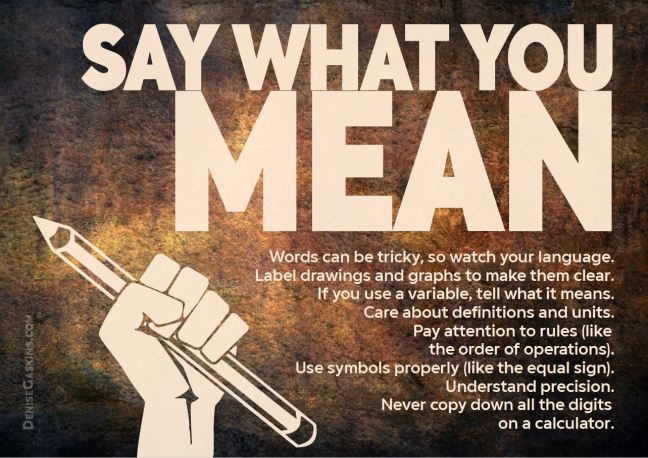
Math Tip # 6: Say What You Mean.

  • Words can be tricky, so watch your language.
  • Label drawings and graphs to make them clear.
  • If you use a variable, tell what it means.
  • Care about definitions and units.
  • Pay attention to rules (like the order of operations).
  • Use symbols properly (like the equal sign).
  • Understand precision. Never copy down all the digits on a calculator.

Continue reading Say What You Mean

Master Your Tools

As I’ve mentioned before, I decided to try my hand at rewriting the Standards for Mathematical Practice into student-friendly language.

Here’s my version of SMP5…

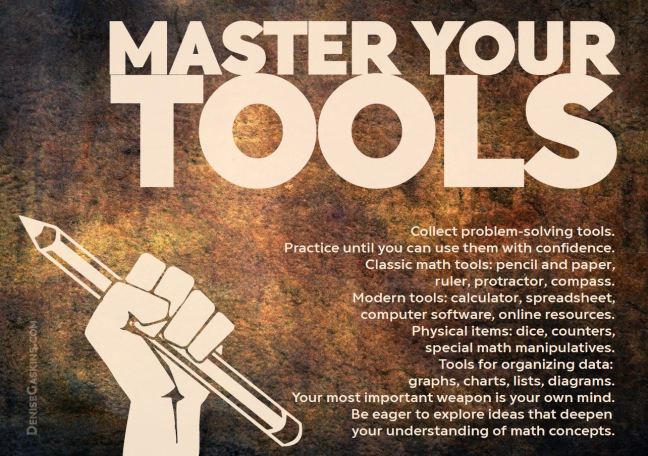
Math Tip # 5: Master Your Tools.

  • Collect problem-solving tools.
  • Practice until you can use them with confidence.
  • Classic math tools: pencil and paper, ruler, protractor, compass.
  • Modern tools: calculator, spreadsheet, computer software, online resources.
  • Physical items: dice, counters, special math manipulatives.
  • Tools for organizing data: graphs, charts, lists, diagrams.
  • Your most important weapon is your own mind. Be eager to explore ideas that deepen your understanding of math concepts.

Continue reading Master Your Tools

Look Beneath the Surface

So, I decided to try my hand at rewriting the Standards for Mathematical Practice into student-friendly language.

Here’s the fourth installment…

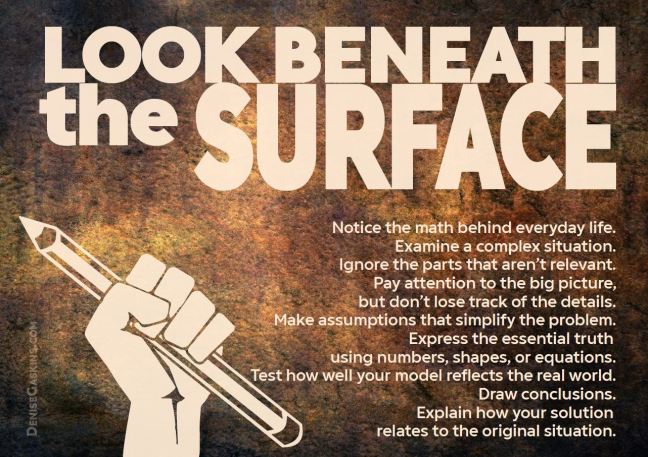
Math Tip # 4: Look Beneath the Surface.

  • Notice the math behind everyday life.
  • Examine a complex situation. Ignore the parts that aren’t relevant.
  • Pay attention to the big picture, but don’t lose track of the details.
  • Make assumptions that simplify the problem.
  • Express the essential truth using numbers, shapes, or equations.
  • Test how well your model reflects the real world.
  • Draw conclusions. Explain how your solution relates to the original situation.

Continue reading Look Beneath the Surface

Know How to Argue

You may remember, I decided to try my hand at rewriting the Standards for Mathematical Practice into student-friendly language.

My kids loved to argue. Do yours?

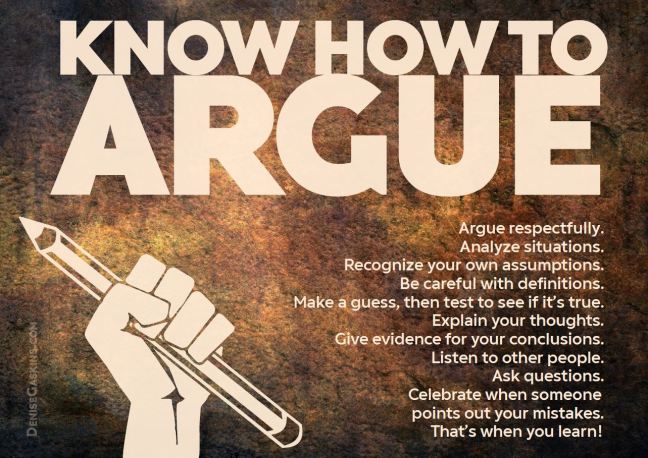
Math Tip # 3: Know How to Argue.

  • Argue respectfully.
  • Analyze situations.
  • Recognize your own assumptions.
  • Be careful with definitions.
  • Make a guess, then test to see if it’s true.
  • Explain your thoughts. Give evidence for your conclusions.
  • Listen to other people. Ask questions to understand their point of view.
  • Celebrate when someone points out your mistakes. That’s when you learn!

Continue reading Know How to Argue

W.W. Sawyer’s Rules of Mathematics

“In the beginnings of arithmetic and algebra, the main purpose is not to get the pupil making calculations. The main purpose is to get him into the habit of thinking, and to show him that he can think the problems out for himself.

“Pupils ask ‘Am I allowed to do this?’ as if we were playing a game with certain rules.

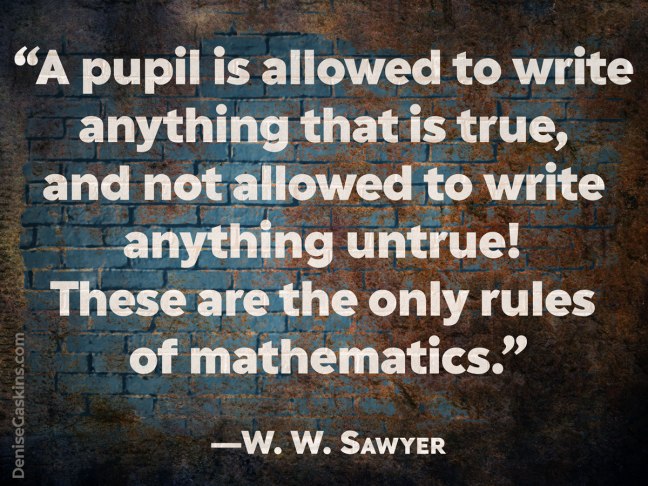
“A pupil is allowed to write anything that is true, and not allowed to write anything untrue!

“These are the only rules of mathematics.”

—W. W. Sawyer, Vision in Elementary Mathematics

[THE FINE PRINT: I am an Amazon affiliate. If you follow the link and buy something, I’ll earn a small commission (at no cost to you). But this book is a well-known classic, so you should be able to order it through your local library.]

Inspired by Sawyer’s Two Rules

I love this quote so much, I turned it into a printable math activity guide. I hope it helps inspire your students to deeper mathematical thinking.

Here’s the product description…

Join the Math Rebellion: Creative Problem-Solving Tips for Adventurous Students

Take your stand against boring, routine homework.

Fight for truth, justice, and the unexpected answer.

Join the Math Rebellion will show you how to turn any math worksheet into a celebration of intellectual freedom and creative problem-solving.

Help your students practice thinking for themselves as they follow the Two Rules of the Math Rebellion: “A pupil is allowed to write anything that is true, and not allowed to write anything untrue! These are the only rules of mathematics.”

Find Out More

Don’t Panic

As I mentioned last Saturday, I decided to try my hand at rewriting the Standards for Mathematical Practice into student-friendly language.

Here’s the second installment…

Math Tip # 2: Don’t Panic.

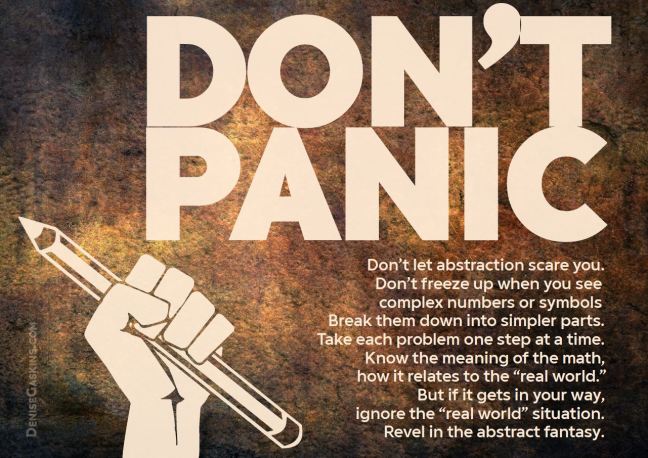
  • Don’t let abstraction scare you.
  • Don’t freeze up when you see complex numbers or symbols.
  • Break them down into simpler parts.
  • Take each problem one step at a time.
  • Know the meaning of the math, how it relates to the “real world.”
  • But if it gets in your way, ignore the “real world” situation. Revel in the abstract fantasy.

Continue reading Don’t Panic

Never Give Up

Have you read the Standards for Mathematical Practice? Good idea in theory, but horribly dull and stilted. Like math standards in general, the SMPs sound as if they were written by committee. (Duh!)

I’ve seen several attempts to rewrite the SMPs into student-friendly language. Many of those seem too over-simplified, almost babyish.

Probably I’m just too critical.

Anyway, I decided to try my hand at the project. Here’s the first installment…

Math Tip # 1: Never Give Up.

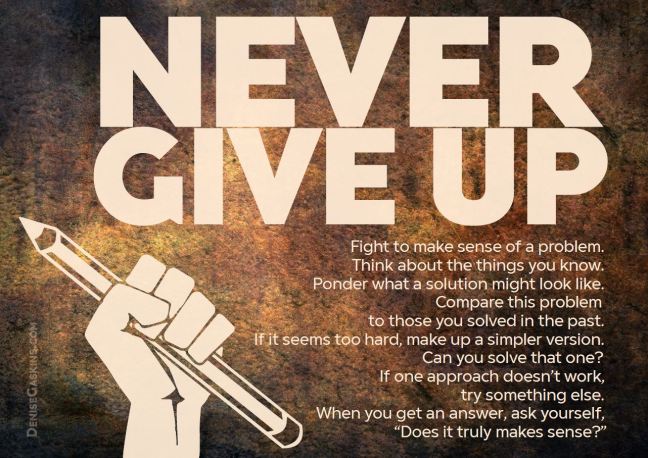
  • Fight to make sense of a problem.
  • Think about the things you know.
  • Ponder what a solution might look like.
  • Compare this problem to those you solved in the past.
  • If it seems too hard, make up a simpler version. Can you solve that one?
  • If one approach doesn’t work, try something else.
  • When you get an answer, ask yourself, “Does it truly makes sense?”

Download the poster, if you like:

What do you think? Would this resonate with your students?

What changes do you suggest?

You can find the whole SMP series (eventually) under the tag: Posters.

Update: I Made a Thing

I had so much fun making these posters that I decided to put them into a printable activity guide. It includes the full-color poster shown above and a text-only version, with both also in black-and-white if you need to conserve printer ink.

Here’s the product description…

Join the Math Rebellion: Creative Problem-Solving Tips for Adventurous Students

Take your stand against boring, routine homework.

Fight for truth, justice, and the unexpected answer.

Join the Math Rebellion will show you how to turn any math worksheet into a celebration of intellectual freedom and creative problem-solving.

This 42-page printable activity guide features a series of Math Tips Posters (in color or ink-saving black-and-white) that transform the Standards for Mathematical Practice to resonate with upper-elementary and older students.

Available with 8 1/2 x 11 (letter size) or A4 pages.

Check It Out

Math for Star Wars Day

May the Fourth be with you!

Here is a math problem in honor of one of our family’s favorite movies…
Han Solo was doing much-needed maintenance on the Millennium Falcon. He spent 3/5 of his money upgrading the hyperspace motivator. He spent 3/4 of the remainder to install a new blaster cannon. If he spent 450 credits altogether, how much money did he have left?

Stop and think about how you would solve it before reading further.

Continue reading Math for Star Wars Day

How to Succeed in Math: Answer-Getting vs. Problem-Solving

You want your child to succeed in math because it opens so many doors in the future.

But kids have a short-term perspective. They don’t really care about the future. They care about getting through tonight’s homework and moving on to something more interesting.

So how can you help your child learn math?

When kids face a difficult math problem, their attitude can make all the difference. Not so much their “I hate homework!” attitude, but their mathematical worldview.

Does your child see math as answer-getting? Or as problem-solving?

Answer-getting asks “What is the answer?”, decides whether it is right, and then goes on to the next question.

Problem-solving asks “Why do you say that?” and listens for the explanation.

Problem-solving is not really interested in “right” or “wrong”—it cares more about “makes sense” or “needs justification.”

Homeschool Memories

In our quarter-century-plus of homeschooling, my children and I worked our way through a lot of math problems. But often, we didn’t bother to take the calculation all the way to the end.

Why didn’t I care whether my kids found the answer?

Because the thing that intrigued me about math was the web of interrelated ideas we discovered along the way:

  • How can we recognize this type of problem?
  • What other problems are related to it, and how can they help us understand this one? Or can this problem help us figure out those others?
  • What could we do if we had never seen a problem like this one before? How would we reason it out?
  • Why does the formula work? Where did it come from, and how is it related to basic principles?
  • What is the easiest or most efficient way to manipulative the numbers? Does this help us see more of the patterns and connections within our number system?
  • Is there another way to approach the problem? How many different ways can we think of? Which way do we like best, and why?

What Do You think?

How did you learn math? Did your school experience focus on answer-getting or problem-solving?

How can we help our children learn to think their way through math problems?

I’d love to hear from you! Please share your opinions in the Comments section below.

CREDITS: “Math Phobia” photo by Jimmie (blog post title added) via Flickr (CC BY 2.0). Phil Daro video by SERP Media (the Strategic Education Research Partnership) via Vimeo.