Thinking Thursday: John Allen Paulos

Thinking Thursday math journal prompt

Writing to Learn Math: What did the author mean? Put the thought in your own words. Do you agree or disagree? Why?

Do you want your children to develop the ability to reason creatively and figure out things on their own?

Help kids practice slowing down and taking the time to fully comprehend a math topic or problem-solving situation with these classic tools of learning: Notice. Wonder. Create.

Continue reading Thinking Thursday: John Allen Paulos

How to Think like a School Math Genius

Teen student thinking

“The true joy in mathematics, the true hook that compels mathematicians to devote their careers to the subject, comes from a sense of boundless wonder induced by the subject.

    “There is transcendental beauty, there are deep and intriguing connections, there are surprises and rewards, and there is play and creativity.

      “Mathematics has very little to do with crunching numbers. Mathematics is a landscape of ideas and wonders.”

      —James Tanton

      James Tanton has a new website. It looks cool, and it’s a great place to discover the things he’s working on these days.

      But his wonderful, old-fashioned site full of great insights and interesting problems is gone.

      😞 I hate it when some part of the internet that I love disappears. So here’s my attempt to recover one tiny bit of the old site, five tips for creative problem solving through intellectual play.

      Continue reading How to Think like a School Math Genius

      Tell Children Interesting Things

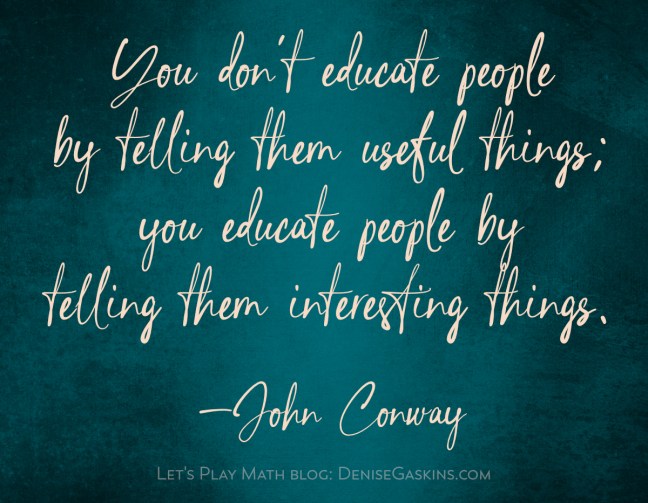
      quote by John Conway

      “You don’t educate people by telling them useful things; you educate people by telling them interesting things.”

      — John Conway

      If you want help educating your children with interesting things about math, check out Denise Gaskins’ Playful Math store.

      We’re currently running a huge back-to-school sale on ALL of my playful math ebooks, problem-solving activities, math journaling task cards, and math art projects.

      So many great ways to play with math!

      The 20% discount will automatically apply when you check out. No discount code required.

      Check it out:

      Back to School Sale 2025

      Morning Coffee: That Moment of Epiphany

      Morning Coffee Lifelong Learning for Parents

      One of the best ways we can help our children learn mathematics (or anything else) is to be lifelong learners ourselves.

      Here are a few stories to read as you sip your morning brew. . .

      Download your printable Morning Coffee journal

      This week’s rabbit hole started with a thought-provoking article from Dan Meyer…

      “It would have been quite easy, nothing at all really, to share the epiphany with students, to share the short-cut, to tell my kid that these are all the even numbers and here is where you’ll find them…”

      —Dan Meyer

      Read more about the value of taking the harder long-cut in this fifth installment of professional development for homeschooling parents.

       
      * * *

      Are you looking for more creative ways to play math with your kids? Check out all my books, printable activities, and cool mathy merch at Denise Gaskins’ Playful Math Store. Or join my email newsletter.

      This blog is reader-supported. If you’d like to help fund the blog on an on-going basis, then please join me on Patreon for mathy inspiration, tips, and an ever-growing archive of printable activities.

      “Morning Coffee: That Moment of Epiphany” copyright © 2025 by Denise Gaskins. Image at the top of post copyright © Kira auf der Heide / Unsplash.

      Playing to Learn

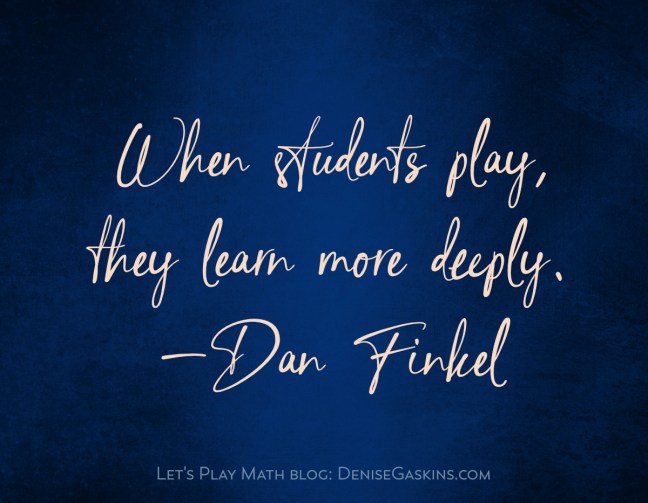
      quotation from Dan Finkel

      “Play and rigor support each other.

        “When students are invited to play with math, they learn more deeply, more robustly, and remember more consistently.

          “Play is promoted as something that can engage kids and give them a more positive attitude about school, but it’s easy to assume that it’s not useful for learning, when in reality the opposite is true:

            “The student who is playing tends to be the student who is learning most deeply.”

            —Dan Finkel, Math for Love newsletter

            Mental Math: Three Basic Principles

            Doing mental math on the couch

            “We know that algorithms are amazing human achievements, but they are not good teaching tools because mimicking step-by-step procedures can actually trap students into using less sophisticated reasoning than the problems are intended to develop.”

            — Pam Harris, Math Is Figure-Out-Able Podcast

            Whether you work with a math curriculum or take a less-traditional route to learning, do not be satisfied with mere pencil-and-paper competence. Instead, work on building your children’s mental math skills, because mental calculation forces a child to understand arithmetic at a much deeper level than is required by traditional pencil-and-paper methods.

            Traditional algorithms (the math most of us learned in school) rely on memorizing and rigidly following the same set of rules for every problem, repeatedly applying the basic, single-digit math facts. Computers excel at this sort of step-by-step procedure, but children struggle with memory lapses and careless errors.

            Mental math, on the other hand, relies on a child’s own creative mind to consider how numbers interact with each other in many ways. It teaches students the true 3R’s of math: to Recognize and Reason about the Relationships between numbers.

            The techniques that let us work with numbers in our heads reflect the fundamental properties of arithmetic. These principles are also fundamental to algebra, which explains why flexibility and confidence in mental math is one of the best predictors of success in high school math and beyond.

            Your textbook may explain these properties in technical terms, but don’t be intimidated by the jargon. These are just common-sense rules for playing with numbers.

            Continue reading Mental Math: Three Basic Principles

            Morning Coffee: What Is Mathematics?

            Morning Coffee Lifelong Learning for Parents

            One of the best ways we can help our children learn mathematics (or anything else) is to be lifelong learners ourselves.

            Here are a few stories to read as you sip your morning brew. . .

            Download your printable Morning Coffee journal

            This week’s rabbit hole started with a thought-provoking blog post by Sara Van Der Werf…

            “We are all mathematicians. We all have the power to notice, describe, and generalize patterns. You have all had this ability since birth.

              “If we believe this then every day we must plan lessons that allow students to act as mathematicians. We must put something in front of our students to notice. We must put something in front of our students to describe, to generalize.”

              —Sara Van Der Werf

              Read more about how to develop mathematical thinking in this fourth installment of professional development for homeschooling parents.

               
              * * *

              Are you looking for more creative ways to play math with your kids? Check out all my books, printable activities, and cool mathy merch at Denise Gaskins’ Playful Math Store. Or join my email newsletter.

              This blog is reader-supported. If you’d like to help fund the blog on an on-going basis, then please join me on Patreon for mathy inspiration, tips, and an ever-growing archive of printable activities.

              “Morning Coffee: What Is Mathematics?” copyright © 2025 by Denise Gaskins. Image at the top of post copyright © Kira auf der Heide / Unsplash.

              Charlotte Mason Math: Living Books

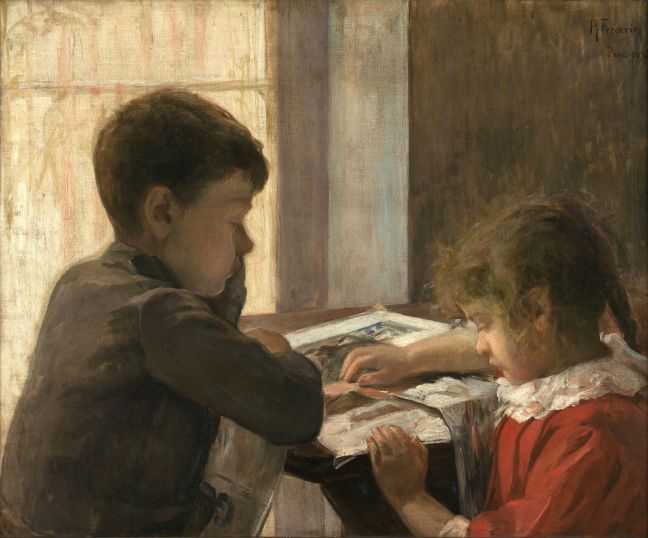
              “The Reading Lesson” painting by Jonathan Pratt, public domain

              [An addendum to my earlier Charlotte Mason Math series.]

              “Our business is to give [children] mind-stuff, and both quality and quantity are essential. Naturally, each of us possesses this mind-stuff only in limited measure, but we know where to procure it; for the best thought the world possesses is stored in books; we must open books to children, the best books; our own concern is abundant provision and orderly serving.”

              — Charlotte Mason, Toward A Philosophy of Education

              Most homeschool teachers, whatever our curriculum or schooling approach, understand the importance of teaching with living books. We read aloud biographies, historical fiction, or the classics of literature. We scour library shelves for the most creative presentations of scientific topics that interest our children, and encourage our high school students to go back to the original documents whenever possible.

              And we teach math with a textbook.

              Not that textbooks are inherently bad, because math is an abstract science. We need to meet the ideas  — the “mind-stuff” — of math on their own terms, and textbooks can help with that.

              But it’s not enough.

              Continue reading Charlotte Mason Math: Living Books

              Morning Coffee: Anyone Can Learn Math

              Morning Coffee Lifelong Learning for Parents

              One of the best ways we can help our children learn mathematics (or anything else) is to be lifelong learners ourselves.

              Here are a few stories to read as you sip your morning brew:

              Once again, my rabbit hole started with a thought-provoking blog post from Dan Finkel…

              “Not everyone can become a great artist — but a great artist can come from anywhere.”
              —Ego, from Ratatouille

                “Ego’s parsing of the phrase anyone can cook is not obvious, and it’s not really the primary meaning of the phrase. The truth is, there are really three meanings all wrapped up there: anyone can learn to have the joy and pleasure of cooking in their life, even if they don’t become a master chef. Some people will get serious about it. And the visionaries who change the way we think about the art can come from anywhere — lock them out of the field and we all suffer.”
                —Dan Finkel

                Read more about how anyone can learn math in this third installment of professional development for homeschooling parents.

                 
                * * *

                Are you looking for more creative ways to play math with your kids? Check out all my books, printable activities, and cool mathy merch at Denise Gaskins’ Playful Math Store. Or join my email newsletter.

                This blog is reader-supported. If you’d like to help fund the blog on an on-going basis, then please join me on Patreon for mathy inspiration, tips, and an ever-growing archive of printable activities.

                “Morning Coffee: Anyone Can Learn Math” copyright © 2025 by Denise Gaskins. Image at the top of post copyright © Kira auf der Heide / Unsplash.

                Podcast: Using Math Journals and Games

                mother and daughter math journaling

                I have a new podcast interview, and I think you’ll enjoy it!

                Check out Cindy Rollins’s The New Mason Jar on your favorite podcast app, or listen on the website:

                Go to the podcast ❱

                Here’s an excerpt…

                Writing to Learn

                Just as a nature journal records our children’s explorations and discoveries in nature, so a math journal tracks our children’s explorations in the world of mathematics.

                  In a math journal, children record their experiences with numbers, shapes, and patterns through drawing or writing. Journaling teaches them to see with mathematical eyes — not just to remember what we adults tell them, but to create their own math.

                    The process of writing forces children to pin down their thoughts, to transform nebulous concepts into firm ideas, to struggle with vagueness and build understanding.

                      As William Zinsser says in his book Writing to Learn: “Writing is how we think our way into a subject and make it our own. Writing enables us to find out what we know, and what we don’t know.”

                        Through journaling, children develop a richer mathematical mindset. They begin to see connections and grow confident in their ability to think through new problems.

                        We had a great discussion! Listen to the whole thing:

                        Go to the podcast ❱

                         
                        * * *

                        Are you looking for more creative ways to play math with your kids? Check out all my books, printable activities, and cool mathy merch at Denise Gaskins’ Playful Math Store. Or join my free email newsletter.

                        This blog is reader-supported. If you’d like to help fund the blog on an on-going basis, then please join me on Patreon for mathy inspiration, tips, and an ever-growing archive of printable activities.

                        “Podcast: Using Math Journals and Games” copyright © 2025 by Denise Gaskins. Image at the top of the post copyright © AntonLozovoy / Depositphotos.