Math Journaling Adventures Launched: Order Your Copy Today

Math Journaling Adventures: Creative Logbooks for All Ages

And so it begins: the Math Journaling Adventures is LIVE on Kickstarter!

Check It Out ❯

⭐ Don’t delay! First-day backers get the best deals. Choose one of the Earlybird rewards:

  • Earlybird 2-Logbook Sets in Digital, Paperback, Spiral-Bound, or Hardcover
  • Earlybird Everything Bundles in Digital or Paperback

To have a successful campaign, we need plenty of people to back the project early. The more supporters we get in these early days, the more likely the Kickstarter platform folks will help spread the news for us.

Continue reading Math Journaling Adventures Launched: Order Your Copy Today

Playful Math 179: Our Sweet Sixteen Carnival

Welcome to the sweet-16 birthday edition of the Playful Math Carnival. Originally called Math Teachers at Play, our first carnival was published in February 2009.

Each Playful Math Carnival offers a smorgasbord of delectable tidbits of mathy fun. It’s like a free online magazine devoted to learning, teaching, and playing around with math from preschool to high school.

There’s so much playful math to enjoy!

By tradition, we start the carnival with a math activity in honor of our 179th edition. But if you’d rather jump straight to our featured blog posts, click here to see the Table of Contents.

NOTE: Our wonderful volunteer hosts have kept the Playful Math Carnival going when so many other blog carnivals died off. If you’d like to sign up to host the carnival for a month, email Denise for information.

Try These Prime Puzzles

Did you know there are 179 even-numbered days this year?

  • How many even-numbered days will there be in a leap year?
  • But there are 365 days in a standard year and 366 in a leap year. Shouldn’t there be half that many even-numbered days?

179 is a prime number, and it’s also a knockout prime. You can knock out any of the digits, and what’s left is still prime: 17, 19, or 79.

  • Can you find another knockout prime number?

179 is a twin prime. That means that one of its odd-numbered neighbors is also prime.

  • Is the other twin 177 or 181? Can you tell without looking it up?
  • Why are twin primes limited to the odd numbers? That doesn’t seem fair!

179 is also an emirp. That’s a special kind of prime that forms a different prime number when you write it backwards: 971 is also prime.

  • How many emirps can you find?

“A palindrome is a word that when written in reverse results in the same word. for example, ‘racecar’ reversed is still ‘racecar’. Related to palindromes are semordnilaps. These are words that when written in reverse result in a distinct valid word. For example, ‘stressed’ written in reverse is ‘desserts’. Not all words are palindromes or semordnilaps.

    “While certainly not all numbers are palindromes, all non-palindromic numbers when written in reverse will form semordnilaps.

      “Narrowing to primes brings back the same trichotomy as with words: some numbers are emirps, some numbers are palindromic primes, but some are neither.”

      The On-Line Encyclopedia of Integer Sequences A006567

      Click here for all the mathy goodness!

      Morning Coffee: Professional Development for Homeschooling Parents and Other Teachers

      Morning Coffee Lifelong Learning for Parents

      Lately, I’ve spent most of my writing time thinking about the value of narration—the Charlotte Mason approach to teaching by getting kids to put ideas in their own words.

      For students, I’m writing a new series of Math Adventure Journals to get them thinking about math and putting those thoughts into words. If you’re interested, sign up to be notified when the Kickstarter goes live.

      But we parents can harness the value of narration in our own learning. After all, one of the best ways we can help our children learn mathematics (or anything else) is to be lifelong learners ourselves.

      To that end, I’ve decided to relaunch my “Morning Coffee” series of professional development posts for homeschooling parents.

      Here’s How It Works

      As I read articles and follow rabbit trails around the internet, I’ll collect the posts that speak to me. Then I’ll share these in a printable format with journaling pages for your response.

      Since I’m interested in math education, many of the articles I read will be about math—but the principles of learning apply to every subject we teach.

      To kick off the series, let’s start with one of my favorite articles ever…

      Morning Coffee # 1: Learning to Ask Good Questions

      Download your printable Morning Coffee journal

      David Butler’s post Twelve matchsticks: focus or funnel presents an interesting math puzzle. But even better, it opens up a rabbit hole of thought-provoking posts about how to talk with children—or anyone:

        “The approach where you have an idea in your head of how it should be done and you try to get the student to fill in the blanks is called funnelling. It’s actually a rather unpleasant experience as a student to be funnelled by a teacher. You don’t know what the teacher is getting at, and often you feel like there is a key piece of information they are withholding from you, and when it comes, the punchline feels rather flat.”

        The printable file includes links to three more articles as I follow the rabbit around the internet. Enjoy!

         
        * * *

        Are you looking for more creative ways to play math with your kids? Check out all my books, printable activities, and cool mathy merch at Denise Gaskins’ Playful Math Store. Or join my email newsletter.

        This blog is reader-supported. If you’d like to help fund the blog on an on-going basis, then please join me on Patreon for mathy inspiration, tips, and an ever-growing archive of printable activities.

        “Morning Coffee: Professional Development for Homeschooling Parents and Other Teachers” copyright © 2025 by Denise Gaskins. Image at the top of post copyright © Kira auf der Heide / Unsplash.

        Playful Math 178: Nicomachus’s Carnival

        Playful Math Blog Carnival 178

        Welcome to the 178th edition of the Playful Math Education Blog Carnival — a smorgasbord of delectable tidbits of mathy fun. It’s like a free online magazine devoted to learning, teaching, and playing around with math from preschool to high school.

        Bookmark this post, so you can take your time browsing.

        There’s so much playful math to enjoy!

        By tradition, we start the carnival with a puzzle/activity in honor of our 178th edition. But if you’d rather jump straight to our featured blog posts, click here to see the Table of Contents.

        Activity: Nicomachus’s Theorem

        Welcome to 2025, a perfectly square year — and the only one this century!

        2025 = (20 + 25)2

        • When is the next time we’ll have a perfect-square year?
        • Can you find the only perfect square less than 2025 that works by this pattern? When you split the number’s digits into two smaller numbers and square their sum, you get back to that number.

        2025 = the sum of all the numbers in the multiplication table, from 1×1 to 9×9

        2025 = the sum of the first 9 perfect cubes

        • When is the next time this will happen, that the year is the sum of the first n perfect cubes?

        And by Nicomachus’s theorem:

        2025 = 13 + 23 + 33 + 43 + 53 + 63 + 73 + 83 + 93
        so it must also = (1 + 2 + 3 + 4 + 5 + 6 + 7 + 8 + 9)2

        Try it for yourself with small numbers: Get some blocks, and build the first few perfect cubes. Then see if you can rearrange the block to form the sum of those numbers squared.

        Can you show that…

        • 13 = 12
        • 13 + 23 = (1 + 2)2
        • 13 + 23 + 33 = (1 + 2 + 3)2
        • 13 + 23 + 33 + 43 = (1 + 2 + 3 + 4)2
        • 13 + 23 + 33 + 43 + 53 = (1 + 2 + 3 + 4 + 5)2

        Nicomachus theorem 3D

        Older Students: Can you see that the pattern would continue as long as you want? How might you prove that?

        Here’s the formula for triangular numbers, to get you started:

        (1 + 2 + 3 + … + n) = n(n + 1)/2

        Click here for all the mathy goodness!

        Start the New Year Right: Playful Math Carnival 177 via Math Hombre

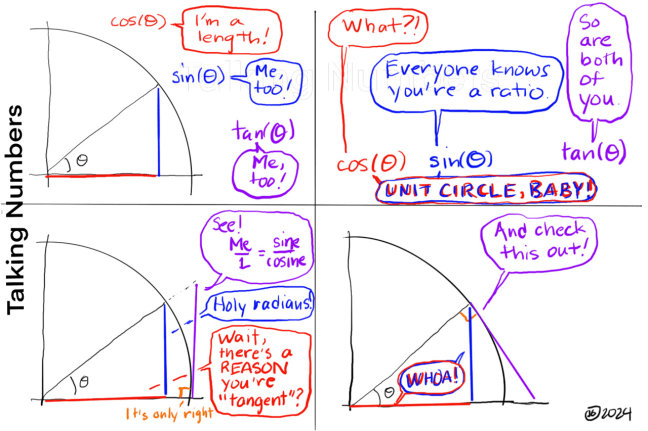
        Talking Numbers from Playful Math Carnival 177

        If you’re looking for an entertaining way to weather the coming storm — or just curious about how learning math could possibly be fun — you’ll definitely want to check out the latest edition of the Playful Math Carnival.

        It’s a collection of awesome blog posts curated by John Golden and published on the Math Hombre website:

        The whole point of the carnival is to show that math doesn’t have to be tedious or repetitive. Through a bunch of fun and engaging posts, we celebrate math that’s playful, creative, and totally relevant to everyday life.

        Because what could be more relevant than having fun while we learn?

        Continue reading Start the New Year Right: Playful Math Carnival 177 via Math Hombre

        Charlotte Mason Math: Practical Tips for a Living Math Education

        “Young italian woman with two sleeping children on coast’ painting by August Riedel, public domain

        Focus on the logic of reasoning.

        Correct answers are important, of course, but as children explain their thinking, they will often catch and fix mistakes on their own.

        “Two and two make four and cannot by any possibility that the universe affords be made to make five or three. From this point of view, of immutable law, children should approach Mathematics; they should see how impressive is Euclid’s ‘Which is absurd,’ just as absurd as would be the statements of a man who said that his apples always fell upwards, and for the same reason.”

         — Charlotte Mason, Towards a Philosophy of Education

        “Most remarks made by children consist of correct ideas badly expressed. A good teacher will be wary of saying ‘No, that’s wrong.’ Rather, he will try to discover the correct idea behind the inadequate expression. This is one of the most important principles in the whole of the art of teaching.”

         — W. W. Sawyer, Vision in Elementary Mathematics

        • Tip: If you’re not sure how to draw out your child’s reasoning, read Christopher Danielson’s wonderful examples and advice on talking math with your kids: Talking Math with Your Kids.

        Continue reading Charlotte Mason Math: Practical Tips for a Living Math Education

        Charlotte Mason Math: Wrong Answers and Slovenly Teaching

        "Playing with the kittens" painting by Emile Munier, public domain

        The second place where a surface-level reading of Charlotte Mason’s books can lead to misunderstanding involves the treatment of wrong answers. Mason wrote:

        “… quite as bad as these is the habit of allowing that a sum is nearly right, two figures wrong, and so on, and letting the child work it over again. Pronounce a sum wrong, or right — it cannot be something between the two. That which is wrong must remain wrong: the child must not be let run away with the notion that wrong can be mended into right.”

         — Charlotte Mason, Home Education

        Does this call to mind images of your own childhood schoolwork? It does for me: laboring over a worksheet or quiz and then taking it to my teacher to be graded. Right was right, and wrong could not be mended. In such a performance-oriented setting, mistakes can take on the flavor of moral failure.

        Is this authoritarian approach the way Mason wants us to teach math to our children? Where is the summa corda — the joyful praise — in that?

        No. Please, no. Very definitely no.

        Mason wanted us to avoid slovenliness in our teaching. In this passage, she warned against several forms this might take.

        Continue reading Charlotte Mason Math: Wrong Answers and Slovenly Teaching

        Gratis Games and Playful Math News

        Get your free copy today!
        Do you want to help your children learn math?

        Teach them to play.

        Grab a free copy of my Let’s Play Math Sampler: 10 Family-Favorite Games for Learning Math Through Play, which contains short excerpts from my most popular titles. It’s a great way to get started with playful math. 😍

        As a bonus, I’ll add you to my Playful Math News email subscription and send you monthly tips and activity ideas for playing math with your kids.

        From time to time, I’ll even throw in a free sample of whatever I’ve been working on — an early draft of something that will eventually show up in one of my books or printable activity guides.

        For example, check out this fun freebie I sent last April:

        Don’t miss out on all this mathy goodness. Sign up today!

        Get the Games Book Now

        Charlotte Mason Math: The Trouble with Manipulatives

        “Mother Playing with Child” painting by Mary Cassatt, public domain

        Two passages in Charlotte Mason’s writing about math are in my opinion widely misunderstood. The first relates to the proper use of manipulatives.

        Mason believed strongly in the importance of physical objects and oral work (mental math) in early math education. In her priorities, the use of written calculation fell in distant third place.

        “A bag of beans, counters, or buttons should be used in all the early arithmetic lessons, and the child should be able to work with these freely, and even to add, subtract, multiply, and divide mentally, without the aid of buttons or beans, before he is set to ‘do sums’ on his slate.”

         — Charlotte Mason, Home Education

        Continue reading Charlotte Mason Math: The Trouble with Manipulatives