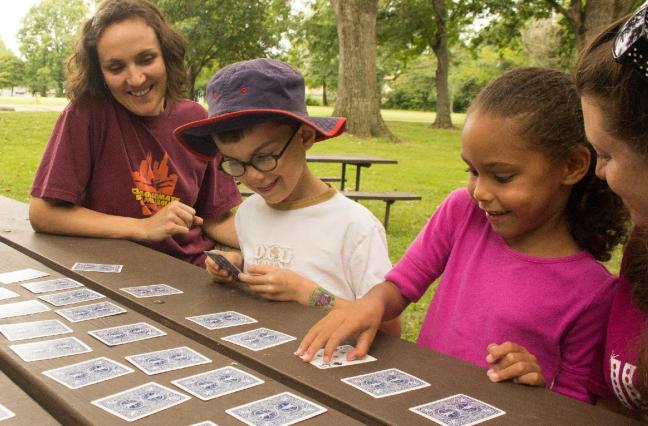
Game: Tens Concentration

Math concepts: addition, number bonds for 10, visual memory
Number of players: any number, mixed ages
Equipment: math cards, one deck

Set Up

Each player draws a card, and whoever choses the highest number will go first. Then shuffle the cards and lay them all face down on the table, spread out so no card covers any other card. There are 40 cards in a deck, so you can make a neat array with five rows of eight cards each, or you may scatter them at random.

Continue reading Game: Tens Concentration

Quotations XII: Mathematicians at Play

This week’s quotes for teachers:

It is the duty of all teachers, and of teachers of mathematics in particular, to expose their students to problems much more than to facts.

Paul Halmos

There are many things you can do with problems besides solving them. First you must define them, pose them. But then, of course, you can also refine them, depose them, or expose them, even dissolve them! A given problem may send you looking for analogies, and some of these may lead you astray, suggesting new and different problems, related or not to the original. Ends and means can get reversed. You had a goal, but the means you found didn’t lead to it, so you found new goal they do lead to. It’s called play.

Creative mathematicians play a lot; around any problem really interesting they develop a whole cluster of analogies, of playthings.

David Hawkins
The Spirit of Play [pdf, 1.4MB]
quoted by Rosemary Schmalz, Out of the Mouths of Mathematicians

Top 10 Reasons To Homeschool

This week’s Carnival of Homeschooling highlights the Department of Education’s (yes, the federal government agency) list of top reasons to homeschool your children. Janine Cate of Why Homeschool, the carnival’s home blog, says:

I’ve noticed that these reasons for homeschooling are phrased with the assumption that there must be something wrong with the school, wrong with the child or wrong with the family to motivate homeschooling. This is not surprising considering the list came from the Department of Education. Thus, I’ve added my own commentary in parenthesis.

It is an interesting read, as are the many homeschooling blog articles in the carnival. Check it out!

As I write, there is still time to send in your submissions for this week’s Carnival of Education, which should be up sometime tomorrow at The Education Wonks. I will come back then to put up a specific link.

Edited to add: The Carnival Of Education—Week 127 is now posted.

How to Make Math Cards

Many of the games on this blog call for Math Cards. You do not need to look for these in stores or in your school supply catalog. Math cards are simply a modified deck of normal, poker-style playing cards. Remove all face cards and jokers from the deck, leaving the ace through ten of each suit. Or use a set of Rook cards, without the bird.

Using the ace as a one, this gives you four sets of numbers 1-10, and you will be ready to play your way to fluency in almost any arithmetical topic: addition, subtraction, multiplication, division, greater-than/less-than, fractions, negative numbers, and more.

Card Holder for Young Hands

Math card holder

Little hands often have trouble holding more than a few cards at a time. Your child may enjoy making and using a card holder.

Save the plastic lids from two large margarine tubs or similar containers. Place the lids together, top to top. Line up the edges, then staple them together, putting two or three staples near the center of the lids. Let your child decorate the card holder with stickers, if desired.

To use the card holder, slip playing cards between the two lids and fan them out. The lids will hold the cards upright, so the child can easily see them all.

 
* * *

This blog is reader-supported.

If you’d like to help fund the blog on an on-going basis, then please join me on Patreon for mathy inspiration, tips, and an ever-growing archive of printable activities.

If you liked this post, and want to show your one-time appreciation, the place to do that is PayPal: paypal.me/DeniseGaskinsMath. If you go that route, please include your email address in the notes section, so I can say thank you.

Which I am going to say right now. Thank you!

“How to Make Math Cards” copyright © 2007 by Denise Gaskins.