
Games are fun, building a positive attitude toward math. They give students a refreshing break from textbook work and make kids willing to practice their math. Games make math practice enjoyable, something children want to do. We can happily work through many more calculations during a game than anyone would ever want to do on a homework page.
Benefits of Math Games
But more important than the fun, math games push children to think about what numbers mean and how they work. The numbers in a math game are not just meaningless abstractions, but tools that players can use to gain an advantage over their opponent.
A good math game reinforces the idea that math is about reasoning, using the things you know to figure out what you need. Math is not just about getting the right answer. It’s about what goes on in your head on the way to that answer. The answer itself is merely a side-effect. of what really matters, your thinking.
A good math game helps students develop flexibility, the ability to adapt, applying what they have learned to new situations, finding a way to work out the things they haven’t mastered yet. All these add up to a more robust type of mathematical fluency than what many people imagine possible.
What Makes a Good Math Game?
Avoid math games that focus on speed. Instead, look for games that encourage reasoning and give players strategic choices.
For example, consider the classic game Math War, where each student has a deck of cards and turns them up to do calculations and capture their opponent’s cards.
It’s a quick and easy way to fill up a few spare minutes at the end of a lesson.
There is a BAD way to play Math War: Each child turns up one card, and they race to say the sum or product. This focus on speed discourages a weaker player, who needs practice the most.
A BETTER way to play is to have each player turn up two cards and do their own calculations. Weaker players have an equal chance to win.
But the BEST way to play is for players to draw three or four cards at a time. The player whose turn it is calls the trump (high or low, for which answer will win), and then each player chooses two cards to lay down. Draw to replenish your hand before the next turn.
Can you see how this system transforms a game of speed or pure chance into a truly educational game, one that forces players to think about the math?
Plus, it’s a lot more fun to play when you have choices.
Mix Up the Rules
One hallmark of mathematical thinking is asking the question “what if..?”
Encourage children to tinker with the rules of a game. What if we play it this way? How does our strategy change? Is the new game easier or harder? which version do you prefer?
A friend’s son took one of the games from my Addition & Subtraction games book and changed the rules to include negative numbers. So when I added the game to my Prealgebra & Geometry games book, I made sure to give him credit in the text.
His mom posted a couple months ago: “He is in middle school now, playing his game again to refresh his understanding of negative numbers.”
Tell a Math Story
One of my favorite ways to fill time when my children were little was the Math Story Game. We played in the car while driving to town, or while washing dishes together, or waiting for another child to finish soccer practice.
Think of a favorite food, hobby, pet, toy, etc, How might that be connected to numbers, shapes, or patterns? Tell a math story or puzzle or problem for the child to answer.
Then its their turn to make up a problem for you. Taking turns makes it a game, not a quiz. Kids love trying to stump the adult.

Games Are for All Ages
Math games are not just for young children. There are some great ways to practice middle and even high school topics with games.
Many games don’t require much time or special equipment. You can take advantage of idle time (standing in line, waiting room, restaurant waiting for food).
For several great ways to play math with your kids, check out my blog page: My Best (Free) Math Games for All Ages.
Here are three games work with a wide range of ages or skill levels…
“I Spy” with Numbers and Shapes
- Take turns naming and guessing objects.
- “I spy 2.” (panes in the window)
- “I spy a square.” (top of the end table)
Keep the Streak
- First player names any number. (12)
- On your turn, say a way to make that number using math. (7 + 5, 1/2 of 24, etc)
- How long can you keep the streak going?
Insomnia: A Cooperative Game
- Roll 4 or 5 dice, and everyone uses the same numbers.
- Try to calculate all the numbers from 1 to 20 using any or all of your dice numbers.
- Example: If you roll 1, 3, 6, 6 …
1 = itself, and so do 3 and 6
2 = 3 − 1, or 6 − (1 + 3)
4 = 3 + 1, or 6 − 3+1, or 3 + (6/6 × 1) - What other numbers can you find? Is it possible to get all 20 with these dice?
- Optional: Keep going beyond 20. How many numbers can you make?
Good Games Don’t Grow Old
One hallmark of a good math game is that you can replay over and over without it growing old.
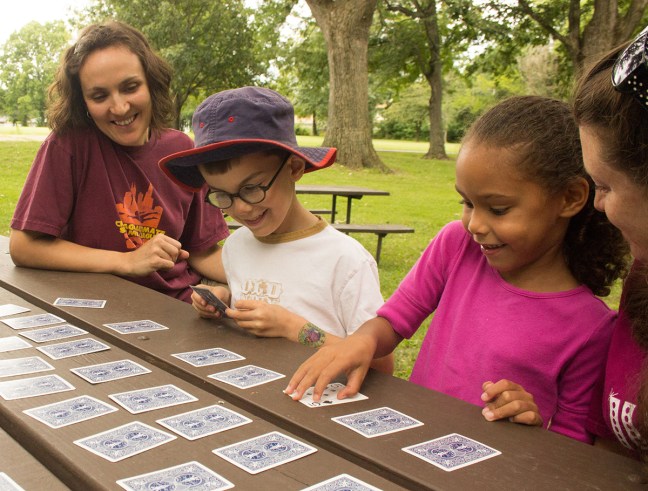
Tens Concentration is my favorite ice-breaker game (everyone is familiar with the basics of a memory game).
Spread out the numbers Ace-10 from a deck of playing cards face down on table. Take turns flipping up two cards. If you get a 10, keep it and turn up another, and if you get 2 cards that add up to ten, keep the pair.
More than once, when I had a math club of young kids in the house and my older daughter noticed us playing the game, she asked if she could join in.
You know a game is a winner when kids volunteer to play it.
* * *
Have you tried gameschooling, for math or other subjects? I’d love to hear about your favorite games!
This blog is reader-supported.
If you’d like to help fund the blog on an on-going basis, then please join me on Patreon for mathy inspiration, tips, and an ever-growing archive of printable activities.
If you liked this post, and want to show your one-time appreciation, the place to do that is PayPal: paypal.me/DeniseGaskinsMath. If you go that route, please include your email address in the notes section, so I can say thank you.
Which I am going to say right now. Thank you!
“Gameschooling Math” copyright © 2023 by Denise Gaskins. Photos copyright © blackregis2 and monkeybusiness / Depositphotos, and “Math in the Park” photo copyright © Denise Gaskins.
 Denise Gaskins' Let's Play Math