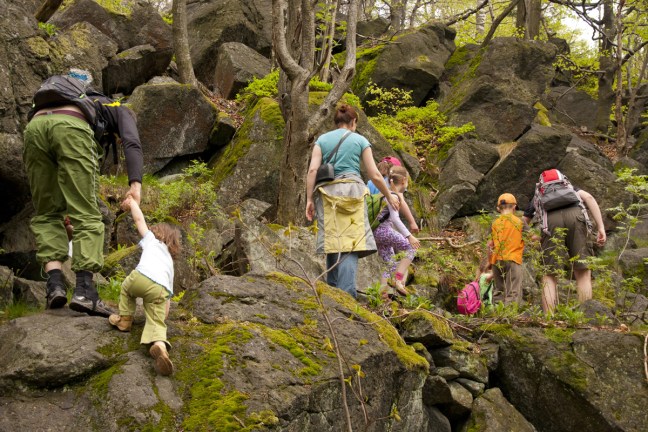
“I love your image of math as a nature walk. My children are ready to start their homeschooling journey, and I want to put them on the right track from the beginning. How can I help them think about math and problem-solving without using a textbook?”
The most difficult part of teaching our children real math is to change our own way of thinking about the subject you’ve already taken that step, so it looks like your family’s learning journey is off to a great start.
[For readers who are wondering what I mean by math as a nature walk, check out this post. You may also enjoy my article on natural learning: Math with Young Children.]
Exploring the World of Mathematics
When you begin to think about math as a nature walk, you set aside the tyranny of answer-getting. Instead, you embrace the freedom of exploring ideas, discovering relationships, making new mental connections.
Young children constantly explore their world, piecing together the mystery of how things work. Mathematical concepts are just part of life’s daily adventure. Their minds grapple with understanding the three-ness of three blocks or three fingers or one raisin plus two more raisins makes three.
Wise homeschooling parents put those creative minds to work. They build a foundation for mathematical thinking with games that require the same problem-solving skills children need for abstract math: the ability to visualize a situation and to apply common sense.
Problem-Solving in the Early Years
Even without “thinking skills” workbooks, thinking and plotting come naturally to my kids.
Children confront a world that refuses to bend to their wishes, yet they find ways to accomplish their goals. They tinker with the Lego model until that stubborn piece finally stays in place, they pester their older sister until she puts down her book and plays with them, or they fix a broken holster with duct tape and string—and who knows? Maybe they even use chewing gum. Whatever the problem, my kids will figure out something.
I will bet your children are just the same. It’s human nature. As George Polya, one of the last century’s great math teachers, wrote, “Solving problems can be regarded as the most characteristically human activity.”
We need to help our students apply that same type of crafty common sense to math. But how?
Polya continued, “If you wish to learn swimming you have to go into the water, and if you wish to become a problem solver you have to solve problems.”
In other words: Students learn to solve math problems through doing it—practice, practice, and more practice. If you’d like to practice problem-solving with your children, try one of the following games, which encourage the same sort of abstract thinking they will eventually need for algebra.
Tell Me a Story…
One of the best mental math games relies on adult/child conversation, a proven method for increasing children’s reasoning skills. As soon as your children can count past five, give them simple, oral story problems to solve:
“If you have two cookies and I give you two more cookies, how many cookies will you have then?”
Don’t limit your story problems to a child’s grade level. If children can make a picture in their minds, they will be able to work with it. As you all get used to the game, occasionally throw in something more difficult: bigger numbers, division with a remainder, or an answer that comes out negative. See what your kids can do with a tough problem, and you might be pleasantly surprised.
Most importantly, take turns. If I asked my daughter a story problem, she got to give me one. And I had to try to solve it, even if she used made-up numbers like 80-hundred and a gazillion.
This is a game, not an oral quiz.
For more math-story tips and example problems, see my earlier post, Tell Me a (Math) Story.
Can You Guess My Secret?
By the time they reach school age, children are ready to try a more abstract challenge. Don’t stop playing with stories, but add another math game to your repertoire. Introduce the idea of variables, or unknown numbers. I call them “Mystery Numbers.”
Elementary textbooks slip a few snippets of stealth algebra into even the earliest years of schoolwork with “missing addend” problems. Your children have seen these:
5 + [] = 7
Because the numbers are small, children can do them in their heads. Without recognizing it, they engage in algebraic thinking: “If 5 + [] = 7, that means [] must be whatever is left from 7 if I take away the 5. So the secret number is 2.”
Solve for mystery numbers in subtraction and multiplication problems, too. Encourage your children to do plenty of these problems, both orally and written out. The textbooks never have enough of these, so you will have to make up your own. Give your secret numbers silly names, like “monkey” or “dragon-spit.”
And sometimes use a letter symbol, to ease your children’s transition to algebra:
“I know a secret number. I can’t tell you its name, so I’ll call it N for number. If you had N plus three more, that would be five. Can you tell what my secret number is?”
Don’t forget to take turns. If you let the kids make up problems for you, it becomes a game instead of busywork. Children love trying to outwit their parents.
Have fun thinking math with your kids!
* * *
Are you looking for more creative ways to play math with your kids? Check out all my books, printable activities, and cool mathy merch at Denise Gaskins’ Playful Math Store. Or join my email newsletter.
This blog is reader-supported. If you’d like to help fund the blog on an on-going basis, then please join me on Patreon for mathy inspiration, tips, and an ever-growing archive of printable activities.
“FAQ: Real Math for Early Learners” copyright © 2025 by Denise Gaskins. Image at the top of the blog copyright © jowka23 / Depositphotos.
 Denise Gaskins' Let's Play Math