New Membership Tiers: One-on-One Mentorship

Two women chatting over tea

Over the years, in my public writing and in personal correspondence, I’ve tried to help younger parents by sharing the things I wish someone would have told me forty years ago. Oftentimes, I will answer a question but never hear back what the person ended up doing or how their family got along.

It leaves me feeling as though I could have done more to encourage them along the way.

In the past few years, I’ve watched a professional writer I admire organize several more formal mentorships for younger indie authors to grow their writing and publishing careers. I think a similar program could be helpful for homeschooling families.

So now I’m offering two new Patreon membership tiers that give you a direct one-on-one connection with me through email or email-plus-video.

My goal is to help you think about math as a creative, playful investigation where you and your children explore concepts together using the math program or curriculum of your choice. This is not a tutoring arrangement. I will help you understand and teach math, but I will not do the teaching for you.

Here’s How It Works

(1) You email me every Sunday—or pick the day that works best for you, at least once every two weeks—to keep me up to date with what you are doing: good times, rough spots, progress or no progress, plans for the coming week. You can also ask any questions about math or education (or indie book publishing).

(2) I’ll write back with encouragement and tips, and I’ll answer questions to the best of my ability. Caveat: I’ve forgotten everything except the broad brushstrokes of calculus and beyond.

(3) If you signed up for a video mentorship, include in your first email a list of several dates and times when you would be available for our monthly one-on-one chat. I’ll compare that with my schedule to find a time we can meet.

Interested?

These new tiers are limited to a few members each—first paid, first in. Check out all the details on my Patreon home page.

Join me on Patreon

 
* * *

Thank you for reading!

“New Membership Tiers: One-on-One Mentorship” copyright © 2025 by Denise Gaskins. Image at the top of the post copyright © deagreez1 / Depositphotos.

Hints for the Patty Paper Trisection

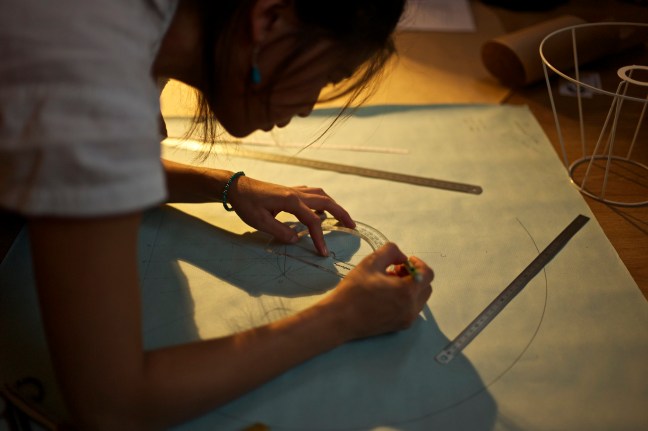
drafting tools

No peeking! This post is for those of you who have given the trisection proof a good workout on your own.

If you have a question about the proof or a solution you would like to share, please post a comment here.

But if you haven’t yet worked at the puzzle, go back and give it a try.

When someone just tells you the answer, you miss out on the fun. Figure it out for yourself — and then check the answer just to prove that you got it right.

Continue reading Hints for the Patty Paper Trisection

Puzzle: Patty Paper Trisection

student using drafting tools

One of the great unsolved problems of antiquity was to trisect any angle, to cut it into thirds with only the basic tools of Euclidean geometry: an unmarked straight-edge and a compass.

Like the alchemist’s dream of turning lead into gold, this proved to be an impossible task. If you want to trisect an angle, you have to “cheat.” A straight-edge and compass can’t do it. You have to use some sort of crutch, just as an alchemist would have to use a particle accelerator.

One “cheat” that works is to fold your paper.

I will show you how it works, and your job is to show why.

Continue reading Puzzle: Patty Paper Trisection

Mental Math: Early Addition

child counting on fingers

From the very beginning of a child’s experience with math, we want to focus on reasoning, making sense of numbers, thinking about how they relate to each other and how we can use these relationships to solve problems.

The basic idea of addition is putting like things together: combining parts to make a whole thing, putting together sets to make a collection, or starting with an original amount and adding the increase as it grows. Connecting two numbers in relationship with a third number we call the sum.

When you work with young children learning addition, remember the two key mental-math strategies I mentioned in the previous post.

  • Use friendly numbers.

For early single-digit addition, the most important friendly numbers are 5 and 10, the pairs of numbers that make 10, and the doubles.

  • Estimate, then adjust.

When children apply their creative minds to reasoning about math, they can use friendly numbers to get close to an answer, and then tweak the result as needed.

Continue reading Mental Math: Early Addition

Tell Children Interesting Things

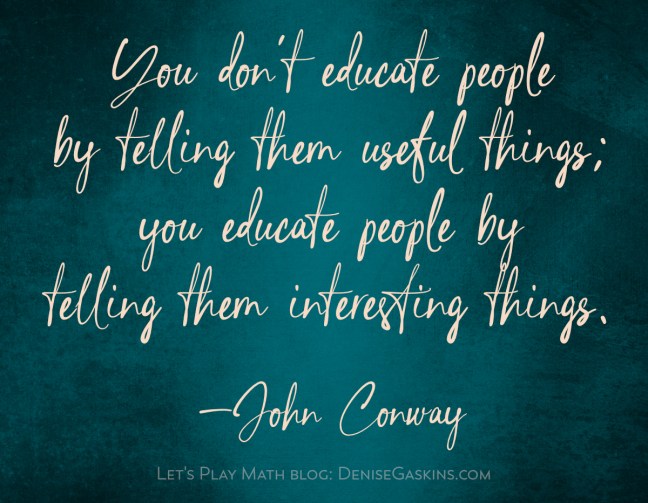
quote by John Conway

“You don’t educate people by telling them useful things; you educate people by telling them interesting things.”

— John Conway

If you want help educating your children with interesting things about math, check out Denise Gaskins’ Playful Math store.

We’re currently running a huge back-to-school sale on ALL of my playful math ebooks, problem-solving activities, math journaling task cards, and math art projects.

So many great ways to play with math!

The 20% discount will automatically apply when you check out. No discount code required.

Check it out:

Back to School Sale 2025

Morning Coffee: That Moment of Epiphany

Morning Coffee Lifelong Learning for Parents

One of the best ways we can help our children learn mathematics (or anything else) is to be lifelong learners ourselves.

Here are a few stories to read as you sip your morning brew. . .

Download your printable Morning Coffee journal

This week’s rabbit hole started with a thought-provoking article from Dan Meyer…

“It would have been quite easy, nothing at all really, to share the epiphany with students, to share the short-cut, to tell my kid that these are all the even numbers and here is where you’ll find them…”

—Dan Meyer

Read more about the value of taking the harder long-cut in this fifth installment of professional development for homeschooling parents.

 
* * *

Are you looking for more creative ways to play math with your kids? Check out all my books, printable activities, and cool mathy merch at Denise Gaskins’ Playful Math Store. Or join my email newsletter.

This blog is reader-supported. If you’d like to help fund the blog on an on-going basis, then please join me on Patreon for mathy inspiration, tips, and an ever-growing archive of printable activities.

“Morning Coffee: That Moment of Epiphany” copyright © 2025 by Denise Gaskins. Image at the top of post copyright © Kira auf der Heide / Unsplash.