Two Hands-On Craft Projects

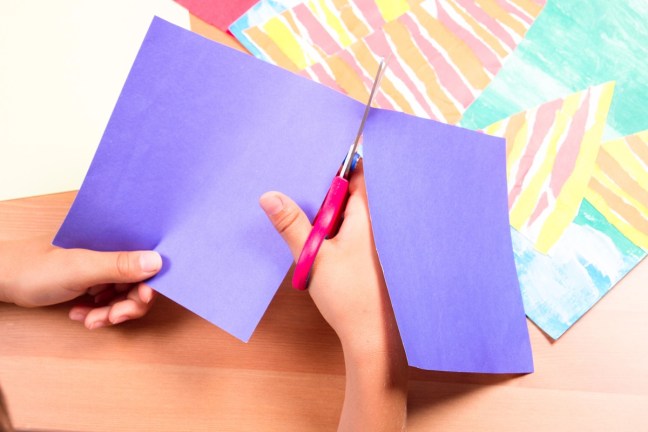
photo: Cutting a paper square

Here are a couple of fun foldable projects to try with your kids.

Both of the projects below start with squares of paper. Do you know how to convert any piece of paper into a square? Here are two methods.

  • Can you tell why they work, how each method creates a true square?
  • What if you didn’t have a rectangular page to start with — could you still create a square?

Minecraft Endless Card

A square flexagon. If you don’t care for Minecraft, just create four square designs of your own to fold, cut, and paste.

https://hattifant.com/minecraft-endless-card-paper-craft

What math do you notice in the finished card? What questions can you ask?

Origami Puzzle Purse

Write a decorative note to a friend, then fold it into a compact little puzzle.

https://hannaleetidd.com/blogs/news/how-to-make-a-victorian-love-token

What do you notice? What do you wonder?

Have fun folding math with your kids!

 
* * *

Are you looking for more creative ways to play math with your kids? Check out all my books, printable activities, and cool mathy merch at Denise Gaskins’ Playful Math Store. Or join my free email newsletter.

This blog is reader-supported. If you’d like to help fund the blog on an on-going basis, then please join me on Patreon for mathy inspiration, tips, and an ever-growing archive of printable activities.

“Two Hands-On Craft Projects” copyright © 2025 by Denise Gaskins. Image at the top of the blog copyright © Vejaa / Depositphotos.

Mental Math: Early Multiplication

mother and daughter talking math together

Children learn best through interaction with others, and mental math prompts can lead to fascinating conversations, listening as our kids apply their creativity to the many ways numbers interact.

With mental math, students master the true 3R’s of math: to Recognize and Reason about the Relationships between numbers.

And these 3Rs are the foundation of algebra, which explains why flexibility and confidence in mental math is one of the best predictors of success in high school math and beyond.

Let’s Try an Example

Multiplication involves scaling one number by another, making it grow twice as big, or three times as much, or eightfold the size. Multiplication by a fraction scales the opposite direction, shrinking to half or a third or five-ninths the original amount.

The key friendly numbers for multiplication and division are the doubles and the square numbers. As with addition and subtraction, students can estimate the answer using any math facts they know and then adjust as needed.

How many ways might children think their way through the most-missed multiplication fact, 8 × 7?

Continue reading Mental Math: Early Multiplication

FAQ: How To Start a Homeschool Math Club

Denise Gaskins reading math with preschoolers

The question hits my inbox whenever parents start planning for a new school year:

“Hello! I am on the board of a homeschool co-op. We have had requests for a math club and wondered if you have any tips for starting one. We service children from K-10th and would need to try to meet the needs of as many ages as possible.”

There are several ways you might organize a homeschool math club, depending on the students you have and on your goals. I think you would have to split the students by age groups — it is very hard to keep that wide of a range of students interested. Then decide whether you want an activity-oriented club or a more academic focus.

When I started my first math club, I raided the math shelves in the children’s section at my library (510-519) for anything that interested me. I figured that if an activity didn’t interest me, I couldn’t make it fun for the kids. Over the years we have done a variety of games, puzzles, craft projects, and more — always looking for something that was NOT like whatever the kids would be doing in their textbooks at home.

Let’s look at the possibilities by grade level…

Continue reading FAQ: How To Start a Homeschool Math Club

Playful Math 182: The Storytelling Carnival

two children digging in the yard

Would you like some great ideas for reading and playing math with your kids?

Sue VanHattum put together a delightful collection of mathematical fiction in honor of Math Storytelling Day:

What are you waiting for? Come join the fun!

Click Here to Read the Carnival Blog

Help Us Keep the Carnival Going

The Playful Math Blog Carnival wants you! We’re transitioning to a seasonal carnival, to make it easier on our volunteer hosts who collect links and write the carnival.

Every carnival brings you a great new collection of puzzles, math conversations, teaching tips, and all sorts of mathy fun. It’s like a free online magazine of mathematical adventures, helpful and inspiring no matter when you read them.
Putting together a blog carnival can be a lot of work, but it’s a great opportunity to share the work of bloggers you admire and to discover new math-friends online. I love that part of being a host!

Classroom teachers, homeschoolers, college professors, unschoolers, or anyone who likes to play around with math — if you would like to take a turn hosting the carnival, please let me know!

CREDITS: Feature photo (top) copyright © 2025 Sue VanHattum.

Mental Math: Early Subtraction

mother and child doing math homework

By doing mental math, we help our children use the basic principles of arithmetic to simplify problems so they can think about number relationships, mastering the basic structures of how numbers work.

And the more our children practice these structures in mental math, the better prepared they will be to recognize the same principles in algebra.

The basic idea of subtraction is finding the difference between two quantities: comparing a larger amount to a smaller one, figuring out what’s left when you remove a part, or finding the distance between two measurements (or two points on the number line).

When you work with young children learning subtraction, remember our two key mental-math strategies.

  • Use friendly numbers.

For early subtraction with numbers less than 20, the most important friendly numbers are 5 and 10, the pairs of numbers that make 10, and the doubles.

  • Estimate, then adjust.

When children apply their creative minds to reasoning about math, they can use friendly numbers to get close to an answer, and then tweak the result as needed.

Continue reading Mental Math: Early Subtraction