The question hits my inbox whenever parents start planning for a new school year:
“Hello! I am on the board of a homeschool co-op. We have had requests for a math club and wondered if you have any tips for starting one. We service children from K-10th and would need to try to meet the needs of as many ages as possible.”
There are several ways you might organize a homeschool math club, depending on the students you have and on your goals. I think you would have to split the students by age groups — it is very hard to keep that wide of a range of students interested. Then decide whether you want an activity-oriented club or a more academic focus.
When I started my first math club, I raided the math shelves in the children’s section at my library (510-519) for anything that interested me. I figured that if an activity didn’t interest me, I couldn’t make it fun for the kids. Over the years we have done a variety of games, puzzles, craft projects, and more — always looking for something that was NOT like whatever the kids would be doing in their textbooks at home.
Let’s look at the possibilities by grade level…
Early Elementary
Hands-on activities, finding and making patterns, measuring, comparing data. Family Math and its spin-offs would be a great place to start looking for ideas. You could also use some of the game ideas in my math game books or Real Math for Early Learners blog post.
I would encourage parents to stay in with these younger students and help them through the activities, if possible.
Middle Elementary Through Middle School
We usually start with a warm-up type activity, a short game or puzzle like those in my math game books or Teaching Negative Numbers blog post. Then we move on to our bigger project for the session. That may be something like the Function Machine. Students always enjoy strategy games. We have made up story problems for each other, done some hands-on algebra with the younger kids, cut up Mobius strips, made flexagons, built giant polyhedra out of drinking straws, played with logic puzzles, etc.
Look for ideas in Family Math and in books by Marilyn Burns, Theoni Pappas, and Claudia Zaslavsky. Or you might browse some of the websites listed in my Elementary and Middle School Fun Stuff page.
This can be a good age to start on math competitions, like the Mathematical Olympiads or MathCounts. These encourage students to think more creatively about math and build their problem-solving skills.
Junior High and Older
Some of the advanced game books in my Tabletop Math Games Collection would make a good warm-up, or for an older group of students I had a few years ago, I bought Theoni Pappas’s Mathematics Calendar and looked for problems on that. They liked the fact that no matter how difficult the problem looked, the answers would always be whole numbers, never greater than 31. Sadly, that calendar is no longer being published, but you can have your students make up their own.
For our main activities, we have done trigonometry and surveying, made flexagons, puzzled through Lewis Carroll soriteses, enjoyed the Best Math Game Ever, or used some of the resources for Playing with Algebra and Beyond. Some of our activities were the same as with the middle-school group, but with more mathematical vocabulary, more complicated functions, or perhaps with some proofs thrown in to spice things up.
Books by Brian Bolt are full of interesting ideas for this age group. Competitions for this age group include MathCounts and the American Mathematics Competitions.
Math History
Another approach to a math co-op would be to survey the history of math and try activities from different eras. I know that I personally have learned a lot through studying how mathematical ideas developed in history.
I have not tried this approach with a co-op class yet, but I have been doing a little math history with my Alexandria Jones blog posts. There are several books that you might find helpful — try www.livingmath.net for tips and book lists. One advantage to the historical approach is that you might be able to combine a wider age-range of students in a single class. If you do try it, please write and let me know how it goes.
A Caveat, and an Inspiration
Occasionally, one of my classes will run into an activity that flops — usually because I picked something that turns out to be too hard for the kids. They are patient with me, however, and still seem to enjoy our meetings. At least, I have been told that some students actually begged their parents to let them come back. 😉
If you’d like a less formal math club, I love this model:
“People have this notion that math is about getting a right answer, and the testing really emphasizes that notion. And that’s such a bad way to approach math because it makes it scary.
“When you look at little kids, they pose their own questions. They say, ‘Ooooh, what’s bigger than a million?’ And they think about things their own way. At school, the teacher poses the questions, and the students answer their questions. Schooling is not a natural environment for learning.”
— Sue VanHattum
More Resources
- Posts about the Richmond Math Salon
More ideas from Sue VanHattum.
- Building a Children’s Math Library of Living Books
I love math books — but I’m a piker compared to this homeschool mom!
- Living Math Website and Forum
Plenty of great advice, ideas, links, and more.
- Natural Math
I have no idea how to characterize this wonderful site. Explore — you’re sure to be inspired!
- Don Cohen’s Map to Calculus
Scroll around and click on anything to discover a wealth of hands-on activities.
- Math Circle in a Box
Download the 171-page pdf full of advice on creating and sustaining a math circle, tips on how to effectively lead a math circle, sample presentations, etc.
- So You’re Going to Lead a Math Circle
Much shorter pdf full of good advice and ideas.
You may also find useful ideas in my weekly Math Game Monday and Thinking Thursday (math journaling) posts.
* * *
Are you looking for more creative ways to play math with your kids? Check out all my books, printable activities, and cool mathy merch at Denise Gaskins’ Playful Math Store. Or join my free email newsletter.
This blog is reader-supported. If you’d like to help fund the blog on an on-going basis, then please join me on Patreon for mathy inspiration, tips, and an ever-growing archive of printable activities.
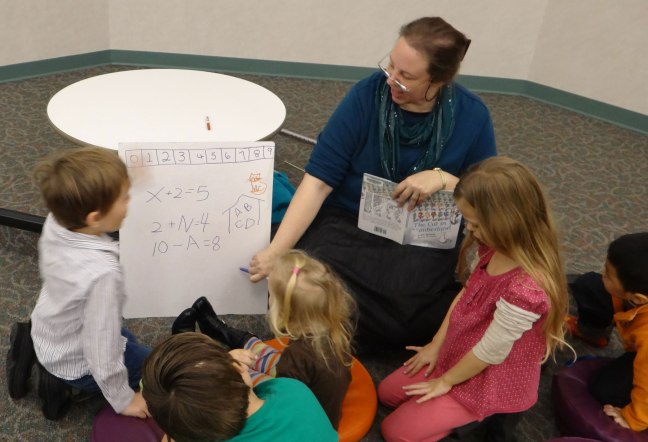
“FAQ: How To Start a Homeschool Math Club” copyright © 2025 by Denise Gaskins. Image at the top of the blog from a co-op class with
The Cat in Numberland by Ivar Ekeland. Denise Gaskins' Let's Play Math