
Mental math is doing calculations with our minds, and perhaps with the aid of scratch paper or a whiteboard to jot down notes along the way.
But we cannot simply transfer the standard pencil-and-paper calculations to a mental chalkboard. That’s far too complicated.
We still want to follow our basic strategies of using friendly numbers, estimating, and adjusting the answer. So how can we help children do math in their heads as the numbers get bigger and the problems more challenging?
How might kids figure out a multi-digit addition like 87 + 39?
Here are three useful strategies…
Funny Numbers
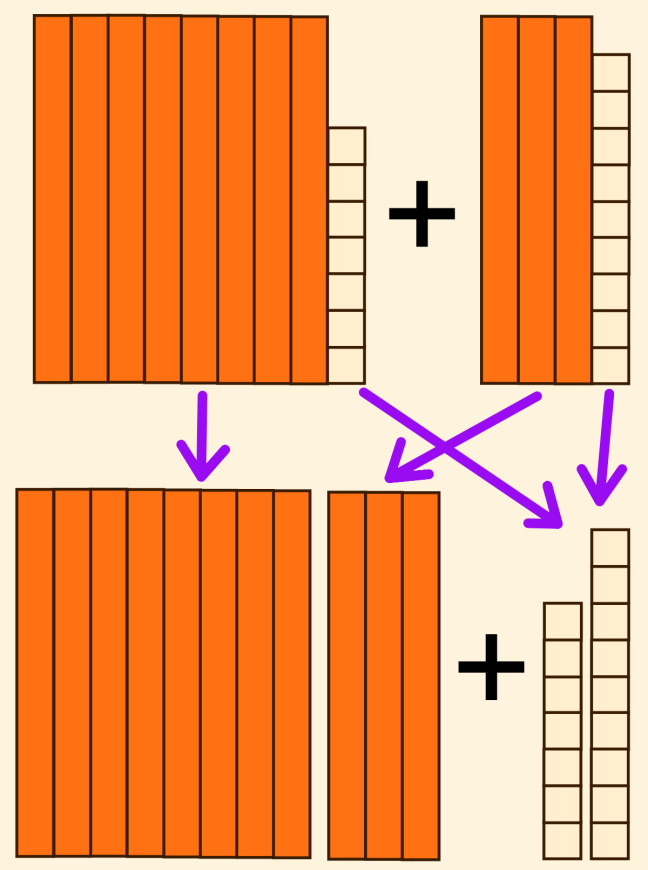
We can split up the calculation by place value, but we don’t try to keep track of “carrying” or renaming. Instead, we find our answer in funny numbers, and then later adjust it to the common form.
Working the largest parts first, 8 tens plus 3 tens are 11 tens. And 7 plus 9 is 16. Our answer is eleventy-sixteen.
Funny numbers let us laugh while making sense of mental math.
87 + 39
= (80 + 30) + (7 + 9)
= 110 + 16
Give and Take
We can imagine the numbers as blocks or pebbles that we can move around, recombining them into friendlier quantities.
For example, we could take one piece from 87 and give it to 39 to make a friendly multiple of ten:
87 + 39
= 86 + (1 + 39)
= 86 + 40
Or we could take three pieces from 39 to transform 87 into a friendlier number:
87 + 39
= (87 + 3) + 36
= 90 + 36

Number Complements
As we work more with large multi-digit numbers, it becomes useful to know the number complements for the powers of ten. We can use the pairs that make 100 or 1,000 to solve many problems.
For example, we can use the partner that pairs with 87 to make a very friendly 100:
87 + 39
= (87 + 13) + 26
= 100 + 26
We don’t make children memorize the number complements, but we do build awareness of them as a useful tool.
So, a student might think: “87 is getting close to 100, which is a very easy number to work with. How much more does it need? Oh, I can take 13 from here and move it to there, and then the problem solves itself.”

Math Is Mental Play
The main thing in all this is to play with the number relationships.
- Try taking turns with mental math puzzles, letting the kids challenge you with problems.
- Practice number complements with the “I Have, You Need” game.
- Or play the “How Many Ways?” game and see if you can find five different methods to solve one calculation.
Remember, in teaching math, the right answer is never our goal. Our goal is to get students reasoning about numbers, shapes, and patterns.
Read the Whole Series
Check out all the posts in my Mental Math Series:
- Mental Math Is the Key to Algebra
- Three Basic Principles
- Early Addition
- Early Subtraction
- Early Multiplication
- Early Division
- Advanced Addition
- Coming Soon: Advanced subtraction strategies…
* * *
“Mental Math: Advanced Addition” copyright © 2025 by Denise Gaskins. Image at the top of the blog copyright © SomeMeans / Depositphotos.
Are you looking for more creative ways to play math with your kids? Check out all my books, printable activities, and cool mathy merch at Denise Gaskins’ Playful Math Store. Or join my free email newsletter.
This blog is reader-supported. If you’d like to help fund the blog on an on-going basis, then please join me on Patreon for mathy inspiration, tips, and an ever-growing archive of printable activities.
 Denise Gaskins' Let's Play Math