In the first section of George Lenchner’s Creative Problem Solving in School Mathematics, Lechner poses this problem. If you have seen it before, be patient — his point was much more than simply counting blocks.
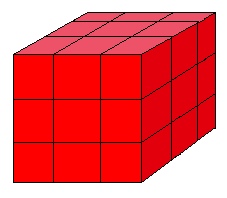
A wooden cube that measures 3 cm along each edge is painted red. The painted cube is then cut into 1-cm cubes as shown below. How many of the 1-cm cubes do not have red paint on any face?
Create Your Own Math
And then he challenges us as teachers:
- Do you have any ideas for extending the problem?
- If so, then jot them down.
This is strategically placed at the end of a right-hand page, and I was able to resist turning to read on. I came up with a list of 15 other questions that could have been asked — some of which I used in my Alexandria Jones stories.
Lechner wrote only seven elementary-level problems, and yet his list had at least two questions that I had not considered.
How many can you come up with?
For hints on creating your own list, read Jonathan Halabi’s How to modify problems—an example.
My Favorite Puzzles
Several of the puzzles I created grew from my experience with MathCounts problems about combinatorics and probability — topics that weren’t in the curriculum during my schooldays, but which I now thoroughly enjoy.
- If I choose one of the small cubes at random and toss it in the air, what is the probability that it will land red-painted side up?
- If I tossed all the small cubes in the air, so that they landed randomly on the table, how many cubes should I expect to land with a painted face up?
- If I put all the small cubes in a bag and randomly draw out 3, what is the probability that at least 3 faces on the cubes I choose are painted red?
- If I put the small cubes in a bag and randomly draw out 3, what is the probability that exactly 3 of the faces are painted red?
The amazing thing to me was that I’ve learned enough in my years of math coaching to actually solve the problems I made up. Well, at least, I was able to get answers that seemed reasonable to me. I would love to hear what you come up with, as a “reality check” on my own calculations.
* * *
“Puzzle: Random Blocks” copyright © 2026 by Denise Gaskins. Image at the top of the blog copyright © 5seconds / Depositphotos.
Are you looking for more creative ways to play math with your kids? Check out all my books, printable activities, and cool mathy merch at Denise Gaskins’ Playful Math Store. Or join my free email newsletter on Substack.
This blog is reader-supported. If you’d like to help fund the blog on an ongoing basis, then please join me on Patreon (or choose the paid level on Substack) for mathy inspiration, tips, and an ever-growing archive of printable activities.

