
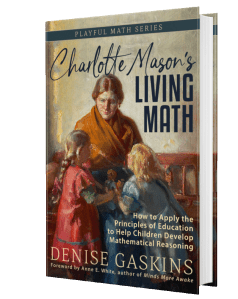
 The following is an excerpt from Charlotte Mason’s Living Math, coming to your favorite bookstore or library this November.
But if you’re impatient—or if you want the exclusive, deluxe, full-color paperback or hardcover edition—you can order your copy now on my Playful Math Store.
This section comes from the chapter called “How Shall We Teach?” which also includes tips about textbooks, a little-known truth about the math facts, and what to do if you never understood math yourself.
Moving Toward Mastery
With any mathematical idea, our children need time to build knowledge. As we recognize their progress, we can shape our plans to better fit the next step in their development.
Here are four stages in growth from first contact to confidence:
- Exploration: become aware of the new idea, gathering experience by trial and error, playing with the concept, discovering how much it can do, searching out its limits.
- Translation: describe the results of their exploration, learning to express the relations they discover in some type of mathematical language (words, pictures, or symbolic notation).
- Consolidation: develop confidence in moving between experience and symbolic expressions, organizing their discoveries, asking new questions, and possibly launching their own related investigations.
- Mastery: use their knowledge fluently in a variety of situations, making it a foundation to support new concepts.
We celebrate when our children can translate a mathematical situation into symbols and calculate answers, even while recognizing they have not yet reached full understanding. As learning to identify a new bird or plant doesn’t confer expertise in biology, so there is much more to math than writing symbols.
“Our own school experiences can make it hard for us to teach without being tempted to ‘help them master’ a concept that they may or may not be ready to master,” according to living math expert Julie Brennan. “What we never learned in school was the concept of playing around with math, allowing ideas to ‘percolate,’ so to speak, before mastery occurs. And that process may take time.”
So how do we know when our children understand the math they’ve studied? When they can use it flexibly and creatively, as Mason explains:
“Perhaps the chief function of a teacher is to distinguish information from knowledge in the acquisitions of his pupils.
“Because knowledge is power, the child who has got knowledge will certainly show power in dealing with it. He will recast, condense, illustrate, or narrate with vividness and with freedom the arrangement of his words.
“The child who has got only information will write and speak in the stereotyped phrases of his text-book, or will mangle in his notes the words of his teacher.”
—Charlotte Mason
* * *
Are you looking for more creative ways to play math with your kids? Check out all my books, printable activities, and cool mathy merch at Denise Gaskins’ Playful Math Store. Or join my email newsletter.
This blog is reader-supported. If you’d like to help fund the blog on an ongoing basis, then please join me on Patreon (or choose the paid level on Substack) for mathy inspiration, tips, and an ever-growing archive of printable activities.
“Four Stages of Learning Math (or Anything Else)” copyright © 2026 by Denise Gaskins. Image at the top of the blog copyright © Milkos / Depositphotos.

