“I am inclined to believe that one of the origins of mathematics is man’s playful nature, and for this reason mathematics is not only a Science, but to at least the same extent also an Art.”
—Rózsa Péter
This week, we have the first mathematical adventure of Alexandria Jones, which takes place in the early days of her father’s archaeological expedition mentioned in the introduction post.
Herein we meet the one major character who is not named after a mathematician from history: Alex’s nemesis, Simon Skulk.
While my fiction doesn’t rise close to the level of “art,” I hope it offers a glimpse into the playful nature of mathematics for you and your children.
The Secret of the Pharaoh’s Treasure
Alexandria Jones stood outside her father’s tent. The glare of the sun on the rocky desert hurt her eyes. Holding up a hand to shield her gaze, she spotted her dad (the world-famous archaeologist) arguing with the foreman.
Poor Dad, she thought. He was sure this was the right site, but so far he’s found nothing.
She looked down at her feet, where her faithful dog Ramus waited, panting. “Well, Rammy, it looks like Dad will be busy for while. What do you say? Shall we go exploring?”
Alexandria ducked into the tent for her backpack and canteen.
Thump! Something bounced against the side of the tent. Ramus barked.
Alex stepped outside and looked quickly around. No one was in sight. She saw a fist-sized rock beside the tent, with a note tied to it. She picked it up and read:
Ha! The real Pharaoh’s Treasure lies under a pyramid of stones, and it’s mine. You can’t stop me this time!
—Simon Skulk
“Find him, Rammy. Which way did he go?”
Growling, the dog ran down the trail to the valley. Alex followed him, but pulled up short when Ramus started into a dark cave. She swung her backpack off her shoulder and drew out a flashlight.
“The treasure must have been buried in a cave, as some of the later pharaohs were,” she said. “Okay, Rammy. Lead on.”
The cave ended at the foot of a head-high pyramid of small, rough-cut stones. Her father’s enemy was just setting his lantern on the ground.
“You creep!” Alex shouted. “That treasure belongs in a museum.”
The man laughed and reached for a stone. “Not if I find it first. The Pharaoh’s Treasure should bring me a pretty profit!”
Alexandria Jones ran to grab a stone from the pyramid. If she could just uncover the treasure before he did…
Can You Find the Pharaoh’s Treasure?
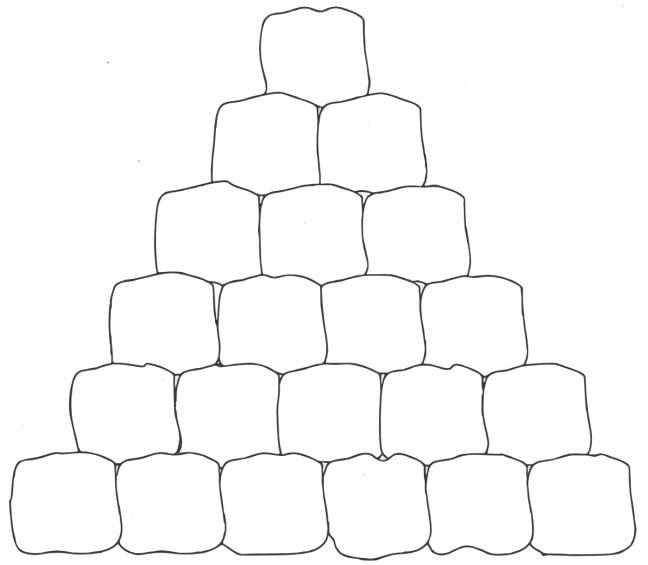
The Pharaoh’s Pyramid is a strategy game for two players. Print out the PDF gameboard or draw your own pyramid of stones.
- Each player will need a pencil or colored marker. Youngest player gets the choice of going first or second.
- On your turn, draw an “X” on one or two stones, to remove them from the pyramid. You do not have to work from the top down; you may mark any stones you wish. But if you want to mark two stones on the same turn, they must be touching each other.
- Take turns marking stones until they are all gone. Whoever marks the last stone uncovers the Pharaoh’s Treasure and wins the game.
If you draw your own game, experiment with different sized pyramids. How does changing the number of stones affect the strategy of the game?
The Pharaoh’s Treasure, Continued
“I can’t believe it!” Simon Skulk threw down the last stone in disgust and walked away. At the mouth of the cave, he turned back and shook his fist. “You haven’t seen the last of me, Alexandria Jones.”
Her muscles aching, Alex sank to the ground and hugged her dog. The she gave him a little push toward the front of the cave. “Rammy, go get Dad.”
Ramus barked once and took off running.
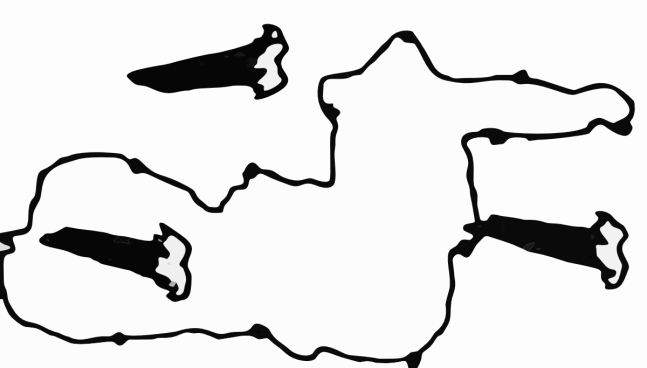
Alex turned back to look at the Pharaoh’s Treasure. Where the last stone had stood was a hole. In the hole lay three wooden sticks, like tent pegs, and a long loop of rope with twelve evenly-spaced knots.
What could it be?
It seemed as though Alex sat there forever, shivering as the desert sun went down, her muscles growing stiff.
Finally, Ramus came bounding into the cave and licked her face. Her father ran in behind the dog, giving her a hug that chased the stiffness away.
Then, slipping on a pair of vinyl gloves from his pocket, Fibonacci Jones reached into the hole and gently touched the pegs and rope.
“You found it,” he said. “The Pharaoh’s Treasure! Isn’t it beautiful?”
Alexandria frowned. “But what is it?”
The ancient Egyptians were careful builders, Fibonacci Jones explained. To keep their pyramids, temples, and other buildings squared up properly, Egyptian surveyors (called “rope stretchers”) used a powerful design tool: the right triangle.”
How to Use the Rope Triangle
You can make your own rope stretcher’s triangle with a piece of string and three straight pins.
Tie eleven evenly-spaced knots, about 2 inches (5 cm) apart, and then tie the ends of the string together to make the twelfth knot. Getting the knots right is the hardest part. Check your spacing with a ruler or by folding the string several times, to make sure the knots all line up.
Then use the straight pins as your pegs, and use the cardboard back of a spiral notebook or the side of a cardboard box as your ground:
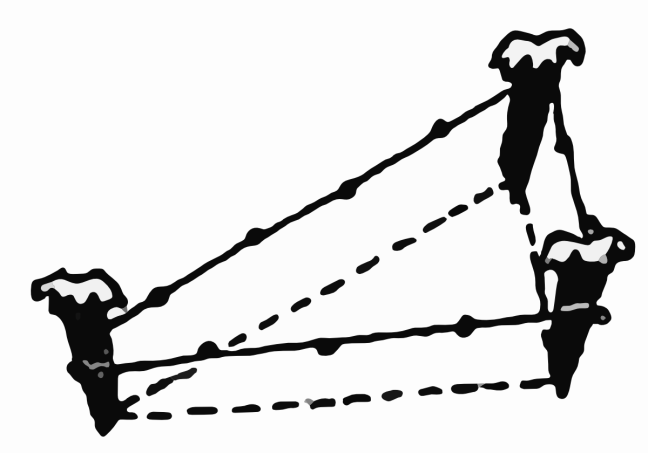
- Pound one peg into the ground where you want the square corner. Loop the rope around the peg with one knot exactly at the peg.
- Move along the line of your wall a distance of three knots on the rope. Pound in the second peg, with the rope looped around it and with one knot exactly at the peg.
- Slip the last peg into the rope loop and pull it tight, four knots from the first peg at the corner. Pound this last peg into the ground, making sure it is exactly at its knot.
This makes a right triangle with sides of 3, 4, and 5 lengths on the rope. The corner is perfectly square.
A Puzzle for Older Students
Play around with your Pharaoh’s Treasure model.
- Can you explain why the instructions above form a right angle?
- There are other ways to form a right angle using the rope and pegs. Can you find an alternate method?
You need to find some way to make two lines that are perpendicular to each other. Feel free to use extra ropes or pegs, if needed. The Egyptian rope stretchers could use as many or as few ropes as they liked.
If you want a hint, consider Euclid’s Book 1, Proposition 11.
And if you get stumped, I will put one possible answer in a future post. But don’t give up too quickly. Remember the math adventurer’s rule.
Math Adventurer’s Rule: Figure it out for yourself!
When I tell you the answer, you miss out on the fun of solving the puzzle. Figure it out for yourself—and then check the answer just to prove that you got it right.
To be continued…
* * *
Are you looking for more creative ways to play math with your kids? Check out all my books, printable activities, and cool mathy merch at Denise Gaskins’ Playful Math Store. Or join my email newsletter.
This blog is reader-supported. If you’d like to help fund the blog on an ongoing basis, then please join me on Patreon (or choose the paid level on Substack) for mathy inspiration, tips, and an ever-growing archive of printable activities.
“The Secret of the Pharaoh’s Treasure” copyright © 2026 by Denise Gaskins. Image at the top of the blog copyright © Simon Berger / Unsplash.

