
We’ve been looking at Deans for Impact’s white paper, “The Science of Learning,” which summarizes cognitive science research and its implications for teachers (and homeschoolers). The paper poses six key questions that help us to apply the principles of science in teaching our children.
This week, let’s explore how students learn and retain new information.
Because if we want our children to be able use what we teach them, the first step is to help them remember it.
How Do Students Learn and Retain New Information?
Principles from The Science of Learning:
- To learn, students must transfer information from working memory (where it is consciously processed) to long-term memory (where it can be stored and later retrieved). For long-term knowledge to be useful, students have to think about meaning.
- Practice is essential to long-term learning, but not all practice is equivalent.
- Effective feedback is essential for learning.
Tips for Teachers
- Assign tasks that focus on meaning, such as asking students to explain or organize material.
- Focus lessons on sense-making, while making sure that students’ background knowledge is solid.
- Use mnemonics for hard-to-remember details, not for foundational concepts. Mnemonics can’t replace reasoning.
- Practice should require thinking, not simple recall. Focus on using the material, not just repeating it.
- Feedback should not focus on grading performance, but encourage growth and offer suggestions for improvement.
My Comments
We connect information (facts, data) to the ideas we have made sense of. We retain the information that we use, that we focus our thinking on, and that reinforces those ideas.
I appreciate the caution that practice needs to focus on sense-making, not simple recall.
Games are great for practice because they have low stakes, no pressure to perform, and they offer immediate feedback. But we need the right kind of games, the ones that rely on using meaning, not just answer-getting.
Knowledge becomes solid in our minds when we use it to do something else, when our focus is not on the answer to this particular problem but on a goal that this problem will help us reach. The best practice is not an end in itself, but a tool we use to achieve our strategic goal.
This reminds me of the common math-teacher observation that students never really learn the last math course they take. Rather, they learn whatever they studied previously as they put that knowledge to use in the new course.
“The average student does not really learn to add fractions in an arithmetic class; but by the time he has survived a course in algebra he can add numerical fractions. He does not learn algebra in the algebra course; he learns it in calculus, when he is forced to use it.
“He does not learn calculus in a calculus class either; but if he goes on to differential equations he may have a pretty good grasp of elementary calculus when he gets through.
“And so on throughout the hierarchy of courses; the most advanced course, naturally, is learned only by teaching it.
“This is not just because each previous teacher did such a rotten job. It is because there is not time for enough practice on each new topic; and even it there were, it would be insufferably dull.”
—Ralph P. Boas, Lion Hunting and Other Mathematical Pursuits
But we can activate the power of reasoning practice for our students by avoiding the “insufferably dull” math-fact-recall games and instead playing games that require strategic thinking.
Try This Today: The Substitution Game
The Substitution Game features low-floor, high-ceiling cooperative play that works with any age (or with a mixed-age group). It’s a great way to build skills through practice that involves creative thinking, using math and enjoying it.
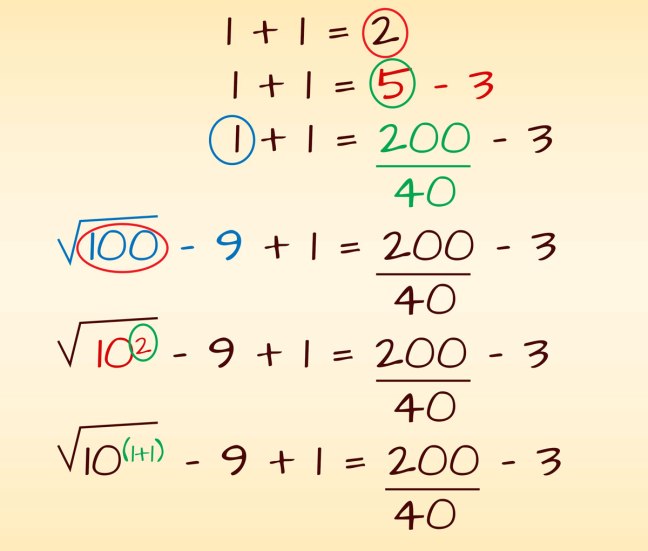
The first player writes a simple equation at the top of the paper, such as “1 + 1 = 2.” Then all players take turns complexifying this equation.
On your turn, copy the equation to the next line, replacing one number with an equivalent expression. For instance, replace the number 2 with:
5 − 3
or 50 ÷ 25
or (1/3) × 6
… or any other calculation that equals two.
Use parentheses or brackets as needed to make your expression perfectly clear. For example, I put parentheses around my fraction above so people can tell I didn’t mean “1/(3×6),” which is definitely not a substitute for two.
If you have colored pencils or markers, circle the number you plan to substitute. Then write the substitution below in the same color. Finally, fill out the rest of the equation using a neutral-colored pencil or marker.
The other players should check to make sure they agree with your math.
After you change part of the equation, it is no longer available for anyone else to use. If you substitute “5 − 3” for the 2, the other players cannot replace your creation with their own version of that number. But they can alter individual numbers within your creation. So the next player may decide to substitute for the 5, writing a new expression in its place.
For young players, an older child or an adult may take dictation. This lets the young one focus on thinking about the numbers without struggling to write an ever-growing equation.
Continue until the paper is full, or until the equation looks satisfyingly complex, or until you run out of time.
Targeted Practice
As students grow comfortable with the basic game, pose additional challenges. Perhaps each substitution must use multiplication, or a fraction, or contain a specific number.
For example, if your challenge is to play division, you could replace the number 3 in an existing equation with:
15 ÷ 5
or (70 ÷ 7) − 7
or (1/4) × 300 ÷ 25
… or any other calculation that uses division. Remember to use parentheses or brackets as needed to make your expression perfectly clear.
If you’re playing with a mixed-ability group, each player may have a different challenge. An elementary student may be practicing the times-7 number family while a teenager practices with trigonometric functions.
You can also play the Substitution Game as solitaire, just for the fun of complexifying equations.
How crazy can you make the math?
* * *
Read the whole Science of Learning series.
“The Science of Learning 2: Memory” copyright © 2026 by Denise Gaskins. Image at the top of the blog copyright © ArturVerkhovetskiy / Depositphotos.
Are you looking for more creative ways to play math with your kids? Check out all my books, printable activities, and cool mathy merch at Denise Gaskins’ Playful Math Store. Or join my email newsletter.
This blog is reader-supported. If you’d like to help fund the blog on an ongoing basis, then please join me on Patreon (or choose the paid level on Substack) for mathy inspiration, tips, and an ever-growing archive of printable activities.

