When two non-mathematicians meet on the street and one says, “I’ve got problems,” the other answers, “I’m so sorry for you.”
When two mathematicians meet and one says, “I’ve got problems,” the other says, “Oh, goody!”
—Herta Taussig Freitag
Whenever you get a group of mathematicians together, at least one of them will suggest a puzzle to play with. This is how mathematics grows, puzzle upon puzzle, generation after generation.
And since human nature hasn’t changed, we know that the same thing happened in the ancient Ptolemaic Egyptian of Alexandria.
So let’s explore a few of the math stumpers that enchanted those old Greek scholars…
Euclid and Straight Lines
Before the days of mass-produced paper, Euclid’s students drew diagrams in the sand. Almost any flat section of ground served as a classroom, and sketches could be easily erased by smoothing out the sand.
Take a ruler or other flat object outdoors, rake up a bit of dirt until it’s loose, then smooth it out. What geometric principles can you discover?
- Press your straightedge into the ground to make a straight line. How far can you make that line extend?
- Pick a point somewhere near the middle of your line and center your straightedge on that point. Lift the straightedge so it barely touches the soil. Rotate it a partial turn around that point, and then press your straightedge into the ground to make a new line.
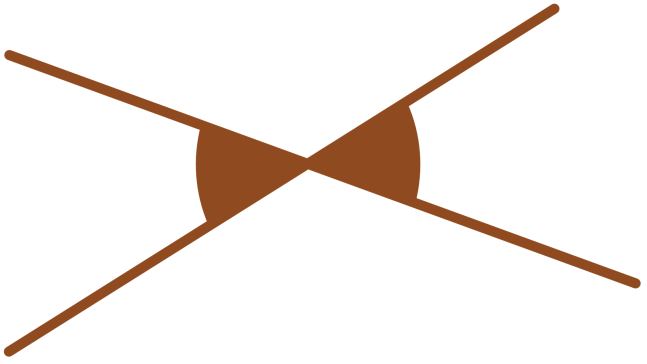
What can you notice about the two lines, and about the angles swept out by your rotation?
What else can you notice? Don’t stop with one idea, but milk the diagram for everything you can get.
- Now hold your straightedge in the air over your second line.
- Keeping it in the same orientation, parallel to that line, slide it up or down along the first line.
- At some point of your choice, press the straightedge into the ground to make a new line.
What can you notice about the parallel lines, and the places where they intersect the original line? How are they the same? How are they different?
Look for intersecting and parallel lines in the world around you. Can you find the same relationships you noticed in your geometry sketches?

Pappus’s Invariant
Pappus of Alexandria lived sometime around AD 300. He wrote a summary of all the mathematics that was known in his day. He called it the Collection. Many works of the ancient Greek mathematicians survive only because Pappus wrote them down in his book.
He also wrote about his own studies in geometry and other subjects. Here is a math-art puzzle that Pappus enjoyed, which demonstrates what mathematicians call an invariant—something that never changes, no matter how you shift the things around it.
Smooth out your geometric ground to make a new diagram. Create this pattern:
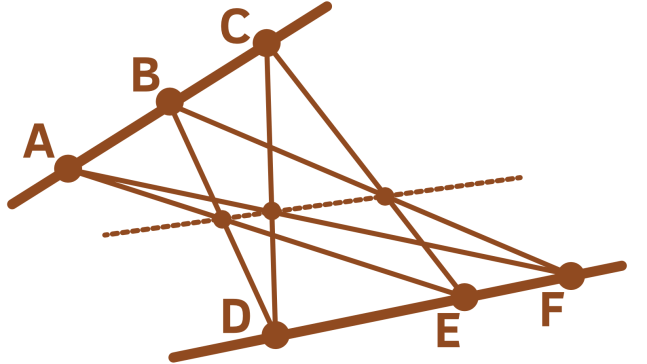
- Make a line and mark on it any three points of your choice: A, B, and C from left to right.
- Somewhere not too far away (so you have room to draw connections) make another line. It go wherever you like, but the rest of the diagram will be easier if the slant isn’t too extreme compared to your first line. Mark three points on your new line, and label them from left to right: D, E, and F.
- Now construct the pattern: Connect each point to the points on the other line that are not in the same left-to-right position. That is, connect point A to E and F, and connect B to D and F, and so on.
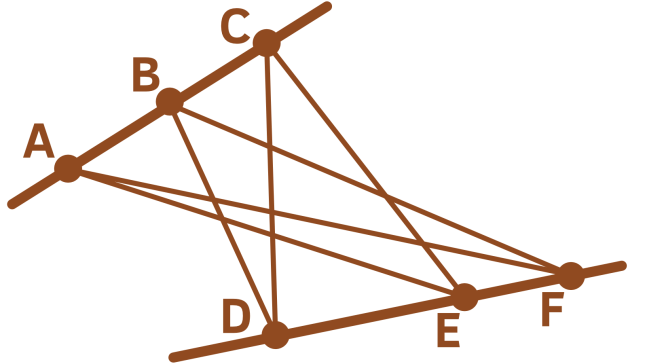
What can you notice about the diagram you constructed? What shapes and angles can you find?
Go indoors and draw the pattern on paper. Make several designs, each with different points and slants. Color them, if you like. What can you notice about the patterns? What is the same, and what is different?
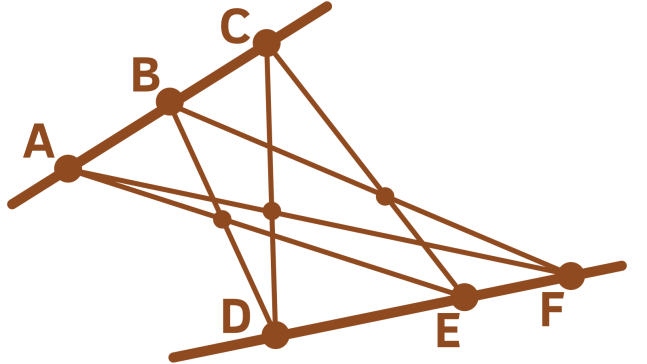
Pappus noticed something about his diagram of intersecting triangles. In particular, he looked at the points where corresponding lines crossed.
- Mark where the two left-to-middle lines meet, and where the right-to-middle lines meet, and where the left-to-right lines cross each other.
Can you see what’s special—that is, what’s invariant—about these three points in every design you constructed?
The Epitaph of Diophantus
Diophantus, a mathematician who lived in Alexandria around AD 250. He wrote Arithmetica, the first known book about solving problems with algebra. He is famous for his study of Diophantine equations, where the variables must always represent whole numbers.
Can you solve the epitaph of Diophantus?
“This tomb holds Diophantus. Ah, what a marvel! And the tomb tells scientifically the measure of his life.
“God vouchsafed that he should be a boy for the sixth part of his life; when a twelfth was added, his cheeks acquired a beard; He kindled for him the light of marriage after a seventh; and in the fifth year after his marriage, He granted him a son.
“Alas! late-begotten and miserable child, when he had reached the measure of half his father’s life, the chill grave took him.
“After consoling his grief by this science of numbers for four years, he reached the end of his life.”
The Math Adventurer’s Rule: Figure It Out for Yourself!
Whenever I give a problem in an Alexandria Jones story or companion post, I will try to post the answer soon afterwards.
But don’t peek!
If I tell you the answer, you miss out on the fun of solving the puzzle. Figure it out for yourself—and then check the answer just to prove that you got it right. But never read the answers until you’ve given the problem a good workout on your own.
Euclid and Straight Lines
Things you might notice about intersecting lines:
- The lines form four angles around the point of rotation.
- The angles directly opposite each other (called vertical angles) grow or shrink by the same amount as the line rotates. They are always equal to each other.
- Any two angles that touch each other add up to a full straight line (180 degrees).
- If we rotate the line until all the angles are the same, we form four right angles. Each right angle is half of a straight line (90 degrees).
Things you might notice about parallel lines:
- The third line is an exact copy of the second, except in a new position.
- All the angles around the new intersection are exact copies of the corresponding angles around the first intersection.
- Therefore, we can mark angles that are equivalent to each other. Can you find them all?
- Assuming the intersections are not perpendicular, then all four of the smaller angles match, and all four of the larger angles also match.
- Any smaller angle of either intersection could add up to any of the larger angles to make the equivalent (in imagination) of one straight line, 180 degrees.
In Euclid’s Elements, Book 1, these ideas are counted as propositions 13–15 and 27–29.

Pappus’s Invariant
Pappus discovered that no matter how you draw your original lines or where you make the points on them, if you follow his instructions, the three points where the corresponding lines cross will always be collinear. That is, you can always connect them to make a new straight line.
The Epitaph of Diophantus
Let’s make the letter D stand for the number of years that Diophantus lived.
- He was a boy for 1/6 of his life, which would be D/6 years.
- Then he was a youth for 1/12 of his life, until he got a beard—that’s D/12 years.
- After another seventh, he got married, so that’s D/7 more years as a bachelor.
- Then, when he had been married 5 years, his son was born. That’s just a plain 5 years, not a fraction.
This is where the riddle gets tricky. The phrase “when he had reached the measure of half his father’s life” could mean the son was half as old as Diophantus was when the son died, or that the son lived half as long as Diophantus’s total life.
You can try both options, but the first will lead to Diophantus living a fractional age, some number of years plus part of the next year. But Diophantine problems must always have whole number solutions.
- So, the son lived D/2 years.
- Finally, Diophantus lived 4 more years after his son died. Again, that’s a plain 4 years, not a fraction of anything.
Put all of these parts together to make an algebraic equation for how long Diophantus lived:
D = D/6 + D/12 + D/7 + 5 + D/2 + 4
And then imagine solving that with Roman numerals!
Diophantus lived for 84 years.
* * *
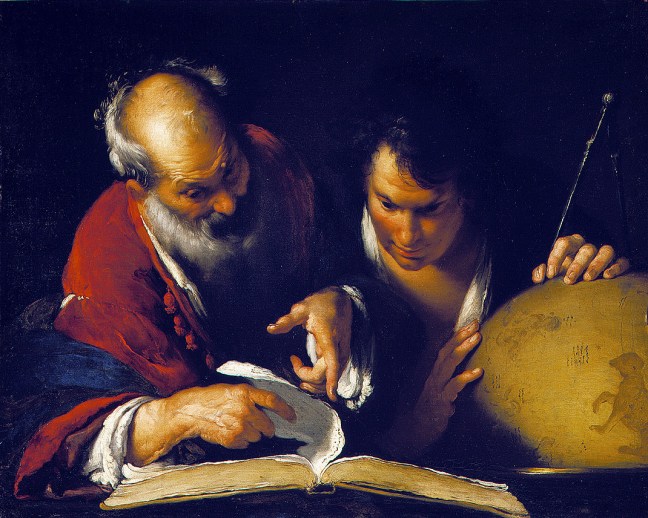
“The Pharaoh’s Treasure: Historical Puzzles” copyright © 2026 by Denise Gaskins. Image at the top of the blog is “Eratosthenes Teaching in Alexandria” by Bernardo Strozzi, 1635, public domain.
Are you looking for more creative ways to play math with your kids? Check out all my books, printable activities, and cool mathy merch at Denise Gaskins’ Playful Math Store. Or join my email newsletter.
This blog is reader-supported. If you’d like to help fund the blog on an ongoing basis, then please join me on Patreon (or choose the paid level on Substack) for mathy inspiration, tips, and an ever-growing archive of printable activities.

