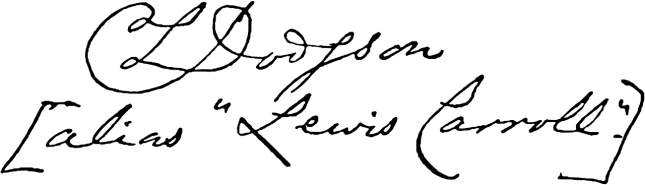
On a friend’s blog, I found this delightful letter written by Charles Lutwidge Dodgson to a young man named Wilton Cox.
The pseudonym Lewis Carroll comes from an alteration of the Latinized name Carolus (for Charles) and the replacement of Lutwidge with Lewis.
The Puzzle
Honoured Sir,
Understanding you to be a distinguished algebraist (that is, distinguished from other algebraists by different face, different height, etc.), I beg to submit to you a difficulty which distresses me much.
If x and y are each equal to 1, it is plain that:
2 × (x² − y²) = 0
…and also that:
5 × (x − y) = 0.
Hence 2 × (x² − y²) = 5 × (x − y).
Now divide each side of this equation by (x − y).
Then 2 × (x + y) = 5.
But (x + y) = (1 + 1), i.e. = 2.
So that 2 × 2 = 5.
Ever since this painful fact has been forced upon me, I have not slept more than 8 hours a night, and have not been able to eat more than 3 meals a day.
I trust you will pity me and will kindly explain the difficulty to Your obliged,
Lewis Carroll
Can You Solve It?
This is a great puzzle to give to any algebra student who has gotten past the factoring of binomials, namely:
x² − y² = (x + y) × (x − y)
…as it demonstrates the importance of a fact that they’ve heard many times but probably never understood: You can never divide by zero.
Division by zero is “undefined” because it leads to mathematical nonsense like the above.
If you try to divide any number (say for example, 23) by zero, that is the same as saying, “I want to find the number that, when multiplied by zero, will equal my starting number 23.” No number could do that.
Even if your starting number was zero itself, dividing by zero makes no sense. In that case, any number can multiply by zero to equal zero, but an arithmetic calculation cannot have the answer “any number.”
In either case, you get mathematical nonsense.
As students move into algebra and beyond, they must be careful with division and fractions. If they ever let a divisor or the denominator of a fraction to equal zero, then all the rest of their work becomes just as useless as “2 × 2 = 5.”
* * *
Are you looking for more creative ways to play math with your kids? Check out all my books, printable activities, and cool mathy merch at Denise Gaskins’ Playful Math Store. Or join my email newsletter.
This blog is reader-supported. If you’d like to help fund the blog on an on-going basis, then please join me on Patreon for mathy inspiration, tips, and an ever-growing archive of printable activities.
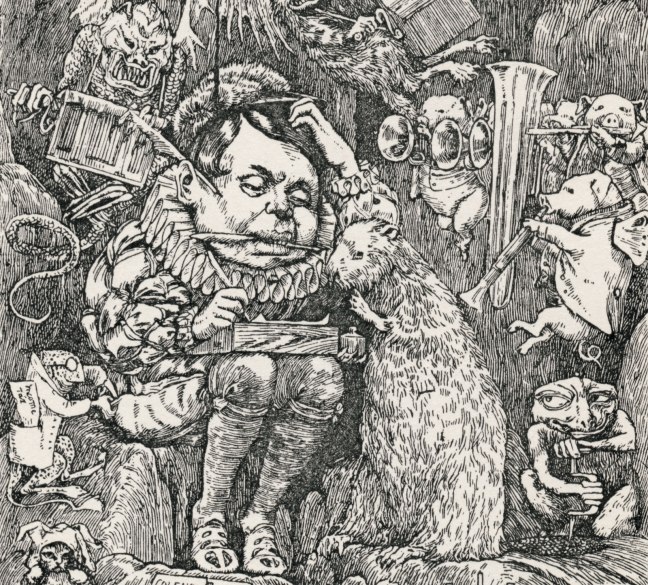
“Algebra Puzzle from Lewis Carroll” copyright © 2024 by Denise Gaskins. Image at the top of the blog “The Beaver’s Lesson” by Henry Holiday, illustration for “The Hunting of the Snark” by Lewis Carroll, public domain.
 Denise Gaskins' Let's Play Math