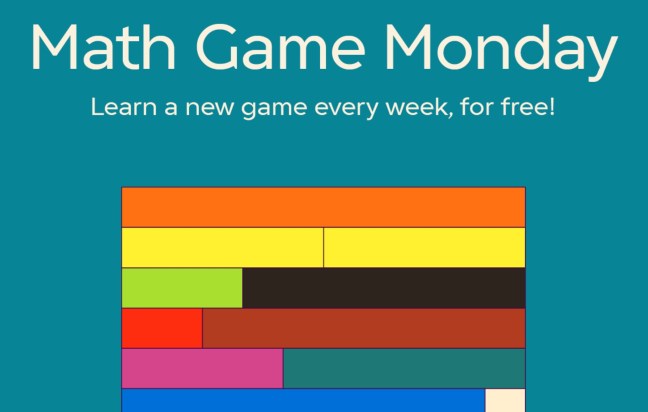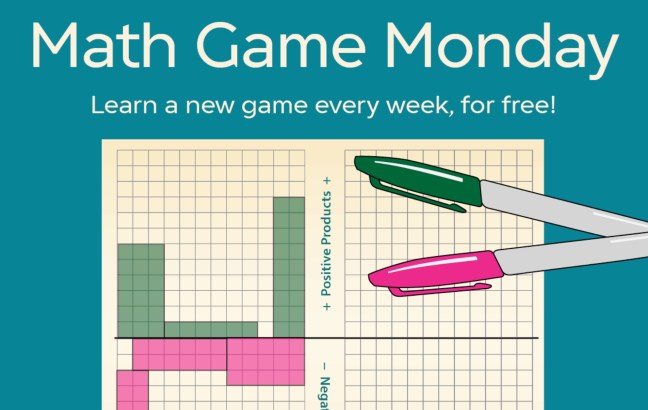
This game uses the area model to visualize and build understanding of integer multiplication.
Many parents remember struggling to learn math. We hope to provide a better experience for our children. And one of the best ways for children to enjoy learning is through hands-on play.
So what are you waiting for? Let’s play some math!
Grid Fight
Math Concepts: integer multiplication, area model for multiplication.
Players: two players or two teams.
Equipment: printed gameboard or square grid paper, playing cards, pencils or colored markers.
“I am inclined to believe that one of the origins of mathematics is man’s playful nature, and for this reason mathematics is not only a Science, but to at least the same extent also an Art.”
—Rózsa Péter
This week, we have the first mathematical adventure of Alexandria Jones, which takes place in the early days of her father’s archaeological expedition mentioned in the introduction post.
Herein we meet the one major character who is not named after a mathematician from history: Alex’s nemesis, Simon Skulk.
While my fiction doesn’t rise close to the level of “art,” I hope it offers a glimpse into the playful nature of mathematics for you and your children.
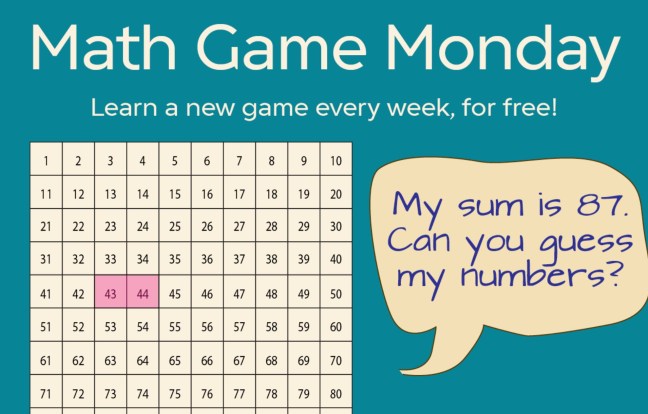
This game requires students to make logical deductions about number relationships.
Many parents remember struggling to learn math. We hope to provide a better experience for our children. And one of the best ways for children to enjoy learning is through hands-on play.
So what are you waiting for? Let’s play some math!
Digit Disguises
Math Concepts: addition, subtraction, multiplication, division, algebraic reasoning.
Players: two players or two teams. Best with teams.
Equipment: printed gameboards (optional), pencils and paper, or whiteboard and markers.
This game takes strategic thinking and planning ahead, and it makes a great journaling prompt, too.
Many parents remember struggling to learn math. We hope to provide a better experience for our children. And one of the best ways for children to enjoy learning is through hands-on play.
So what are you waiting for? Let’s play some math!
Walter Joris’s Sequencium
Math Concepts: strategic thinking.
Players: two players or two teams.
Equipment: blank paper, colored pencils or markers.
Many parents remember struggling to learn math. We hope to provide a better experience for our children. And one of the best ways for children to enjoy learning is through hands-on play.
So what are you waiting for? Let’s play some math!
Symmetry Challenge
Math Concepts: symmetry, geometry.
Players: only two.
Equipment: graph paper or blank hundred chart, colored pencils or markers.
This game builds understanding of decimals, and also of the inverse relationship between multiplication and division.
Many parents remember struggling to learn math. We hope to provide a better experience for our children. And one of the best ways for children to enjoy learning is through hands-on play.
So what are you waiting for? Let’s play some math!
Decimal Product Game
Math Concepts: multiplying decimals, decimal place value.
Players: two players or two teams.
Equipment: printed game board, colored markers or a set of matching tokens for each player, two paperclips or other small tokens to mark the factors.
This game builds calculations skills and helps develop fluency.
Many parents remember struggling to learn math. We hope to provide a better experience for our children. And one of the best ways for children to enjoy learning is through hands-on play.
So what are you waiting for? Let’s play some math!
Bowling
Math Concepts: addition, subtraction, multistep calculation, column addition (for final score).
Players: any number.
Equipment: one deck of playing cards (face cards and jokers removed), game board, ten tokens for covering numbers, pencil or pen, and (optional) scratch paper for adding up the scores.
This game pushes students to consider area and perimeter beyond the basic shapes.
Many parents remember struggling to learn math. We hope to provide a better experience for our children. And one of the best ways for children to enjoy learning is through hands-on play.
So what are you waiting for? Let’s play some math!
Area Battle
Math Concepts: area, square units, perimeter, regular and irregular polygons.
Players: two to four.
Equipment: homemade game cards, pencils or markers.
Nim is a pure strategy game for two players. On each turn, players remove an option until finally no choice remains.
Game options might include:
How many stones to take from a pile.
Which position to claim on a gameboard.
How far to count in a given sequence.
The rules can vary at the players’ whim (as long as both players agree). How many possibilities do you start with, what are the rules for removing options, and how do you win or lose the game? Everything is open to change. And with every tweak, players must reanalyze their strategy.
Welcome to the 184th edition of the Playful Math Education Blog Carnival — a smorgasbord of delectable tidbits of mathy fun. It’s like a free online magazine devoted to learning, teaching, and playing around with math from preschool to high school.
With all the links, a blog carnival can feel overwhelming. Bookmark this article, so you can take your time reading the posts.
“Living math” means bringing our children face-to-face with the big ideas of mathematics to help them develop their reasoning skills. When the ideas of math come to life for our children, their minds delight in seeing how numbers and shapes connect to each other and exploring these relationships.
Scattered between the playful math links below, you’ll find quotations from my new book Charlotte Mason’s Living Math, along with several paintings of children playing and learning which I considered for the book but ran out of room.
“The lesson” by Rafael Frederico, 1895.
By tradition, we start the carnival with a puzzle/activity in honor of our 184th edition. But if you’d rather jump straight to our featured blog posts, click here to see the Table of Contents.