Playing to Learn

quotation from Dan Finkel

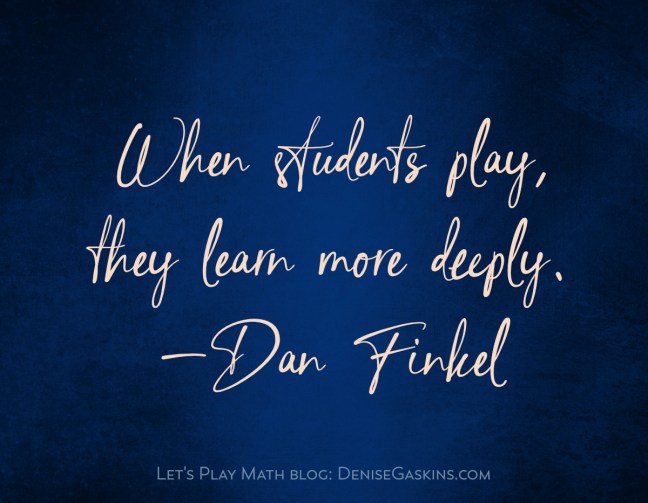
“Play and rigor support each other.

    “When students are invited to play with math, they learn more deeply, more robustly, and remember more consistently.

      “Play is promoted as something that can engage kids and give them a more positive attitude about school, but it’s easy to assume that it’s not useful for learning, when in reality the opposite is true:

        “The student who is playing tends to be the student who is learning most deeply.”
        —Dan Finkel, Math for Love newsletter

        Playful Math for the Summer

        playful dog at the beach

        I continue to dig myself out of the avalanche of tasks that built up during the years that I spent mostly down south with my mom as she was weakening.

        But here are two tidbits of mathy fun that came across my desk recently, which I think you’ll enjoy…

        Numberhive Place Value

        I think I’ve mentioned before how much I love the Numberhive game. They recently posted a series of print-and-play freebies for their new place value variation.

        DiceCulus Core Game — Mini PnP

        This cool-looking game is in prelaunch on the crowdfunding site Gamefound, but the creator has posted a free Mini Print & Play version you can download now, suitable for prealgebra and up. (The full game will have multiple variations, including a preschool level.)

        Math Journaling and Games

        Finally, the Math Journaling Adventures books and kids’ gear are now live in my store, and all my math game books are still on sale through the month of June.

        Have fun playing math with your kids!

         
        * * *

        Are you looking for more creative ways to play math with your kids? Join my free email newsletter.

        This blog is reader-supported. If you’d like to help fund the blog on an on-going basis, then please join me on Patreon for mathy inspiration, tips, and an ever-growing archive of printable activities.

        “Playful Math for the Summer” copyright © 2025 by Denise Gaskins. Image at the top of the post copyright © damedeeso / Depositphotos.

        Podcast: Using Math Journals and Games

        mother and daughter math journaling

        I have a new podcast interview, and I think you’ll enjoy it!

        Check out Cindy Rollins’s The New Mason Jar on your favorite podcast app, or listen on the website:

        Go to the podcast ❱

        Here’s an excerpt…

        Writing to Learn

        Just as a nature journal records our children’s explorations and discoveries in nature, so a math journal tracks our children’s explorations in the world of mathematics.

          In a math journal, children record their experiences with numbers, shapes, and patterns through drawing or writing. Journaling teaches them to see with mathematical eyes — not just to remember what we adults tell them, but to create their own math.

            The process of writing forces children to pin down their thoughts, to transform nebulous concepts into firm ideas, to struggle with vagueness and build understanding.

              As William Zinsser says in his book Writing to Learn: “Writing is how we think our way into a subject and make it our own. Writing enables us to find out what we know, and what we don’t know.”

                Through journaling, children develop a richer mathematical mindset. They begin to see connections and grow confident in their ability to think through new problems.

                We had a great discussion! Listen to the whole thing:

                Go to the podcast ❱

                 
                * * *

                Are you looking for more creative ways to play math with your kids? Check out all my books, printable activities, and cool mathy merch at Denise Gaskins’ Playful Math Store. Or join my free email newsletter.

                This blog is reader-supported. If you’d like to help fund the blog on an on-going basis, then please join me on Patreon for mathy inspiration, tips, and an ever-growing archive of printable activities.

                “Podcast: Using Math Journals and Games” copyright © 2025 by Denise Gaskins. Image at the top of the post copyright © AntonLozovoy / Depositphotos.

                Math Journal: Three Quick Number Games

                photo of family playing a dice game

                Math Journaling Adventures Kickstarter projectHere are three quick math games you can fit in whenever you have a few minutes’ free time. Have fun playing math with your kids!

                And if you enjoy these games, check out my Math Journaling Adventures project to discover how similar playful writing activities can help your students learn mathematics. Preorder your books today!

                Continue reading Math Journal: Three Quick Number Games

                Playful Math 179: Our Sweet Sixteen Carnival

                Welcome to the sweet-16 birthday edition of the Playful Math Carnival. Originally called Math Teachers at Play, our first carnival was published in February 2009.

                Each Playful Math Carnival offers a smorgasbord of delectable tidbits of mathy fun. It’s like a free online magazine devoted to learning, teaching, and playing around with math from preschool to high school.

                There’s so much playful math to enjoy!

                By tradition, we start the carnival with a math activity in honor of our 179th edition. But if you’d rather jump straight to our featured blog posts, click here to see the Table of Contents.

                NOTE: Our wonderful volunteer hosts have kept the Playful Math Carnival going when so many other blog carnivals died off. If you’d like to sign up to host the carnival for a month, email Denise for information.

                Try These Prime Puzzles

                Did you know there are 179 even-numbered days this year?

                • How many even-numbered days will there be in a leap year?
                • But there are 365 days in a standard year and 366 in a leap year. Shouldn’t there be half that many even-numbered days?

                179 is a prime number, and it’s also a knockout prime. You can knock out any of the digits, and what’s left is still prime: 17, 19, or 79.

                • Can you find another knockout prime number?

                179 is a twin prime. That means that one of its odd-numbered neighbors is also prime.

                • Is the other twin 177 or 181? Can you tell without looking it up?
                • Why are twin primes limited to the odd numbers? That doesn’t seem fair!

                179 is also an emirp. That’s a special kind of prime that forms a different prime number when you write it backwards: 971 is also prime.

                • How many emirps can you find?

                “A palindrome is a word that when written in reverse results in the same word. for example, ‘racecar’ reversed is still ‘racecar’. Related to palindromes are semordnilaps. These are words that when written in reverse result in a distinct valid word. For example, ‘stressed’ written in reverse is ‘desserts’. Not all words are palindromes or semordnilaps.

                  “While certainly not all numbers are palindromes, all non-palindromic numbers when written in reverse will form semordnilaps.

                    “Narrowing to primes brings back the same trichotomy as with words: some numbers are emirps, some numbers are palindromic primes, but some are neither.”

                    The On-Line Encyclopedia of Integer Sequences A006567

                    Click here for all the mathy goodness!

                    Puzzle: Henry Dudeney’s Pebble Game

                    photo of girl playing with pebbles on the beach

                    English mathematician and puzzle-meister Henry Ernest Dudeney once wrote:

                    “It may be said generally that a game is a contest of skill for two or more persons, into which we enter either for amusement or to win a prize. A puzzle is something to be done or solved by the individual.

                      “The example that I give here is apparently a game, but, as in every case one player may win if he only play correctly, it is in reality a puzzle. The interest, therefore, lies in attempting to discover the leading method of play.”

                      Below is the puzzle game as Dudeney explained it.

                      Play it for fun at first, then see if you can solve the puzzle.

                      Continue reading Puzzle: Henry Dudeney’s Pebble Game

                      Math Games for the Holidays

                      Snowman Drive math party game

                      Are you looking for fun ways to keep your children busy (and learning!) through the holidays? Here are two printable activity guides you might enjoy:

                      Snowman Drive

                      Snowman Drive math game book(My newest game activity.)

                      Players roll the dice and build their creative snowman (or snowbeast). Will you make a fearless pirate or a dapper aristocrat — or a high-scoring snow spider?

                      A Snowman Drive is a family-friendly party that can also serve as a fundraiser for your church, homeschool group, or organization. The Drive consists of several rounds of the Snowman Game played on a single worksheet, with prizes for the top-scoring players and overall champion.

                      This activity book includes game instructions and gameboard pages for single-family or group play.

                      For ages 5 and up.

                      * * *
                      Download a PDF preview file.
                      * * *
                      FORMAT: 13-page printable PDF file with your choice of 8.5″×11″ (letter size) or A4 pages.

                      Buy Now

                      Christmas Tree Math Games

                      Christmas Tree Math Games book(Number play on a triangular hundred chart.)

                      Christmas Tree Math Games features 4 easy-to-learn games and 6 additional activities for primary and middle-grade students. All you need is a set of dice and a few colorful markers.

                      Math games build mental flexibility and strategic reasoning in players of all ages. And even people who hated math in school can enjoy the friendly challenge of a game.

                      These are NOT the typical memory-and-speed-based math games you’ve probably seen online, but true battles of wit and skill (plus a bit of luck).

                      Perfect ice-breakers for family gatherings, classroom warmups, or for launching a group game night. You’ll be surprised how much fun thinking hard can be!

                      Christmas Tree Math Games includes instructions and tips for the teacher, math game pages for handouts or learning centers, plus a variety of dot-grid journaling paper.

                      For ages 6 and up.

                      * * *
                      Download a PDF preview file.
                      * * *
                      FORMAT: 30-page printable PDF file with your choice of 8.5″×11″ (letter size) or A4 pages.

                      Buy Now

                       
                      * * *

                      Are you looking for more creative ways to play math with your kids? Check out all my books, printable activities, and cool mathy merch at Denise Gaskins’ Playful Math Store. Or join my email newsletter.

                      This blog is reader-supported. If you’d like to help fund the blog on an on-going basis, then please join me on Patreon for mathy inspiration, tips, and an ever-growing archive of printable activities.

                      “Math Games for the Holidays” copyright © 2024 by Denise Gaskins. Image at the top of the post copyright © prarinya / Depositphotos.

                      Gratis Games and Playful Math News

                      Get your free copy today!
                      Do you want to help your children learn math?

                      Teach them to play.

                      Grab a free copy of my Let’s Play Math Sampler: 10 Family-Favorite Games for Learning Math Through Play, which contains short excerpts from my most popular titles. It’s a great way to get started with playful math. 😍

                      As a bonus, I’ll add you to my Playful Math News email subscription and send you monthly tips and activity ideas for playing math with your kids.

                      From time to time, I’ll even throw in a free sample of whatever I’ve been working on — an early draft of something that will eventually show up in one of my books or printable activity guides.

                      For example, check out this fun freebie I sent last April:

                      Don’t miss out on all this mathy goodness. Sign up today!

                      Get the Games Book Now

                      The Rhythm of Math Games

                      Family math game night

                      The art of homeschooling math begins with the rhythm of puzzle play. It continues with games, which are social puzzles.

                      Games are fun, building a positive attitude toward math. They give students a refreshing break from textbook work and make kids willing to practice their math.

                      But more important than the fun, math games push children to think about what numbers mean and how they work. A good math game reinforces the idea that math is about reasoning, using the things you know to figure out what you need.

                      For more about homeschooling with math games, check out my post Gameschooling Math.

                      Continue reading The Rhythm of Math Games