One of my favorite things as a teacher was to gather a group of children to play math together.
Call it a math club or math circle, the name didn’t matter, but the activity was always fun. We did non-schooly games and projects, and the kids enjoyed both the camaraderie and the experience of thinking hard in a stress-free setting.
If you’d like to pull together a math club/circle of your own, here are some tips.
Today’s puzzle involves an unusual teacher trying to collect students to participate in a group activity…
Recently, I stumbled on an old blog post featuring Singapore Math problems, and it brought back memories.
Back when my children were young, the original Primary Math series from Singapore was one of my favorite math curricula. I tweaked our school program constantly, so none of my kids had the same education, but three of them spent a good part of their elementary years in those books.
And I followed the Math in Singapore 2007 blog for its single season of publication. The blog has gone the way of many others, preserved only in the Internet Archive.
In the post I re-discovered, Patsy Wang-Iverson was reporting on a week-long seminar organized by Celine Koh, who offered the following problems (adapted from school exams and study books) for teacher discussion.
In the first section of George Lenchner’s Creative Problem Solving in School Mathematics, Lechner poses this problem. If you have seen it before, be patient — his point was much more than simply counting blocks.
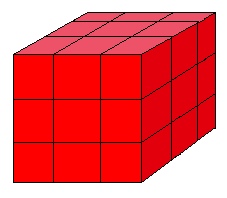
A wooden cube that measures 3 cm along each edge is painted red. The painted cube is then cut into 1-cm cubes as shown below. How many of the 1-cm cubes do not have red paint on any face?
My book business had been on hiatus for nearly 15 years, as I focused on homeschooling five children. I posted on forums and blogged off and on, but the old books fell into (not entirely undeserved) oblivion.
Now my older kids were moving out into their adult lives, and I’d begun to think about publishing again. I dusted off the old manuscripts to see what could be salvaged and began my adventure of indie publishing.
And all the gurus agreed, every author needed an email newsletter.
Share a playful math activity every month? Sure I could do that!
So while I revised and edited the manuscript for Let’s Play Math, to be published in paperback that fall, I launched my first “Playful Math” email, with an idea that’s still fun all these years later: Play math on your calendar.
Now that we’re a few months into the year, many of our New Near’s resolutions have probably fallen by the wayside. It’s inevitable, according to Mark Twain, that we shall “cast our reformation to the winds and go to cutting our ancient shortcomings considerably shorter than ever.”
But there is one resolution that I enjoy keeping—the resolve to play more math.
My favorite way to celebrate at any time of the year is by playing the Year Game. It’s a prime opportunity for players of all ages to fulfill the two most popular resolutions: spending more time with family and friends, and getting more exercise.
So grab a partner, slip into your workout clothes, and pump up those mental muscles!
Welcome to the 184th edition of the Playful Math Education Blog Carnival — a smorgasbord of delectable tidbits of mathy fun. It’s like a free online magazine devoted to learning, teaching, and playing around with math from preschool to high school.
With all the links, a blog carnival can feel overwhelming. Bookmark this article, so you can take your time reading the posts.
“Living math” means bringing our children face-to-face with the big ideas of mathematics to help them develop their reasoning skills. When the ideas of math come to life for our children, their minds delight in seeing how numbers and shapes connect to each other and exploring these relationships.
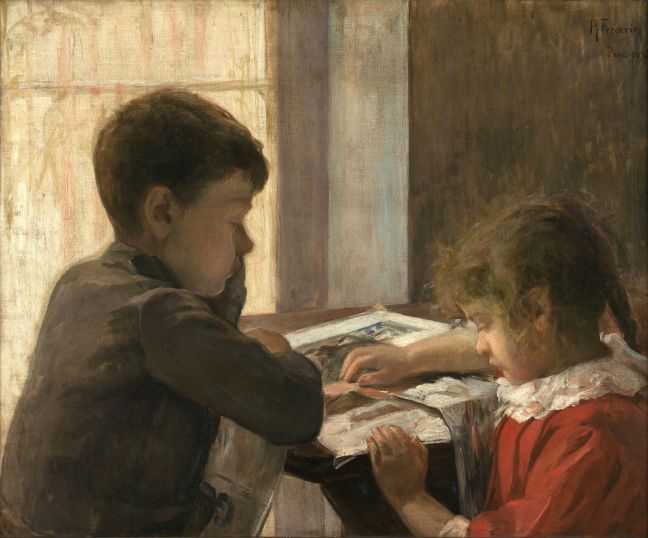
Scattered between the playful math links below, you’ll find quotations from my new book Charlotte Mason’s Living Math, along with several paintings of children playing and learning which I considered for the book but ran out of room.
“The lesson” by Rafael Frederico, 1895.
By tradition, we start the carnival with a puzzle/activity in honor of our 184th edition. But if you’d rather jump straight to our featured blog posts, click here to see the Table of Contents.
Later the same year, not too long after our discussion of the Bill Gates proportions, I stumbled on some more data. I discovered that the median American family’s net worth was $93,100 in 2004, most of that being home equity.
This gave me another chance to play around with proportions. And since I was preparing a workshop for our regional homeschooling conference, I wrote a sample problem:
The median American family has a net worth of about $100 thousand. Bill Gates has a net worth of $56 billion. If Average Jane Homeschooler spends $100 in the vendor hall, what would be the equivalent expense for Gates?
In the last post, I explained that a proportion sets two ratios equal to each other, like equivalent fractions. Each ratio must compare similar thing to similar thing in the same order.
In this case, we are interested in the ratio “Expense compared to Net Worth.”
One of the great unsolved problems of antiquity was to trisect any angle, to cut it into thirds with only the basic tools of Euclidean geometry: an unmarked straight-edge and a compass.
Like the alchemist’s dream of turning lead into gold, this proved to be an impossible task. If you want to trisect an angle, you have to “cheat.” A straight-edge and compass can’t do it. You have to use some sort of crutch, just as an alchemist would have to use a particle accelerator.
One “cheat” that works is to fold your paper.
I will show you how it works, and your job is to show why.




 Denise Gaskins' Let's Play Math