The Pharaoh’s Treasure: Historical Puzzles

Eratosthenes teaching in Alexandria

When two non-mathematicians meet on the street and one says, “I’ve got problems,” the other answers, “I’m so sorry for you.”

    When two mathematicians meet and one says, “I’ve got problems,” the other says, “Oh, goody!”

    —Herta Taussig Freitag

    Whenever you get a group of mathematicians together, at least one of them will suggest a puzzle to play with. This is how mathematics grows, puzzle upon puzzle, generation after generation.

    And since human nature hasn’t changed, we know that the same thing happened in the ancient Ptolemaic Egyptian of Alexandria.

    So let’s explore a few of the math stumpers that enchanted those old Greek scholars…
    Continue reading The Pharaoh’s Treasure: Historical Puzzles

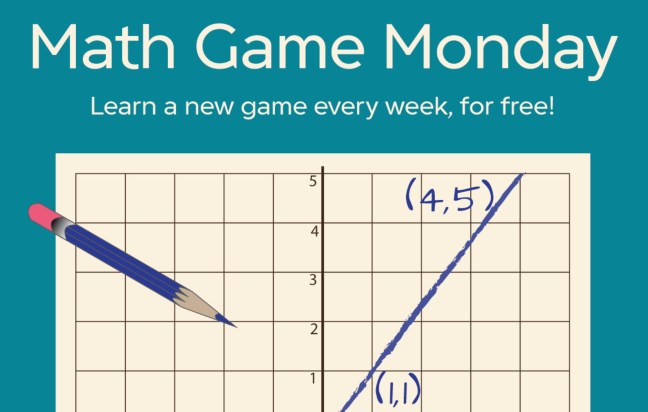
    Math Game Monday: Linear War

    Learn a new game with Math Game Monday

    This game helps players grow comfortable with all the attributes of linear graphs.

    Many parents remember struggling to learn math. We hope to provide a better experience for our children. And one of the best ways for children to enjoy learning is through hands-on play.

    So what are you waiting for? Let’s play some math!

    Linear War

    Math Concepts: coordinate graphing, linear equations, slope, intercepts.
    Players: two to four.
    Equipment: printed or homemade game cards, pencils or markers, ruler or other straightedge.

    Continue reading Math Game Monday: Linear War

    Thinking Thursday: Gian-Carlo Rota

    Thinking Thursday math journal prompt

    Writing to Learn Math: What did the author mean? Put the thought in your own words. Do you agree or disagree? Why?

    Do you want your children to develop the ability to reason creatively and figure out things on their own?

    Help kids practice slowing down and taking the time to fully comprehend a math topic or problem-solving situation with these classic tools of learning: Notice. Wonder. Create.

    Continue reading Thinking Thursday: Gian-Carlo Rota

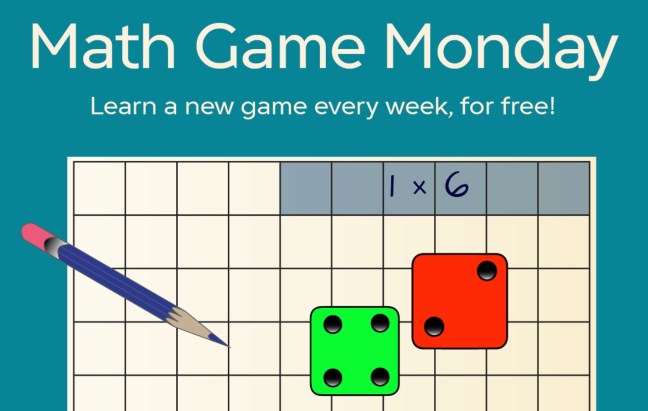
    Math Game Monday: How Close to 100?

    Learn a new game with Math Game Monday

    This game reinforces the most important model for understanding numerical and algebraic multiplication.

    Many parents remember struggling to learn math. We hope to provide a better experience for our children. And one of the best ways for children to enjoy learning is through hands-on play.

    So what are you waiting for? Let’s play some math!

    How Close to 100?

    Math Concepts: area model for multiplication.

    Players: two or three.

    Equipment: blank hundred chart or graph paper, two six-sided dice, pencil or marker.

    Continue reading Math Game Monday: How Close to 100?

    Thinking Thursday: Make a Million

    Thinking Thursday math journal prompt

    Writing to Learn Math: Number play doesn’t have to follow school math methods.

    Do you want your children to develop the ability to reason creatively and figure out things on their own?

    Help kids practice slowing down and taking the time to fully comprehend a math topic or problem-solving situation with these classic tools of learning: Notice. Wonder. Create.

    Continue reading Thinking Thursday: Make a Million

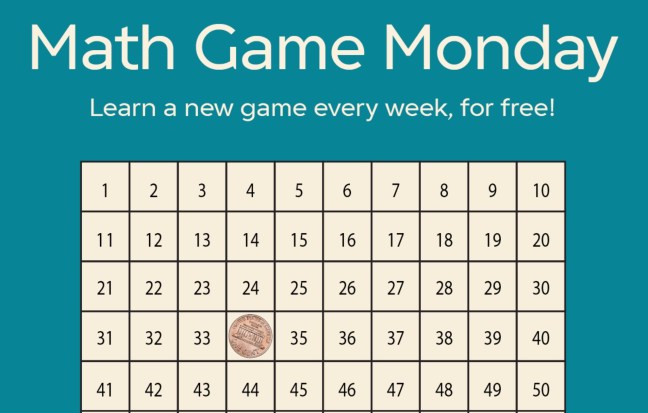
    Math Game Monday: Push the Penny

    Learn a new game with Math Game Monday

    This game offers young children a chance to practice counting and early addition skills while racing to beat their parents.

    Many parents remember struggling to learn math. We hope to provide a better experience for our children. And one of the best ways for children to enjoy learning is through hands-on play.

    So what are you waiting for? Let’s play some math!

    Push the Penny

    Math Concepts: addition to one hundred, thinking ahead.

    Players: two or more.

    Equipment: playing cards (remove face cards and jokers), a hundred chart, and a penny or other small token.

    Continue reading Math Game Monday: Push the Penny

    Thinking Thursday: Linear Crossings

    Thinking Thursday math journal prompt

    Writing to Learn Math: People learn math by playing with ideas. A math journal can be like a science lab book.

    Do you want your children to develop the ability to reason creatively and figure out things on their own?

    Help kids practice slowing down and taking the time to fully comprehend a math topic or problem-solving situation with these classic tools of learning: Notice. Wonder. Create.

    Continue reading Thinking Thursday: Linear Crossings

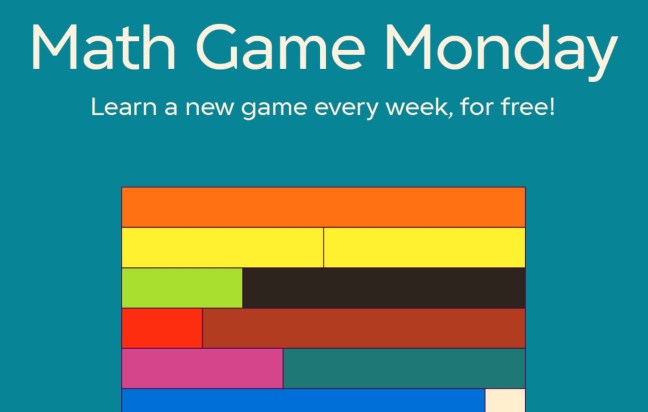
    Math Game Monday: The Partitions Game

    Learn a new game with Math Game Monday

    This game features the Cuisenaire rods, but you may play with any math manipulative based on length: Montessori bead chains, Mortensen or Math-U-See blocks, etc. Or draw pictures on graph paper.

    Many parents remember struggling to learn math. We hope to provide a better experience for our children. And one of the best ways for children to enjoy learning is through hands-on play.

    So what are you waiting for? Let’s play some math!

    The Partitions Game

    Math Concepts: partitions, part/whole, addition, multiplication, algebra.

    Players: two or more.

    Equipment: Cuisenaire rods (or other math manipulatives) or graph paper, pencil and paper (optional).

    Continue reading Math Game Monday: The Partitions Game

    Thinking Thursday: Math Quilt

    Thinking Thursday math journal prompt

    Writing to Learn Math: When students create their own math, they forge a personal connection to mathematical concepts and relationships. And it’s fun!

    Do you want your children to develop the ability to reason creatively and figure out things on their own?

    Help kids practice slowing down and taking the time to fully comprehend a math topic or problem-solving situation with these classic tools of learning: Notice. Wonder. Create.

    Continue reading Thinking Thursday: Math Quilt

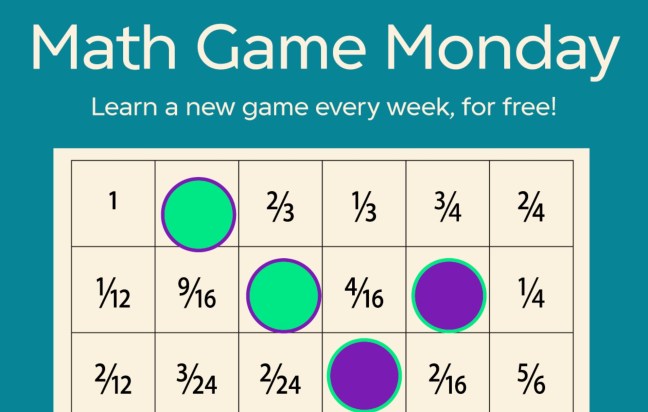
    Math Game Monday: Fraction Product Game

    Learn a new game with Math Game Monday

    This game helps students master multiplying and dividing fractions.

    Many parents remember struggling to learn math. We hope to provide a better experience for our children. And one of the best ways for children to enjoy learning is through hands-on play.

    So what are you waiting for? Let’s play some math!

    Fraction Product Game

    Math Concepts: multiplying fractions, equivalent fractions.
    Players: two, or two teams.
    Equipment: printed game board, colored markers or a set of matching tokens for each player, two glass gemstones or other small tokens to mark the factors.

    Continue reading Math Game Monday: Fraction Product Game