Most of our math contest preparation consists of working lots and lots of old test problems. Occasionally, however, I put together a tip sheet summarizing a topic that my students have trouble remembering.
Blog
Quotations XVIII: The Art of Asking Questions
Priorities, motivation, and a little bit of math from my blackboard…
We make a living by what we get, but we make a life by what we give.
In mathematics, the art of asking questions is more valuable than solving problems.
Continue reading Quotations XVIII: The Art of Asking Questions
Carnival of Homeschooling Centennial Edition
Wow! The Carnival of Homeschooling has reached the 100 mark with this week’s edition at Mom Is Teaching [blog has disappeared]. It doesn’t seem that long ago that Why Homeschool posted the very first CoH. We’ve had an interesting couple of years, full of enlightening, entertaining, and encouraging blog posts. If you’d like to browse, the CoH archive is here.
Continue reading Carnival of Homeschooling Centennial Edition
The Christmas Present Quandary
Alexandria Jones hated using store-bought wrapping paper at Christmas. She tried to wrap each present as a hand-crafted work of art.
Last year, she did mini-scenes with plastic figures building cotton snowmen or skating on aluminum-foil ponds — and, for her brother Leonhard’s gift, her favorite creation: toy dinosaurs having a snowball fight. But those 3-D scenes got knocked about under the Christmas tree.
This year, she decided, she would wrap the packages flat. But then, how could she make them special?
Word Problems in Russia and America
Andrei Toom calls this an “extended version” of a talk he gave a few years ago at the Swedish Mathematical Society. At 159 pages [2010 updated version is 98 pages], I would call it a book. Whatever you call it, it’s a must-read for math teachers:
Main Thesis: Word problems are very valuable in teaching mathematics not only to master mathematics, but also for general development. Especially valuable are word problems solved with minimal scolarship, without algebra, even sometimes without arithmetics, just by plain common sense. The more naive and ingenuous is solution, the more it provides the child’s contact with abstract reality and independence from authority, the more independent and creative thinker the child becomes.
…
Fraction Models, and a Card Game

Models give us a way to form and manipulate a mental image of an abstract concept, such as a fraction. There are three basic ways we can imagine a fraction: as partially-filled area or volume, as linear measurement, or as some part of a given set. Teach all three to give your students a well-rounded understanding.
When teaching young students, we use physical models — actual food or cut-up pieces of construction paper. Older students and adults can firm up the foundation of their understanding by drawing many, many pictures. As we move into abstract, numbers-only work, these pictures remain in our minds, an always-ready tool to help us think our way through fraction problems.
In the News: Teaching Math
Here are a couple of interesting articles about teaching math:
Math Trek (Nov. 10, 2007) — Spinning a good yarn may seem to have little to do with mathematics, but a new study suggests otherwise. Preschoolers who tell stories that include many different perspectives do better in math two years later than those who stick to one simple perspective. The researchers believe that the study may highlight a deep connection between mathematical ability and narrative skills… [Hat tip: Wild About Math!]
Gesturing Helps Grade School Children Solve Math Problems
ScienceDaily (Nov. 5, 2007) — Are math problems bugging your kids? Tell them to talk back — using their hands. Psychologists at the University of Chicago report that gesturing can help kids add new and correct problem-solving strategies to their mathematical repertoires. What’s more, when given later instruction, kids who are told to gesture are more likely to succeed on math problems…
Game: Hundred Chart Nim
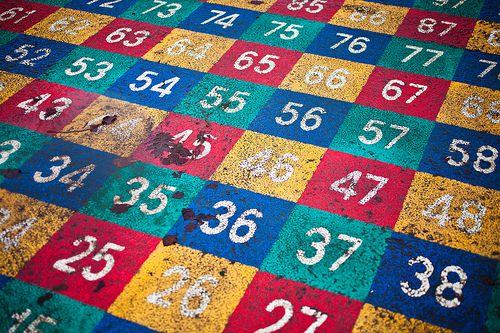
Photo by Håkan Dahlström via flickr.
Math concepts: addition and subtraction within 100, logical strategy
Number of players: 2 or 3
Equipment: printed hundred chart (also called a hundred board) and beans, pennies, or other tokens with which to mark numbers — or use this online hundred chart
Set Up
Place the hundred chart and a small pile of tokens where both players can reach them.
How to Read a Fraction
Fraction notation and operations may be the most abstract math monsters our students meet until they get to algebra. Before we can explain those frustrating fractions, we teachers need to go back to the basics for ourselves. First, let’s get rid of two common misconceptions:
- A fraction is not two numbers.
Every fraction is a single number. A fraction can be added to other numbers (or subtracted, multiplied, etc.), and it has to obey the Distributive Law and all the other standard rules for numbers. It takes two digits (plus a bar) to write a fraction, just as it takes two digits to write the number 18 — but, like 18, the fraction is a single number that names a certain amount of whatever we are counting or measuring.
- A fraction is not something to do.
A fraction is a number, not a recipe for action. The fraction 3/4 does not mean, “Cut your pizza into 4 pieces, and then keep 3 of them.” The fraction 3/4 simply names a certain amount of stuff, more than a half but not as much as a whole thing. When our students are learning fractions, we do cut up models to help them understand, but the fractions themselves are simply numbers.
Dear Good Samaritan
To the person who found my purse in a shopping cart and turned it in: You will probably never see this, but I want to say it anyway. Thank you ever so much! May the Lord bless you for your kindness.

