My son can’t stand long division or fractions. We had a lesson on geometry, and he enjoyed that — especially the 3-D shapes. If we can just get past the basics, then we’ll have time for the things he finds interesting. But one workbook page takes so long, and I’m sick of the drama. Should we keep pushing through?
Those upper-elementary arithmetic topics are important. Foundational concepts. Your son needs to master them.
Eventually.
But the daily slog through page after page of workbook arithmetic can wear anyone down.
Many children find it easier to focus on math when it’s built into a game.
Check out the new playful math blog carnival at Three J’s Learning blog. Joshua put together a great collection of math games, activities, and teaching tips:
The carnival features a “square dancing” puzzle, strategy game discussions, divisibility rules, fake theorems, and mathematical oceans in disguise. And much more!
Each monthly carnival brings you a great new collection of puzzles, math conversations, crafts, teaching tips, and all sorts of mathy fun. It’s like a free online magazine of mathematical adventures. What fun!
Sue VanHattum put together this carnival of evergreen links — helpful and inspiring no matter when you read them.
This carnival offers summer math resources, a four-4s puzzle, set theory for kids, magic math books, fresh insight into the Math War game, counting challenges, and the Fundamental Theorem of calculus. And more!
Do you have a favorite blog post about math activities, games, lessons, or hands-on fun? The Playful Math Blog Carnival would love to feature your article!
We welcome math topics from preschool through the first year of calculus. Old posts are welcome, as long as they haven’t been published in past editions of this carnival.
To submit a blog article for consideration, fill out this form:
Have you noticed a new math blogger on your block that you’d like to introduce to the rest of us? Feel free to submit another blogger’s post in addition to your own. Beginning bloggers are often shy about sharing, but like all of us, they love finding new readers.
“As we go through each lesson, it seems like my daughter has a good handle on the concepts, but when we get to the test she forgets everything. When I ask her about it, she shrugs and says, ‘I don’t know.’ What do you do when your child completely loses what she has learned?”
Forgetting is the human brain’s natural defense mechanism. It keeps us from being overwhelmed by the abundance of sensory data that bombards us each moment of every day.
Our children’s minds will never work like a computer that can store a program and recall it flawlessly months later.
Sometimes, for my children, a gentle reminder is enough to drag the forgotten concept back out of the dust-bunnies of memory.
Other times, I find that they answer “I don’t know” out of habit, because it’s easier than thinking about the question. And because they’d prefer to be doing something else.
Check out the new playful math blog carnival at Math Hombre blog. John put together a great collection of 30+ math games, activities, and teaching tips:
Each monthly carnival brings you a great new collection of puzzles, math conversations, crafts, teaching tips, and all sorts of mathy fun. It’s like a free online magazine of mathematical adventures. What fun!
Simon Gregg put this carnival together a few weeks ago, and I should have posted a link before now, but it’s been a hard few months here, and too many things got shoved aside. Still the posts are evergreen — helpful and inspiring no matter when you read them.
This carnival offers summer camp activities, dancing geometric patterns, new books to enjoy, pattern blocks, the math of peg solitaire, Q-bitz fraction talks, and a taste of some great math conversations on Twitter. And plenty more!
Do you have a favorite blog post about math activities, games, lessons, or hands-on fun? The Playful Math Blog Carnival would love to feature your article!
We welcome math topics from preschool through the first year of calculus. Old posts are welcome, as long as they haven’t been published in past editions of this carnival.
To submit a blog article for consideration, fill out this form:
Don’t procrastinate: The deadline for entries is this Friday, May 25. The carnival will be posted next week at Math Hombre blog.
Have you noticed a new math blogger on your block that you’d like to introduce to the rest of us? Feel free to submit another blogger’s post in addition to your own. Beginning bloggers are often shy about sharing, but like all of us, they love finding new readers.
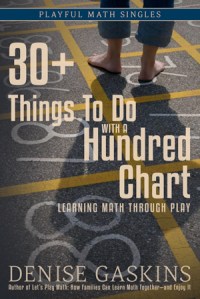
My hundred chart list began many years ago as seven ideas for playing with numbers. Over the years, it grew to its current 30+ activities.
Now, in preparing the new book, my list has become a monster. I’ve collected almost 70 ways to play with numbers, shapes, and logic from preschool to middle school. Just yesterday I added activities for fraction and decimal multiplication, and also tips for naming complex fractions. Wow!
Gonna have to edit that cover file…
In the “Advanced Patterns” chapter, I have a section on math debates. The point of a math debate isn’t that one answer is “right” while the other is “wrong.” You can choose either side of the question — the important thing is how well you support your argument.
Here’s activity #69 in the current book draft.
Have a Math Debate: Adding Fractions
When you add fractions, you face a problem that most people never consider. Namely, you have to decide exactly what you are talking about.
For instance, what is one-tenth plus one-tenth?
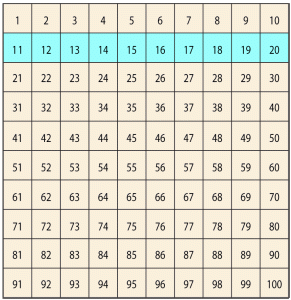
1/10 of 100
Well, you might say that:
of one hundred chart
+ of the same chart
= of that hundred chart
But, you might also say that:
of one chart
+ of another chart
= of the pair of charts
That is, you started off counting on two independent charts. But when you put them together, you ended up with a double chart. Two hundred squares in all. Which made each row in the final set worth of the whole pair of charts.
So what happens if you see this question on a math test:
+ = ?
If you write the answer “”, you know the teacher will mark it wrong.
“In 2018, I want to change the world.
…
I want to make it possible for more children to claim math as their favorite subject.
…
Math is how we describe our world when words are not enough. Everyone deserves to speak math and to play math, to enjoy its beauty and its power.”
If you have some time to spend pondering big ideas, dig into Devlin’s entire series of posts about what real-world mathematics looks like and the implications for math education:
“Make no mistake about it, acquiring that modern-day mathematical skillset definitely requires spending time carrying out the various procedures. Your child or children will still spend time ‘doing math’ in the way you remember.
“But whereas the focus used to be on mastering the skills with the goal of carrying out the procedures accurately — something that, thanks to the learning capacity of the human brain, could be achieved without deep, conceptual understanding — the focus today is on that conceptual understanding.
“That is a very different goal, and quite frankly a much more difficult one to reach.”









 of one hundred chart
 of that hundred chart
 of the pair of charts
 of the whole pair of charts.
 Denise Gaskins' Let's Play Math