If you or your children enjoy clean fantasy tales, check out the new installment in my daughter’s serial quest adventure The Riddled Stone, now available at many online bookstores.
Each week, we’ll be playing with the math, language, and logic topics found in a single chapter. I’ll be posting ideas for extension activities, videos demonstrating the concepts for the week, and additional resources. I’m really excited for the opportunity to share all the extra ideas that have been floating around my brain which I didn’t have room to include in the book (as in Marco Polo’s famous words: “I did not tell half of what I saw.”)
— Lilac Mohr
Here’s a Quick Taste of Week One
This Week’s Activities
Lilac’s blog post includes a full schedule for the eleven-week book club, featuring plenty of classic math puzzlers to play with. Here are the topics for this week.
Read Chapter 1: Mrs. Magpie’s Manual
Alliteration
Memorizing digits of Pi
Palindromes
Calculating your age on other planets
It looks like a lot of fun. I highly recommend the book (read my review), and I’m sure you and your children will enjoy discovering math and magic with Lulu and Elizabeth.
If you’d like to help fund the blog on an on-going basis, then please join me on Patreon for mathy inspiration, tips, and an ever-growing archive of printable activities.
If you liked this post, and want to show your one-time appreciation, the place to do that is PayPal: paypal.me/DeniseGaskinsMath. If you go that route, please include your email address in the notes section, so I can say thank you.
I’m planning ahead for my fall semester homeschool co-op math class. Definitely going to try this with the kids…
Encourage your children to have some fun this week with this Exploding Dots math puzzle from The Global Math Project. What do they notice? Does it make them wonder?
More Explosive Math
You may recognize the connection between Exploding Dots and binary numbers. Or not — the puzzle is accessible to people at almost any age and level of mathematical sophistication.
But what I find amazing is that this puzzle can help us understand all sorts of topics in elementary arithmetic and algebra. So cool!
“I can’t find a home school math program my son likes. We’ve tried Singapore Math, Right Start, Saxon, and Math Mammoth. We subscribed to a month of IXL Math to keep him in practice, but he hates that, too. I know I shouldn’t have changed so many times, but this was our first year of homeschooling, and I was trying to please him. But I’m running out of things to try. Do you think Life of Fred might work?”
You’ve tried all those math programs in one year? Many people recommend that new homeschoolers take a few months off to “detox” from the classroom setting, to relax and enjoy the freedom of making their own choices. But your son might want a few months to detox from his homeschool experience.
I suggest you set aside all those books and focus on games and informal math. Try to avoid schoolish lessons until your son starts to enjoy learning for its own sake.
Check out the new carnival of playful math for all ages at Three J’s Learning blog. You’re sure to enjoy this great collection of puzzles, math conversations, crafts, teaching tips, and all sorts of mathy fun.
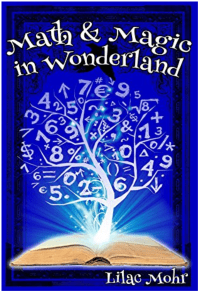
Are you looking for a fun book to read over the summer? I just finished Lilac Mohr’s delightful Math & Magic in Wonderland, and I loved it.
Highly recommended, for kids or adults!
About the Book
A Jubjub bird disguised as a lark,
Borogroves concealing a snark,
When you’re in Tulgey Wood, you must
Be careful whom it is you trust…
With the discovery of Mrs. Magpie’s Manual of Magic for Mathematical Minds, Lulu and Elizabeth embark on an exciting journey to a realm inspired by Lewis Carroll’s poetry. The twins must use ingenuity and sagacity to solve classic logic puzzles that promise to uncover the book’s secrets and earn them The Vorpal Blade. In this interactive novel, the reader is invited to play along with the two heroines on their grand mathematical adventure.
Do you have the smarts to help Lulu and Elizabeth outwit the frumious Bandersnatch?
It’s time to enter Wonderland and find out!
–from the back cover of Math & Magic in Wonderland by Lilac Mohr
What I Liked
Puns, poetry, and plenty of puzzles. Tangrams, tessellations, truth-tellers and liars. History tidbits and many classics of recreational mathematics.
The sisters Lulu and Elizabeth seem real — though perhaps more widely read than most of us. They are different from each other. They make mistakes and have disagreements. But they never deteriorate into the cliché of sibling rivalry that passes for characterization in too many children’s books.
In each chapter, the girls must solve a language, math, or logic puzzle to proceed along their journey. Then a “Play Along” section offers related puzzles for the reader to try.
No matter how challenging the topic, the book never talks down to the reader.
What I Didn’t Like
… Um … Honestly, I can’t think of anything.
Since it’s traditional to criticize the editing of self-published books, I will say this: There was at least one place where the wording seemed a bit awkward. I would have phrased the sentence differently. But don’t ask me to identify the page — I was too caught up in the story to bother jotting down such a quibble. And I tried flipping through the book as I wrote this post, but I can’t find it again.
Buy, or Don’t Buy?
Buy. Definitely buy.
Unless you hate logic puzzles and despise Lewis Carroll’s poetry.
But for everyone else, this book is truly a gem. If you like The Cat in Numberland or The Man Who Counted, then I’m sure you’ll enjoy Math & Magic in Wonderland.
Disclaimer: Like almost all book links on my blog, the links in this post take you to Amazon.com, where you can read descriptions and reviews. I make a few cent’s worth of affiliate commission if you make a purchase — but nowhere near enough to influence my opinion about the book.
And Now for the Giveaway
Lilac offered a paperback copy of Math & Magic in Wonderland for one lucky reader of Let’s Play Math blog.
The giveaway is done. Congratulations, Keshua!
But the comments section below remains open, and I’d still love to hear your answers:
Tell us about your favorite language, math, or logic puzzle book! Or share a book you’ve been wanting to read.
Check out the new playful math education carnival at eat play math blog. Math art, tessellations, review games, problem-solving challenges, and all sorts of mathy fun. Not to mention, Raspberry Tiramisu!
Welcome to the Math Teachers at Play #99 Blog Carnival, a monthly smorgasbord of links to bloggers all around the internet who have great ideas for learning, teaching, and playing around with math… Click here to go read the carnival blog!
June 17 marks World Tessellation Day, a holiday I created to bring awareness to the fun of finding and making tessellations.
Will you celebrate with us?
Here are 10 great ways to play with tessellations, learn about them, and introduce your children to a math concept that opens a variety of creative learning opportunities.
1) Learn about tessellations with your kids.
A tessellation is a tiled mosaic pattern of the same shape laid out over and over again, repeating into infinity. Tessellations can be found in nature, or they can be created by people. Learn more at these websites:
“My oldest son has somehow developed the horrid habit of counting on his fingers. We worked on the math facts all summer. He knows the answers in simple form, such as 9 + 4, but if it’s in a bigger problem like 249 + 54, he counts up to add or counts down to subtract, all using fingers. My younger children have no problem with mental math, but he can’t seem to get it. Are there any tips or tricks to stop this?”
Counting on fingers is not a horrid habit, it is a crutch. Please think for a moment about the purpose of crutches. The blasted things are an uncomfortable nuisance, but there are times when you can’t get anywhere without them. And if you need them, it does you no good for a friend to insist you should crawl along on your own.
That is how your son feels right now about his fingers. He is struggling with something his younger siblings find easy, and he can tell that you are frustrated. His confidence is broken, in a cast, and needs time for healing. So he falls back on what he knows he can do, counting up the answer.
Think positive: this means he still believes that math ought to make sense — that to understand what he is doing is more important than to guess at an answer. You want him to value sense-making, because otherwise he will try to memorize his way through middle school and high school math. That is the road to disaster.
… makes sense
… is more than just arithmetic
… is joyous
… makes them strong
… is meaningful
… is creative
… is full of fascinating questions
… opens up many paths to solutions
… is friendly
… solves big problems and makes the world better
… is a powerful tool they can master
… is beautiful
… lets them learn in their own ways
… is connected to their lives
… asks “why” and not just “how”
… opens the world
From the upcoming new book Avoid Hard Work by James Tanton and the Natural Math team.













 Denise Gaskins' Let's Play Math