You may have seen this video making the edu-blog rounds:
Blog
MTaP #35: Two New Posts
For those of you who read the RSS feed (and thus don’t get to see my changes to old stuff), two of the bloggers featured in MTaP #35 have published follow-up posts:
With those two posts added in, I believe Math Teachers at Play #35 now features exactly 35 posts about fun ways to teach math (not counting the links to the other math blog carnivals). Cool!
Math Teachers at Play #35

Welcome to the Math Teachers At Play blog carnival — which is not just for math teachers.
Do you enjoy math? I hope so! If not, browsing these links just may change your mind. Most of these posts were submitted by the bloggers themselves; others are drawn from my overflowing Google Reader. From preschool to high school, there are plenty of interesting things to learn.
Let the mathematical fun begin…
Be My (Math) Valentine
Just as I was looking for a creative Valentine’s craft for Kitten, this showed up in my inbox:
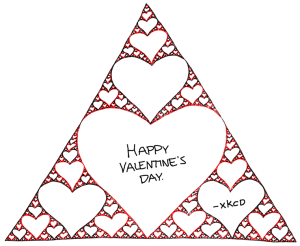
Xi at 360 provides step-by-step instructions, with photos:
And for more Valentine’s Day fun:
Our Power Outage Adventure
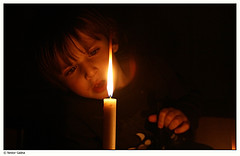 [Photo by Nestor Galina.]
Our power finally came back on this afternoon after a couple of cold, dark nights.
Staying Warm
We heated the house with candles and stove-top burners (propane). We found that if you get enough candles lit in a room, it really can make a difference, and the stove was able to keep the kitchen in the upper-50’s, even above 60 degrees at times, which was pretty comfortable. We dressed in lots of layers and wore gloves, drank a plenty of coffee and hot chocolate, listened to oldies on the battery-powered radio, and went to bed early each night. (Hooray for sleeping bags!)
Quotable: What to Do When You’re Stuck
When a kid is feeling bad about being stuck with a problem, or just very anxious, I sometimes ask him to make as many mistakes as he can, and as outrageous as he can. Laughter happens (which is valuable by itself, and not only for the mood — deep breathing brings oxygen to the brain). Then the kid starts making mistakes. In the process, features of the problem become much clearer, and in many cases a way to a solution presents itself.
— Maria Droujkova
Natural Math discussion of math club activities
Does It Work?
While I was collecting entries for the Math Teachers at Play #35 blog carnival, I ran across this post by Dave Lanovaz:
Math Teachers at Play #34 via Mathematics and Multimedia
Welcome to the 34th edition of the Math Teachers at Play Carnival. Since it is new year, we will be talking about cakes, best of 2010, and calendars…
Babymath: Story Problem Challenge III

<a href="http://www.flickr.com/photos/goetter/2352128932/"Photo by Raphael Goetter via Flickr
Alex and Leon enjoyed their baby sister, but they were amazed at how much work taking care of a baby could be. One particularly colicky night, everyone in the family took turns holding the baby, rocking the baby, patting her back, and walking her around before she finally succumbed to sleep.
Then Alex collapsed on the couch, and Leon sank into the recliner. They teased each other with these story problems.
Top 10 Posts of 2010

2011 will be a fantastic year — or at least, a prime one! (See these posts by Gary, Pat, and James.) But as we move into the new year, it’s also a good time to look back and to look ahead: What did we accomplished last year? And what comes next?
More specifically, for bloggers:
- What did people like to read?
- How can I give them more of it?
So here is my retrospective look at the most popular blog posts of 2010, along with related blogging goals (or dreams?) for 2011.
Days of Christmas with Vi Hart
If you haven’t subscribed to Vi Hart’s blog yet, what are you waiting for?

