Thinking Thursday: Payday Puzzle

Thinking Thursday math journal prompt

Writing to Learn Math: Math journal explanations avoid the formality that turns so many students away from geometry proofs.

Do you want your children to develop the ability to reason creatively and figure out things on their own?

Help kids practice slowing down and taking the time to fully comprehend a math topic or problem-solving situation with these classic tools of learning: Notice. Wonder. Create.

Continue reading Thinking Thursday: Payday Puzzle

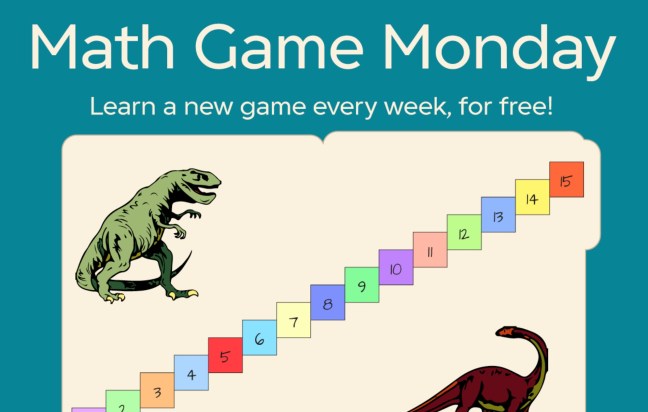
Math Game Monday: Domino Fraction War

Learn a new math game every week, for free

This game offers upper-elementary and middle school students plenty of practice doing estimation and mental math with fractions.

Many parents remember struggling to learn math. We hope to provide a better experience for our children.

And one of the best ways for children to enjoy learning is through hands-on play.

Domino Fraction War

Math Concepts: proper fractions, comparing fractions.

Players: two or more.

Equipment: one set of double-six or double-nine dominoes.

Continue reading Math Game Monday: Domino Fraction War

Thinking Thursday: Half Plus Three

Thinking Thursday math journal prompt

Writing to Learn Math: When students create their own math, they forge a personal connection to mathematical concepts and relationships. And it’s fun!

Do you want your children to develop the ability to reason creatively and figure out things on their own?

Help kids practice slowing down and taking the time to fully comprehend a math topic or problem-solving situation with these classic tools of learning: Notice. Wonder. Create.

Continue reading Thinking Thursday: Half Plus Three

Math Game Monday: Nine Cards

Learn a new math game every week, for free

This game helps young children build mental math skills. And it’s fun for older kids or adults to play along!

Many parents remember struggling to learn math. We hope to provide a better experience for our children.

And one of the best ways for children to enjoy learning is through hands-on play.

Nine Cards

Math Concepts: addition, number bonds for ten.

Players: two or more.

Equipment: one deck of playing cards, face cards and jokers removed.

Continue reading Math Game Monday: Nine Cards

Thinking Thursday: John Allen Paulos

Thinking Thursday math journal prompt

Writing to Learn Math: What did the author mean? Put the thought in your own words. Do you agree or disagree? Why?

Do you want your children to develop the ability to reason creatively and figure out things on their own?

Help kids practice slowing down and taking the time to fully comprehend a math topic or problem-solving situation with these classic tools of learning: Notice. Wonder. Create.

Continue reading Thinking Thursday: John Allen Paulos

Math Game Monday: Hidden Hexagon

Learn a new math game every week, for free

This game offers a fun twist on the old classic Battleship. Can you discover your opponent’s secret shape before they find yours?

Many parents remember struggling to learn math. We hope to provide a better experience for our children.

And one of the best ways for children to enjoy learning is through hands-on play.

Hidden Hexagon

Math Concepts: coordinate graphing (first quadrant), simple linear equations, irregular polygons.

Players: two players or two teams.

Equipment: printed gameboard or square grid paper for each player, pencils, ruler or other straightedge.

Continue reading Math Game Monday: Hidden Hexagon

Thinking Thursday: Fibonacci Growth

Thinking Thursday math journal prompt

Writing to Learn Math: Number play doesn’t have to follow school math methods.

Do you want your children to develop the ability to reason creatively and figure out things on their own?

Help kids practice slowing down and taking the time to fully comprehend a math topic or problem-solving situation with these classic tools of learning: Notice. Wonder. Create.

Continue reading Thinking Thursday: Fibonacci Growth

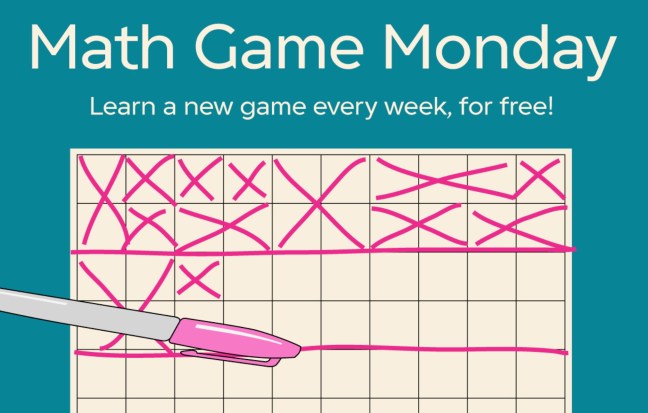
Math Game Monday: Dollar Derby

Learn a new math game every week, for free

This simple counting game helps children grow comfortable with 2-digit numbers and learn the value of coins.

Many parents remember struggling to learn math. We hope to provide a better experience for our children.

And one of the best ways for children to enjoy learning is through hands-on play.

Dollar Derby

Math Concepts: counting, addition, coin value.

Players: two or more.

Equipment: printed hundred charts, six-sided dice, and a large pile of assorted coins.

Continue reading Math Game Monday: Dollar Derby

Thinking Thursday: Dear Younger Me

Thinking Thursday math journal prompt

Writing to Learn Math: Writing helps students stretch their thinking and make sense of new ideas.

Do you want your children to develop the ability to reason creatively and figure out things on their own?

Help kids practice slowing down and taking the time to fully comprehend a math topic or problem-solving situation with these classic tools of learning: Notice. Wonder. Create.

Continue reading Thinking Thursday: Dear Younger Me

FAQ: Playful Math Journaling

Girl student thinking about her math journal prompt

Ever since the school year started, I’ve been getting questions about how to use my new Math Journaling Adventures logbooks.

[SIDE NOTE: These logbooks are included in this month’s Thanksgiving Sale! You’ll get an automatic 10% discount off all print books, applied at checkout, no special code required.]

“I love the way your math books get my children thinking.

    “Finally, they are having fun with math!

      “But sometimes I have no idea what the journaling prompt is all about or how to teach it. Where can I buy a solutions manual?”

      Um, that’s not how math journals work.

      The cool thing about journaling prompts is that they have no “right” answer. They are explorations into different parts of the world of math, nature walks in the land of numbers, shapes, and patterns. Springboards into whatever our children want to investigate, whatever sparks their interest.

      A few of the problem-solving prompts may have specific answers, but it really doesn’t matter if our kids find the exact solution a math professional might give. If they write what makes sense to them, they’ve accomplished the goal.

      If later, they think of something they hadn’t noticed, or they want to change their answer — well, that is mathematical thinking, too.

      Continue reading FAQ: Playful Math Journaling