Playing with a Hundred Chart #36: Cover 100 Squares

Patrick Vennebush shared this puzzle from his new book, One-Hundred Problems Involving the Number 100:

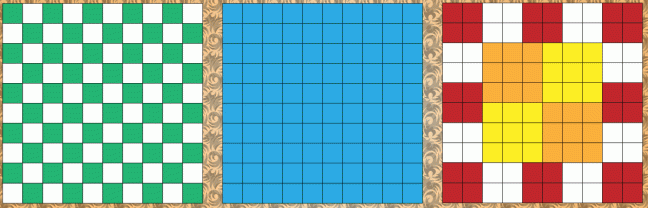
It’s easy to cover a hundred chart with 100 small squares: 10 rows of 10 squares = 100.

It’s easy to cover a hundred chart with one big square: one 10×10 square = 100.

But can you cover the chart with 20 squares? Or with 57 squares? The squares do NOT have to be all the same size.

If we only consider squares with whole-number sides, so they exactly fit on the grid, then:

  • What numbers of squares work to cover the chart?
  • What numbers don’t work — and can you prove it?

Click to read the original puzzle along with some teaching tips at Patrick’s blog:

Covering 100 Squares

If you’d like some printable hundred charts for coloring in squares, download my free Hundred Charts Galore! file.

And discover more ways to play with these printables in my classic blog post: 30+ Things to Do with a Hundred Chart.

The Gerrymander Math Project

With a big election on the horizon, now is a great time to talk about the math of politics.

Does “One person, one vote” make a fair democracy?

Or does it give the majority license to trample a minority?

How can planners arrange voting districts to give everyone the best representation? And is that really what politicians would do, if they had the choice?

Try the Gerrymander Project with your students to investigate these questions and spark real-world mathematical discussion.

First, Create a Map
[Or buy a copy of my printable activity guide, The Gerrymander Project: Math in the World of Politics, which includes a prepared city map with more detailed instructions, answers, and journaling prompts. My publisher has extended the 10% discount code TBLTOP10 through to Election Day, 3 November 2020.]

  • Print a blank hundred chart or outline a 10×10 square on grid paper. This represents your city. Give it a name.
  • Pull out your colored pencils. Choose one color for your city’s Majority Party and another for the Minority Party.
  • Color 10 squares in a neutral color for non-voting areas. These might be malls or parks or the downtown business district — your choice.
  • Color the remaining 90 blocks in a random distribution so that 60% are the Majority color and 40% the Minority. How will you choose which squares to make which colors? Can you think of a way to use dice or playing cards to make your choices random, yet still get the right proportion?

Slip your finished map into a clear page protector, so you can mark on it with dry-erase markers. Or make several copies, so you can write on them without destroying the original.

Then Gerrymander Your City

“Gerrymandering” is the American political tradition of adjusting the voting district boundaries to favor one’s own party at the expense of one’s opponents.

The city has hired you to mark out 10 new voting districts of 9 squares each (not counting the neutral squares, which can go in any district). The squares in each district must touch side-to-side, not just meet at a corner.

So now you get to play “political hack.”

First, see how fair you can make the map:

  • What happens if you ignore the party colors and make your districts as compact as possible, so the people living nearest to each other vote together? Will the Majority Party always win?
  • Can you give all your voters a proportional representation? Both parties should win the number of districts that most closely matches their percentage of the voting population.

Next, try your hand at gerrymandering, but make sure all the squares in each district stay connected. Can you create ten voting districts that will guarantee:

  • A come-from-behind triumph for the Minority Party? They need to carry at least six districts to wrest control of the City Council from their opponents.
  • The greatest possible margin of victory for the Majority Party? Can you keep the Minority from winning any districts at all?

Share Your Thoughts

I’d love to hear your students’ reaction to this project. Please share in the comments section below.

For myself, the more I play with this project, the more I admire the work done by the framers of the U.S. Constitution. Our Electoral College divides the country into “districts” based on state boundaries, giving each a vote roughly proportional to its population — but in a way that slightly strengthens the Minority Party. The system may not be perfect, but it’s done an amazing job through the centuries of maintaining a balance of power, making sure that neither major political party can destroy the other.

Which is NOT to say that our country always protects the rights of true minorities. Clearly, that’s an ongoing struggle.

But overall, the political parties stay relatively balanced, making for a stable government. After more than two centuries, we still have, as Ben Franklin said, “a republic, if you can keep it.”

 
* * *

This blog is reader-supported.

If you’d like to help fund the blog on an on-going basis, then please head to my Patreon page.

If you liked this post, and want to show your one-time appreciation, the place to do that is PayPal: paypal.me/DeniseGaskinsMath. If you go that route, please include your email address in the notes section, so I can say thank you.

Which I am going to say right now. Thank you!

“The Gerrymander Math Project” copyright © 2020 by Denise Gaskins.
More Math War with Special Decks

Just updated my blog post Math Game: War with Special Decks to add a couple of games I missed the first time around:

And…

If you’d like more ways to play with math from preschool to high school, check out My Favorite Math Games.

 
* * *

This blog is reader-supported.

If you’d like to help fund the blog on an on-going basis, then please join me on Patreon for mathy inspiration, tips, and an ever-growing archive of printable activities.

If you liked this post, and want to show your one-time appreciation, the place to do that is PayPal: paypal.me/DeniseGaskinsMath. If you go that route, please include your email address in the notes section, so I can say thank you.

Which I am going to say right now. Thank you!

“More Math War with Special Decks” copyright © 2020 by Denise Gaskins. “Red playing cards” photo by José Pablo Iglesias via Unsplash.com.
Parallel and Perpendicular Art

I love this easy-but-beautiful math art project!

1. Print a page of dotty or lined graph paper for each student. You’ll also need a ruler and a large assortment of markers or colored pencils.

2. Students draw a line across the page, lining up their ruler with the grid points. The first line can be vertical, horizontal, or diagonal.

3. Keep drawing lines, but NEVER cross a line you’ve already drawn. Following the grid will create many lines parallel or perpendicular to each other. What angles can you identify?

4. Color as desired. For a stained-glass effect, outline the colored areas with a black Sharpie marker.

Look for more math art ideas in my new book Geometric Coloring Designs 2: Create Your Own Art.

CREDITS: I saw this project at Cindy’s Love2Learn2Day blog. She got the idea from Zachary‘s MathActivities site.

Playing Math with Michael and Nash

Michael and Nash have been creating and posting new math games with astonishing regularity throughout the pandemic. Their YouTube channel is a great resource for parents who want to play math with elementary-age children.

Today’s entry: Closest to Ten, a quick game for addition and subtraction fluency with a tiny bit of multiplication potential.

And here’s one of my favorites for older players: Factor Triangles, a card game for 2-digit multiplication.

Check out their channel, and have fun playing math with your kids!

Visit Michael and Nash on YouTube

Prime Factor Art on a Hundred Chart

The best way to practice math is to play with it — to use the patterns and connections between math concepts in your pursuit of something fun or beautiful.

So this art project is a great way to practice multiplication. Use the prime factors of numbers from one to one hundred to create a colorful design.

Start with a Hundred Chart

First, download this printable file of hundred charts in non-photo blue (or light gray, if you’re printing in grayscale). The file includes:

  • Line-by-line traditional chart, counting from top to bottom.
  • Line-by-line bottom’s-up chart, counting from bottom to top.
  • Ulam’s Spiral chart, spiraling out from the center.
  • Blank grids for making your own patterns.

Download the Printable Charts

Continue reading Prime Factor Art on a Hundred Chart

Kenken is Mathematical Play

It’s back-to-school time here in the States. And that means it’s time for the Kenken Classroom Newsletter. Yay for math puzzles!

KenKen arithmetic puzzles build mental math skills, logical reasoning, persistence, and mathematical confidence.

Free via email every Friday during the school year.

What a great way to prepare your children for success in math!

Sign up anytime:

Click Here for KenKen Classroom Newsletter

Continue reading Kenken is Mathematical Play

More Math You Can Play — for Free

favorite-math-gamesThe Kickstarter is done, and today I’m kicking back and resting a bit. (And running into town for some errands, because life never stops.)

But even as I’m taking it easy around here, I know many of you are looking for ways to help your children learn to play with math.

So click the button below to go see all the games I’ve posted on my blog over the years. All free for your family’s use, and most of them don’t require anything more than a deck of cards or some paper and pencil.

My Favorite Math Games

So many great ways to play math with your kids. Have fun!

The Best Math Game Ever

The Substitution Game features low-floor, high-ceiling cooperative play that works with any age (or with a mixed-age group) — and you can use it while distance learning, too. It’s great for building algebraic thinking.

Excerpted from my new book, Prealgebra & Geometry: Math Games for Middle School. Look for it at your favorite online bookstore.

The Substitution Game

Math Concepts: addition, subtraction, multiplication, division, order of operations, integers, fractions, equivalence and substitution.

Players: any number (a cooperative game).

Equipment: whiteboard and markers (preferred) or pencil and paper to share. Calculator optional.

Continue reading The Best Math Game Ever

Math Conversation Starter

(Click for larger image.)

What do you see?

Does it make you wonder?

How is perspective art similar to the isometric drawing in yesterday’s post? How is it different?

You may also enjoy:

CREDITS: William Hogarth – “The importance of knowing perspective” (Absurd perspectives), Engraving on paper. From Wikimedia Commons.