I’m planning ahead for my fall semester homeschool co-op math class. Definitely going to try this with the kids…
Encourage your children to have some fun this week with this Exploding Dots math puzzle from The Global Math Project. What do they notice? Does it make them wonder?
More Explosive Math
You may recognize the connection between Exploding Dots and binary numbers. Or not — the puzzle is accessible to people at almost any age and level of mathematical sophistication.
But what I find amazing is that this puzzle can help us understand all sorts of topics in elementary arithmetic and algebra. So cool!
June 17 marks World Tessellation Day, a holiday I created to bring awareness to the fun of finding and making tessellations.
Will you celebrate with us?
Here are 10 great ways to play with tessellations, learn about them, and introduce your children to a math concept that opens a variety of creative learning opportunities.
1) Learn about tessellations with your kids.
A tessellation is a tiled mosaic pattern of the same shape laid out over and over again, repeating into infinity. Tessellations can be found in nature, or they can be created by people. Learn more at these websites:
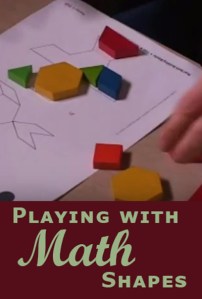
I love it when a plan — or rather, a series of math thoughts — comes together.
On Monday, Emily Grosvenor (author of the Tessalation! picture book) asked me how parents who are insecure in math could help their children learn through play, and I responded with this quote from my Let’s Play Math book:
If you are intimidated by numbers, you can look for patterns of shape and color. Pay attention to how they grow. Talk about what your children notice.
But I wasn’t entirely satisfied with that answer. So many adults have come away from their own school experience thinking math is only numbers. Even with shapes, isn’t it the numbers about them — how many sides, what size of angles, calculate the the area or perimeter — that are important? That’s what school math tends to focus on.
Those of us who are comfortable with math know that there are many more things to notice and think about than just numbers. We know that it’s this noticing, thinking, and wondering that is at the heart of math. And that just playing with shapes can build a powerful foundation for future math learning.
The ability to create, and maintain, and manipulate shapes mentally — that’s the goal. Just like kids who can put numbers together in their heads, kids who can rotate, flip, and think of how shapes fit together in their heads have a powerful tool to analyze not only simple shape puzzles, but dividing up an area that’s a more complex room shape … to look at a piece of artwork … or look at a building … For these kids, all the world around becomes a playground to use mathematical ideas.
Of course, pattern blocks are good for much more than just filling in worksheet pictures. But I love this peek into how a child’s understanding grows, in bits and spurts — without any numbers at all — until the world itself becomes a playground for mathematical ideas.
Want more?
You know what? Children like mathematics. Children see the world mathematically … When we do a puzzle, when we count things, when we see who’s got more, or who’s taller … Play and mathematics are not on opposite sides of the stage.
You could say that Tessalation is a book about tessellations (repeating tiled patterns), but it is really a children’s picture book about discovering order in a chaotic world.
— Emily Grosvenor
Seeing Math in the World
In taking a playful approach to mathematics, I hope to open children’s eyes to math in their world. Schooly math lessons have led many of my math group kids to think a “pattern” has to be a strictly repeating (and rather boring) series of shapes or colors.
But in the real world, patterns are so important that American mathematician Lynn Arthur Steen defined mathematics as the science of patterns.
“As biology is the science of life and physics the science of energy and matter, so mathematics is the science of patterns,” Steen wrote. “We live in an environment steeped in patterns — patterns of numbers and space, of science and art, of computation and imagination. Patterns permeate the learning of mathematics, beginning when children learn the rhythm of counting and continuing through times tables all the way to fractals and binomial coefficients.”
Tessa Truman-Ling’s delight in patterns is contagious. And it will provide a wonderful jumping-off point for a variety of math activities.
Visit Grosvenor’s Kickstarter page to find out more about her lovely book:
Tova Brown concludes her exploration of the Hilbert’s Hotel Paradox with a look at the cardinality of the real numbers.
You run a hotel with an infinite number of rooms. You pride yourself on accommodating everyone, even guests arriving in infinitely large groups — but some infinities are more infinite than others, as it turns out.
Tova Brown dives deeper into Hilbert’s Hotel Paradox, considering the difference between rational numbers and reals.
You run an infinitely large hotel, and are happy to realize that you can accommodate an infinite number of infinite groups of guests.
However, a delicate diplomatic situation arises when a portal to another universe opens, introducing a different kind of guest, in a different kind of group.
Tova Brown continues to examine Hilbert’s Hotel Paradox, pondering infinite sets of infinite sets.
As the proprietor of an infinitely large hotel, you pride yourself on welcoming everyone, even when the rooms are full. Your hotel becomes very popular among infinite sports teams, as a result.
Recruitment season presents a challenge, however, when many infinite teams arrive at once. How many infinite teams can stay in a single infinite hotel?
Tova Brown explores the second part of Hilbert’s Hotel Paradox. What’s infinity plus infinity?
Running an infinite hotel has its perks. Even when the rooms are full you can always find space for new guests, so you proudly welcome everyone who appears at your door.
When two guests arrive at once, you make room. When ten guests arrive, you accommodate them easily. When a crowd of hundreds appears, you welcome them all.
Tova Brown’s introduction to Hilbert’s Hotel Paradox, a riddle about the nature of infinity…
Once upon a time, there was a hotel with an infinite number of rooms. You might be thinking this is impossible, and if so you’re right. A hotel like this could never exist in the real world.
But fortunately we’re not talking about the real world, we’re talking about math. And when we do math we can make up whatever rules we want, just to see what happens.
 But what I find amazing is that this puzzle can help us understand all sorts of topics in elementary arithmetic and algebra. So cool!
 I love it when a plan — or rather, a series of math thoughts — comes together.
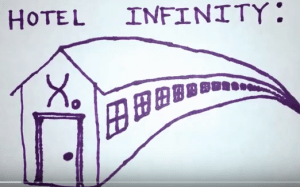 Tova Brown concludes her exploration of the Hilbert’s Hotel Paradox with a look at the cardinality of the real numbers.
 Denise Gaskins' Let's Play Math