2016 Mathematics Game

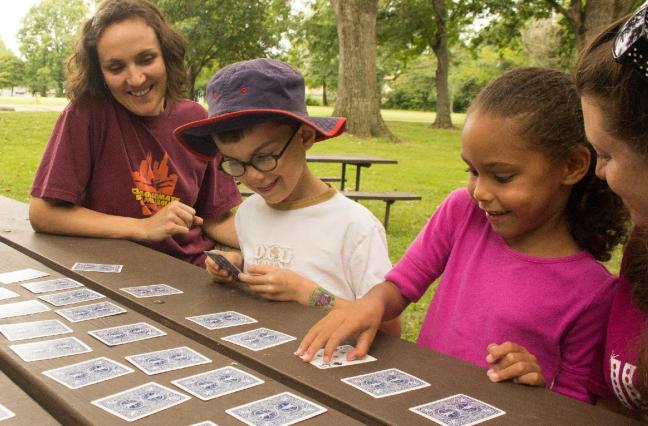
[Feature photo above from the public domain, and title background (below) by frankieleon (CC BY 2.0) via Flickr.]

2016-math-game

Have you made a New Year’s resolution to spend more time with your family this year, and to get more exercise? Problem-solvers of all ages can pump up their (mental) muscles with the Annual Mathematics Year Game Extravaganza. Please join us!

For many years mathematicians, scientists, engineers and others interested in math have played “year games” via e-mail. We don’t always know whether it’s possible to write all the numbers from 1 to 100 using only the digits in the current year, but it’s fun to see how many you can find.

Math Forum Year Game Site

Rules of the Game

Use the digits in the year 2016 to write mathematical expressions for the counting numbers 1 through 100. The goal is adjustable: Young children can start with looking for 1-10, middle grades with 1-25.

  • You must use all four digits. You may not use any other numbers.
  • Solutions that keep the year digits in 2-0-1-6 order are preferred, but not required.
  • You may use +, -, x, ÷, sqrt (square root), ^ (raise to a power), ! (factorial), and parentheses, brackets, or other grouping symbols.
  • You may use a decimal point to create numbers such as .2, .02, etc., but you cannot write 0.02 because we only have one zero in this year’s number.
  • You may create multi-digit numbers such as 10 or 201 or .01, but we prefer solutions that avoid them.

My Special Variations on the Rules

  • You MAY use the overhead-bar (vinculum), dots, or brackets to mark a repeating decimal. But students and teachers beware: you can’t submit answers with repeating decimals to Math Forum.
  • You MAY use a double factorial, n!! = the product of all integers from 1 to n that have the same parity (odd or even) as n. I’m including these because Math Forum allows them, but I personally try to avoid the beasts. I feel much more creative when I can wrangle a solution without invoking them.

Click here to continue reading.

Advent Math Calendars from Nrich

Once again, Nrich.Maths.org and Plus.Maths.org are offering a selection of activities to encourage your students’ mathematical creativity, one for each day in the run-up to Christmas. Click one of the images below to visit the appropriate Advent Math Calendar page.

For Primary Students

Easier activities for elementary and middle school. When you get to the Nrich website, click a number to go to that day’s math.

primary_650px

For Secondary Students

Activities for middle and high school. When you get to the Nrich website, click a number to go to that day’s math.

secondary

For Teens and Adults

“Wild Maths” puzzles and articles for teens and up. When you get to the +Plus Magazine website, you can tell which links are live by the drop shadow under the picture. One link becomes live each day — so come back tomorrow and discover something new!

plusmaths advent

A Penny for Your Math

You know you’re a math teacher when you see a penny in the parking lot, and your first thought is, “Cool! A free math manipulative.”

penny

My homeschool co-op math students love doing math with pennies. They’re rather heavy to carry to class, but worth it for the student buy-in.

This month, I’m finishing up the nearly 150 new illustrations for the upcoming paperback edition of my Let’s Play Math book. I’m no artist, and it’s been a long slog. But a couple of the graphics involved pennies‌—‌so when I saw that penny on the ground, it made me think of my book.

And thinking of my book made me think it would be fun to share a sneak peek at coming attractions…

The Penny Square: An Example of Real Mathematics

Real mathematics is intriguing and full of wonder, an exploration of patterns and mysterious connections. It rewards us with the joy of the “Aha!” feeling. Workbook math, on the other hand, is several pages of long division by hand followed by a rousing chorus of the fraction song: “Ours is not to reason why, just invert and multiply.”

Real math is the surprising fact that the odd numbers add up to perfect squares (1, 1 + 3, 1 + 3 + 5, etc.) and the satisfaction of seeing why it must be so.

Did your algebra teacher ever explain to you that a square number is literally a number that can be arranged to make a square? Try it for yourself:

  • Gather a bunch of pennies‌—‌or any small items that will not roll away when you set them out in rows‌—‌and place one of them in front of you on the table. Imagine drawing a frame around it: one penny makes a (very small) square. One row, with one item in each row.
  • Now, put out three more pennies. How will you add them to the first one in order to form a new, bigger square? Arrange them in a small L-shape around the original penny to make two rows with two pennies in each row.
  • Set out five additional pennies. Without moving the current four pennies, how can you place these five to form the next square? Three rows of three.
  • Then how many will you have to add to make four rows of four?
pennies
Twenty-five is a square number, because we can arrange twenty-five items to make a square: five rows with five items in each row.

Each new set of pennies must add an extra row and column to the current square, plus a corner penny where the new row and column meet. The row and column match exactly, making an even number, and then the extra penny at the corner makes it odd.

Can you see that the “next odd number” pattern will continue as long as there are pennies to add, and that it could keep going forever in your imagination?

The point of the penny square is not to memorize the square numbers or to get any particular “right answer,” but to see numbers in a new way‌—‌to understand that numbers are related to each other and that we can show such relationships with diagrams or physical models. The more relationships like this our children explore, the more they see numbers as familiar friends.

The Penny Birthday Challenge: Exponential Growth

Penny-Challenge-1

A large jar of assorted coins makes a wonderful math toy. Children love to play with, count, and sort coins.

Add a dollar bill to the jar, so you can play the Dollar Game: Take turns throwing a pair of dice, gathering that many pennies and trading up to bigger coins. Five pennies trade for a nickel, two nickels for a dime, etc. Whoever is the first to claim the dollar wins the game.

Or take the Penny Birthday Challenge to learn about exponential growth: Print out a calendar for your child’s birthday month. Put one penny on the first day of the month, two pennies on the second day, four pennies on the third day, etc. If you continued doubling the pennies each day until you reach your child’s birthday, how much money would you need?

Warning: Beware the Penny Birthday Challenge! Those pennies will add up to dollars much faster than most people expect. Do not promise to give the money to your child unless the birthday comes near the beginning of the month.

A Penny Holiday Challenge

The first time I did pennies on a calendar with my homeschool co-op class was during December, so we called it the Penny Christmas Challenge:

  • How many pennies would you need to cover all the days up to the 25th?

I told the kids that if their grandparents asked what gift they wanted for Christmas, they could say, “Not much. Just a few pennies…”


LPM-ebook-300The Penny Square, Dollar Game, and Penny Birthday Challenge are just three of the myriad math tips and activity ideas in the paperback edition of Let’s Play Math: How Families Can Learn Math Together and Enjoy It. Coming in early 2016 to your favorite online bookstore…

November Math Calendars

High school math teacher Chris Rime has done it again. Check out his November 2015 printable math calendars for Algebra 1 (in English or Spanish), Algebra 2, and Geometry students. Enjoy!

algebra-2-november-2015-preview

Things to Do with a Math Calendar

At home:
Post the calendar on your refrigerator. Use each math puzzle as a daily review “mini-quiz” for your children (or yourself).

In the classroom:
Post today’s calculation on the board as a warm-up puzzle. Encourage your students to make up “Today is…” puzzles of their own.

As a puzzle:
Cut the calendar squares apart and trim off the dates. Then challenge your students to arrange them in ascending (or descending) order.

Make up problems to fill a new calendar for next month.
And if you do, please share!

Active Math Game: Rock

Gordon Hamilton of Math Pickle posted Rock – Low unique number game for grades K–2. If you have a set of active kids and a few minutes to spare, give it a try!

How to Play Rock

  • Everyone makes a rock shape with eyes closed.
  • Everyone chooses a number: 0, 1, 2, 3, 4, 5, 6, 7, 8 …
  • Teacher calls out numbers consecutively, starting at 0.
  • When a student hears their number being called they immediately raise a hand. When the teacher tags the hand, they stand up.
  • If more than one hand was raised, those students lose. They become your helpers, tagging raised hands.
  • If only one hand was raised, that child wins the round.

Rock-game

“Each game takes about 45 seconds,” Hamilton says. “This is part of the key to its success. Children who have not learned the art of losing are quickly thrown into another game before they have a chance to get sad.”

The experience of mathematics should be profound and beautiful. Too much of the regular K-12 mathematics experience is trite and true. Children deserve tough, beautiful puzzles.

Gordon Hamilton

What Happens When Grownups Play Rock

What are the best numbers to pick? Patrick Vennebush hosted on online version of the game at his Math Jokes 4 Mathy Folks blog a few years back, though we didn’t have to bend over into rocks‌—‌which is a good thing for some of us older folks.

Vennebush also posted a finger-game version suitable for small groups of all ages, called Low-Sham-Bo:

  • On the count of 1-2-3, each person “throws” out a hand showing any number of fingers from zero to five.
  • The winner is the person who throws the smallest unique number.

You may want to count “Ready, set, go!” for throwing out fingers, so the numbers in the count don’t influence the play.

The official name for this sort of game is Lowest Unique Bid Auction.

 
* * *

This blog is reader-supported.

If you’d like to help fund the blog on an on-going basis, then please join me on Patreon for mathy inspiration, tips, and an ever-growing archive of printable activities.

If you liked this post, and want to show your one-time appreciation, the place to do that is PayPal: paypal.me/DeniseGaskinsMath. If you go that route, please include your email address in the notes section, so I can say thank you.

Which I am going to say right now. Thank you!

“Active Math Game: Rock” copyright © 2015 by Denise Gaskins. .

Spirolateral Math Doodles

This is not a math book coverInterrupt your regular math programming to try this fantastic math doodling investigation!

Anna Weltman wrote a math/art book. It’s great fun for all ages, full of fantastic mathematical explorations — including spirolateral math doodles.

loop-de-loops1

How to Get Started

To make a spirolateral, you first pick a short series of numbers (1, 2, 3 is a traditional first set) and an angle (90° for beginners). On graph paper, draw a straight line the length of your first number. Turn through your chosen angle, and draw the next line. Repeat turning and drawing lines, and when you get to the end of your number series, start again at the first number.

Some spirolaterals come back around to the beginning, making a closed loop. Others never close, spiraling out into infinity—‌or at least, to the edge of your graph paper.

loop-de-loops2

For Further Reading

Articles by Robert J. Krawczyk:

Anna Weltman appeared on Let’s Play Math blog once before, with the game Snugglenumber. And she’s a regular contributor to the wonderful Math Munch blog.

Professor Povey’s Perplexing Problems

Check out this new puzzle book for upper-level high school students & adults:

Professor Povey picture

Thomas Povey is a Professor of Engineering Science at the University of Oxford, where he researches jet-engine and rocket technology. In his new book Professor Povey’s Perplexing Problems, he shares his favorite idiosyncratic stumpers from pre-university maths and physics.

These problems “should test your ability to grapple with the unfamiliar,” Povey writes. “You will learn to tease new problems apart, and apply things you already know in ways you had never considered. You have all the tools you need, but you should see what amazing things you can do with them.”

Can You Solve This?

Alex Bellos shared one of Professor Povey’s puzzles in The Guardian. Can you figure it out?

Professor Povey cover

The book starts off with geometry, but most of the chapters focus on various topics from physics. Some of the puzzles are accessible through applied common sense, but for many of them, it helps to have taken an algebra-based (high school level) physics course.

Kitten is just finishing up her physics textbook, and she still has one more year of homeschooling. I’m hoping to work several of these puzzles into our schedule this year. It should be great fun!

Spoiler

If like me you’re a bit rusty on your physics, don’t worry. Each answer is thoroughly explained—‌in fact, it takes a bit of discipline to close the book and try your hand at each problem before reading on. I wish they’d put the solutions in the back rather than in the main text, to make it easier to browse the problems without reading spoilers.

Speaking of which, here’s the answer to the video puzzle above…

Playful Math Snacks for August: Logic Puzzles

The August “Let’s Play Math” newsletter went out last week to everyone who signed up for Tabletop Academy Press math updates. This month’s issue focuses on logic puzzles for all ages, including a newly-discovered deleted scene from Harry Potter and the Sorcerer’s Stone. What fun!

If you missed this month’s edition, no worries—‌here are some great puzzles from the Let’s Play Math blog archive:

The Centauri Logic Challenge

Sign Up Today

If you missed this month’s edition, no worries — there will be more playful math snacks coming soon. Click the link below to sign up today!

And remember: Newsletter subscribers are always the first to hear about new books, revisions, and sales or other promotions.

New Hundred Chart Game: Odd-Even-Prime Race

Counting all the fractional variations, my massive blog post 30+ Things to Do with a Hundred Chart now offers nearly forty ideas for playing around with numbers from preschool to prealgebra.

Here is the newest entry, a variation on #10, the “Race to 100” game:

(11.5) Play “Odd-‌Even-‌Prime Race.″ Roll two dice. If your token is starting on an odd number, move that many spaces forward. From an even number (except 2), move backward — but never lower than the first square. If you are starting on a prime number (including 2), you may choose to either add or multiply the dice and move that many spaces forward. The first person to reach or pass 100 wins the game.
[Hat tip: Ali Adams in a comment on another post.]

And here’s a question for your students:

  • If you’re sitting on a prime number, wouldn’t you always want to multiply the dice to move farther up the board? Doesn’t multiplying always make the number bigger?

 
* * *

This blog is reader-supported.

If you’d like to help fund the blog on an on-going basis, then please join me on Patreon for mathy inspiration, tips, and an ever-growing archive of printable activities.

If you liked this post, and want to show your one-time appreciation, the place to do that is PayPal: paypal.me/DeniseGaskinsMath. If you go that route, please include your email address in the notes section, so I can say thank you.

Which I am going to say right now. Thank you!

“New Hundred Chart Game: Odd-Even-Prime Race” copyright © 2015 by Denise Gaskins. Image at the top of the post copyright © geishaboy500 (CC BY 2.0).

Math with Many Right Answers

The discussion matters more than the final answer.

One of the most persistent math myths in popular culture is the idea that mathematics is primarily about getting right answers.

The truth is, the answer doesn’t matter that much in math. What really matters is how you explain that answer. An answer is “right” if the explanation makes sense.

And if you don’t give an explanation, then you really aren’t doing mathematics at all.

Try This Number Puzzle

Here is a short sequence of numbers. Can you figure out the rule and fill in the next three blanks?

2, 3, 5, 7, ___, ___, ___, …

Remember, what’s important is not which numbers you pick, but rather how you explain your answer.

Possibility 1

Perhaps the sequence is the prime numbers?

2, 3, 5, 7, 11, 13, 17, …

The prime numbers make a wonderful sequence, though it isn’t the one I was thinking of.

Continue reading Math with Many Right Answers