Alex’s Puzzling Papyrus

(In the last episode, Dr. Fibonacci Jones discovered a torn scrap of papyrus, covered with hieroglyphic numbers. He promised to teach his daughter, Alexandria, how the ancient Egyptian scribes worked multiplication problems using only the times-two table.)

Back at their tent, Dr. Jones handed the papyrus scrap to Alexandria. “What do you see?” he asked.

“Well, there are two columns of numbers,” Alex said. “Let me write them down.” She got a piece of notebook paper and translated the hieroglyphs. Papyrus fragment
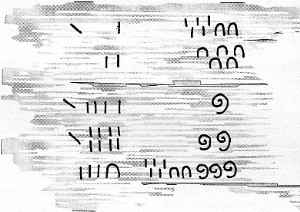
Click on the image for a larger view. Translate the numbers for yourself before reading on. If you need help, read Egyptian Math in Hieroglyphs.

Continue reading Alex’s Puzzling Papyrus

Egyptian Math in Hieroglyphs

Egyptians wrote in hieroglyphs, a type of picture writing, and in hieratics, which were like a cursive form of hieroglyphs.

Hieroglyphs came first. They were carved in the stone walls of temples and tombs, written on monuments, and used to decorate furniture. But they were a nuisance for scribes, who simplified the pictures and slurred some lines together when they wrote in ink on paper-like papyrus. This hieratic writing — like some people’s cursive today — can be hard to read, so we are only using hieroglyphic numbers on this blog.

Download this page from my old newsletter, and try your hand at translating some Egyptian hieroglyphs:

Then try writing some hieroglyphic calculations of your own.

Edited to add: The answers to these puzzles (and more) are now posted here.

To Be Continued…

Read all the posts from the September/October 1998 issue of my Mathematical Adventures of Alexandria Jones newsletter.

The Thief in the Night

Alexandria Jones and her faithful dog Ramus slipped out of the tent when the talking started. One of Dad’s assistants had made the long drive into town to bring back pizza for supper. But now, all the adults would be working past midnight to finish the final site report.

Paperwork was necessary, she knew, but so-o-o boring.

Alex and Rammy wandered around the nearly-dark camp. Many of the tents were down. Crates stood near the road. All the artifacts had been carefully cleaned and labeled, and some were already shipped to the museum lab.

She ran a hand over the edge of a crate, then jerked back, wincing at the splinter that dug into her palm.

Continue reading The Thief in the Night

Solution: The Cat’s Lasagna

The puzzle (from The mysterious temporal freeze) was:

A certain famous cat snarfs down an 11″x13″ pan of lasagna in 3 seconds flat. Assuming the fat feline has a bottomless pit for a stomach and continues to eat at the same rate, how long will it take him to devour a pasta the size of the state of Illinois?

Remember the Math Adventurer’s Rule: Figure it out for yourself! Whenever I give a problem in an Alexandria Jones story, I will try to post the answer soon afterwards. But don’t peek! If I tell you the answer, you miss out on the fun of solving the puzzle. Figure it out for yourself — and then check the answer just to prove that you got it right.

Continue reading Solution: The Cat’s Lasagna

The Mysterious Temporal Freeze

Pyramids clip artAlexandria Jones stepped into the huge tent that protected her father’s excavation site from the desert winds. She laughed to herself. It was like walking into a circus.

She knelt down to whisper in the ear of her faithful dog Ramus. “In this ring, grad students carefully brush away another layer of sand. In the next ring, the artist sketches every piece as it is found.” She waved her arm. “And over there, our flashiest attraction — drum roll, please — the photographers shoot each shard of pottery from every possible angle. But where is the Master of Ceremonies?”

Alex and Rammy found Professor Jones near the back of the tent, talking to another student. While she waited for her dad, she looked through an assortment of numbered artifacts that were ready to be packed and sent to the museum.

Continue reading The Mysterious Temporal Freeze

Historical Tidbits: Alexandria Jones Answers

The Math Adventurer’s Rule: Figure It Out for Yourself!

Whenever I give a problem in an Alexandria Jones story, I will try to post the answer soon afterwards. But don’t peek! If I tell you the answer, you miss out on the fun of solving the puzzle. Figure it out for yourself — and then check the answer just to prove that you got it right.

Continue reading Historical Tidbits: Alexandria Jones Answers

Historical Tidbits: Alexandria Jones

[Read the story of the pharaoh’s treasure: Part 1, Part 2, and Part 3.]

Here are a few more tidbits from math history, along with links to relevant Internet sites or books, and three more math puzzles for you to try. I hope you find them interesting.

Next time, a new adventure (sort of)…

Continue reading Historical Tidbits: Alexandria Jones

Answers and Other Tidbits: The Pharaoh’s Treasure

[Read the story of the pharaoh’s treasure here: Part 1, Part 2, and Part 3.]

I confess: I lied — or rather, I helped to propagate a legend. Scholars tell us that the Egyptian rope stretchers did not use a 3-4-5 triangle for right-angled corners. They say it is a myth, like the corny old story of George Washington and the cherry tree, which bounces from one storyteller to the next — as I got it from a book I bought as a library discard.

None of the Egyptian papyri that have been found show any indication that the Egyptians knew of the Pythagorean Theorem, one of the great theorems of mathematics, which is the basis for the 3-4-5 triangle. Unless a real archaeologist finds a rope like Alexandria Jones discovered in my story, or a papyrus describing how to use one, we must assume the 3-4-5 rope triangle is an unfounded rumor.

Continue reading Answers and Other Tidbits: The Pharaoh’s Treasure

The Secret of the Pharaoh’s Treasure, Part 3

[In the last episode, Alexandria Jones discovered a mysterious treasure: three wooden sticks, like tent pegs, and a long loop of rope with 12 evenly spaced knots. Her father explained that it was an ancient Egyptian surveyor’s tool, used to mark right angles.]

Back at the camp, Fibonacci Jones stacked multi-layer sandwiches while Alexandria poured milk and set the table for supper.

“Geometry,” Fibonacci said.

“What?”

Geo means earth, and metry means to measure. So geometry means to measure the earth. That is what the Egyptian rope stretches did.”

Alex thought for a moment. “So in the beginning, math was just surveying?”

“And taxes…”

Continue reading The Secret of the Pharaoh’s Treasure, Part 3

The Secret of the Pharaoh’s Treasure, Part 2

[In the last episode, Alexandria Jones, daughter of the world-famous archaeologist, caught her father’s arch-enemy trying to uncover the Pharaoh’s Treasure.]

…”I can’t believe it!” Simon Skulk threw down the last stone in disgust and walked away. At the mouth of the cave, he turned back and shook his fist. “You haven’t seen the last of me, Alexandria Jones.”

Her muscles aching, Alex sank to the ground and hugged her dog. The she gave him a little push toward the front of the cave. “Rammy, go get Dad.”

Ramus barked once and took off running.

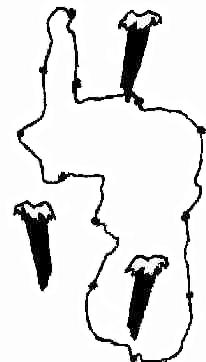
Alex turned back to look at the Pharaoh’s Treasure. Where the last stone had stood was a hole. In the hole lay three wooden sticks, like tent pegs, and a long loop of rope with 12 evenly-spaced knots.

What could it be?

Continue reading The Secret of the Pharaoh’s Treasure, Part 2