How to Make a Flexagon Christmas Card

tetra-tetraflexagonHere’s how Alex created tetra-tetraflexagon Christmas cards to send to her friends:

1. Buy a pack of heavy paper at the office supply store. Regular construction paper tears too easily.

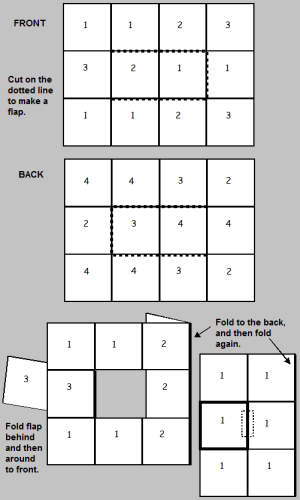
2. Measure and divide the paper into fourths one direction and thirds the other way. Fold each line backward and forward a few times.

3. Number the front and back of the paper in pencil, lightly, as shown. Then carefully cut a center flap along the dotted lines.

4. Fold the paper along the dark lines as shown, so the center flap sticks out from underneath and the right-hand column shows all 2’s.

5. Fold the flap the rest of the way around to the front and fold the right-hand column under again. (Shown as dark lines on the diagram.) This makes the front of the flexagon show 1’s in every square.

6. Carefully, tape the flap to its neighbor on the folded column. Don’t let the tape stick to any but these two squares.

7. Gently erase your pencil marks.

Find All the Faces

A tetra-tetraflexagon has four faces: front, back, and two hidden. It is shaped like a tetragon — better known as a rectangle.

Here’s how to flex your tetra-tetraflexagon card:

  • Face 1 is easy to find. It’s on top when you make the card.
  • Turn the card over to find Face 2.
  • Face 3 is hidden behind Face 2. Fold your flexagon card in half (vertically) so that Face 1 disappears. Unfold Face 2 at the middle, like opening a book. Face 3 should appear like magic.
  • Face 4 is hidden behind Face 3. Fold the card (vertically) to hide Face 2, then open the middle of Face 3. Face 2 vanishes, and Face 4 is finally revealed.

When Faces 2 and 3 are folded to the back, you will notice that any pictures you drew on them will look scrambled. What happened?

Add Your Designs

Alex wrote a holiday greeting on Face 1. Then she drew Christmas pictures on the other three faces of her card.

To Be Continued…

Read all the posts from the December 2000/January 2001 issue of my Mathematical Adventures of Alexandria Jones newsletter.

CREDITS: “Happy Holidays” photo by Mike Brand via Flickr (CC BY 2.0). Video by Shaireen Selamat of DynamicEducator.com.

Puzzle: Exploding Dots

I’m planning ahead for my fall semester homeschool co-op math class. Definitely going to try this with the kids…

Encourage your children to have some fun this week with this Exploding Dots math puzzle from The Global Math Project. What do they notice? Does it make them wonder?

More Explosive Math

You may recognize the connection between Exploding Dots and binary numbers. Or not — the puzzle is accessible to people at almost any age and level of mathematical sophistication.

But what I find amazing is that this puzzle can help us understand all sorts of topics in elementary arithmetic and algebra. So cool!

If you’d like to investigate Exploding Dots in depth, check out James Tanton’s free G’Day Math online course.

10 Ways to Celebrate World Tessellation Day

Guest post by Emily Grosvenor.

June 17 marks World Tessellation Day, a holiday I created to bring awareness to the fun of finding and making tessellations.

Will you celebrate with us?

Here are 10 great ways to play with tessellations, learn about them, and introduce your children to a math concept that opens a variety of creative learning opportunities.

1) Learn about tessellations with your kids.

A tessellation is a tiled mosaic pattern of the same shape laid out over and over again, repeating into infinity. Tessellations can be found in nature, or they can be created by people. Learn more at these websites:

1WorldTessellationDayExcept where otherwise noted, graphics and photos copyright ©2016 Emily Grosvenor. All rights reserved.

Continue reading 10 Ways to Celebrate World Tessellation Day

Playful Math Education Carnival 97

Did you know 97 is an emirp?
Did you know 97 is an emirp? It’s prime both forward and backward! What other emirps can you find?

Welcome to the 97th edition of the Math Teachers At Play math education blog carnival: a monthly smorgasbord of links to bloggers all around the internet who have great ideas for learning, teaching, and playing around with math from preschool to pre-college.

A few articles were submitted by their authors, but most were drawn from the immense backlog in my rss reader. If you’d like to see your blog post featured next month, be sure to send it in yourself. Our hosts are busy parents and teachers who have limited time to scour the Internet for goodies.

To add a bit of color, I’ve thrown in several favorites from my newly updated Math with Living Books pages. Some (affiliate) links go to Amazon.com, where you can read descriptions and reviews — but there’s no need to buy. Most of these books should be available through your local library.

Table of Contents

If you’d like to skip directly to your area of interest, click here:

Please: If you enjoy the carnival, would you consider volunteering to host sometime this year? Classroom teachers, homeschoolers, unschoolers, or anyone who likes to play around with math (even if the only person you “teach” is yourself) — if you would like to take a turn, please speak up!

And now, let the mathematical fun begin!


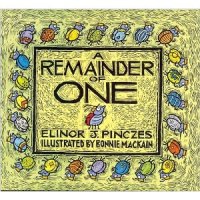
Pinczes-A Remainder of One

When the queen of her bugs demands that her army march in even lines, Private Joe divides the marchers into more and more lines so that he will not be left out of the parade.

Talking Math with Kids

  • Crystal Wagner (@Tri_Learning) shares several Math Games to Play in the Car: “Or maybe you are waiting in line at the grocery store or doctor’s appointment. Turn these times of waiting into learning opportunities.”
  • Christopher Danielson (@Trianglemancsd) shows how The sequence machine can launch math conversations with older students: “Now you can generate number sequences, without being distracted by the multiplication facts.”

richman-bykids

Help inspire your kids to try writing their own unique problems. Includes a wide range of math topics and concepts: money and time, fractions, percentages, geometry, logic, and multi-step problem solving.

[Back to top.]
[Back to Table of Contents.]

Continue reading Playful Math Education Carnival 97

Let’s Play Math FAQs: Introduction

I’ll let you in on a secret about teaching: there is no place in the world where it rolls along smoothly without problems. Only in articles and books can that happen.

—Dr. Ruth Beechick
You Can Teach Your Child Successfully

Learning math is an adventure into the unknown. The ideas we adults take for granted are a wild, unexplored country to our children. Like any traveler in a strange land, they will stumble over rocky places and meet with unexpected detours.

Whenever I visit a parenting forum, I feel compassion for the families who are struggling with math. No other school subject elicits such depths of frustration and despair.

Continue reading Let’s Play Math FAQs: Introduction

New Picture Book: Tessalation!

When I run a math circle or co-op class, I love starting with a picture book. This new beauty from Emily Grosvenor will be perfect.

You could say that Tessalation is a book about tessellations (repeating tiled patterns), but it is really a children’s picture book about discovering order in a chaotic world.

— Emily Grosvenor

Seeing Math in the World

In taking a playful approach to mathematics, I hope to open children’s eyes to math in their world. Schooly math lessons have led many of my math group kids to think a “pattern” has to be a strictly repeating (and rather boring) series of shapes or colors.

But in the real world, patterns are so important that American mathematician Lynn Arthur Steen defined mathematics as the science of patterns.

“As biology is the science of life and physics the science of energy and matter, so mathematics is the science of patterns,” Steen wrote. “We live in an environment steeped in patterns — patterns of numbers and space, of science and art, of computation and imagination. Patterns permeate the learning of mathematics, beginning when children learn the rhythm of counting and continuing through times tables all the way to fractals and binomial coefficients.”

Tessa Truman-Ling’s delight in patterns is contagious. And it will provide a wonderful jumping-off point for a variety of math activities.

Visit Grosvenor’s Kickstarter page to find out more about her lovely book:

Further Exploration

Hotel Infinity: Part Five

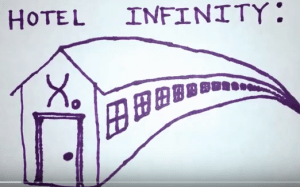
Hotel Infinity1Tova Brown concludes her exploration of the Hilbert’s Hotel Paradox with a look at the cardinality of the real numbers.

You run a hotel with an infinite number of rooms. You pride yourself on accommodating everyone, even guests arriving in infinitely large groups — but some infinities are more infinite than others, as it turns out.

Tova Brown
Hotel Infinity: Part Five

Check out Tova Brown’s growing collection of videos that explore advanced math concepts through story-telling.

Hotel Infinity: Part Four

Hotel Infinity1Tova Brown dives deeper into Hilbert’s Hotel Paradox, considering the difference between rational numbers and reals.

You run an infinitely large hotel, and are happy to realize that you can accommodate an infinite number of infinite groups of guests.

However, a delicate diplomatic situation arises when a portal to another universe opens, introducing a different kind of guest, in a different kind of group.

Can you make room for them all?

Tova Brown
Hotel Infinity: Part Four

Click here to read Part Five…

Hotel Infinity: Part Three

Hotel Infinity1Tova Brown continues to examine Hilbert’s Hotel Paradox, pondering infinite sets of infinite sets.

As the proprietor of an infinitely large hotel, you pride yourself on welcoming everyone, even when the rooms are full. Your hotel becomes very popular among infinite sports teams, as a result.

Recruitment season presents a challenge, however, when many infinite teams arrive at once. How many infinite teams can stay in a single infinite hotel?

Tova Brown
Hotel Infinity: Part Three

Click here to read Part Four…

Hotel Infinity: Part Two

Hotel Infinity1Tova Brown explores the second part of Hilbert’s Hotel Paradox. What’s infinity plus infinity?

Running an infinite hotel has its perks. Even when the rooms are full you can always find space for new guests, so you proudly welcome everyone who appears at your door.

When two guests arrive at once, you make room. When ten guests arrive, you accommodate them easily. When a crowd of hundreds appears, you welcome them all.

Is there no limit to your hospitality?

Tova Brown
Hotel Infinity: Part Two

Click here to read Part Three…