Math Game: Fan Tan (Sevens)

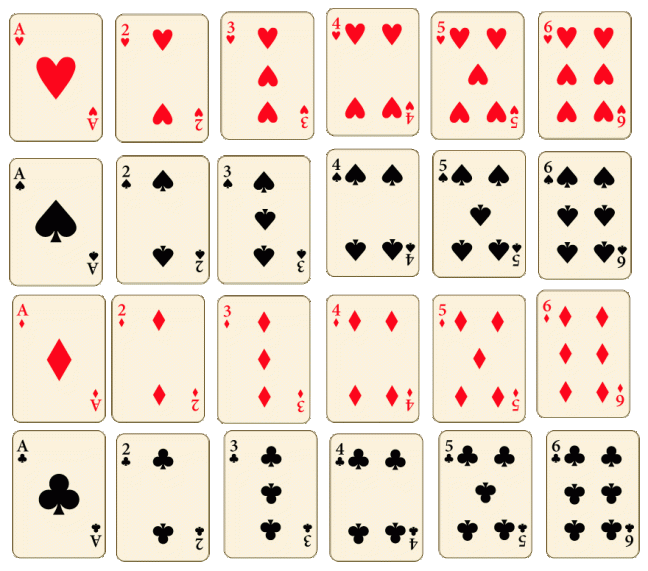
Math Concepts: sorting by attribute (card suits), counting up, counting down, standard rank of playing cards (aces low).
Players: two or more, best with four to six.
Equipment: one complete deck of cards (including face cards), or a double deck for more than six players. Provide a card holder for young children.

How to Play

Deal out all the cards, even if some players get more than others. The player to the dealer’s left begins by playing a seven of any suit. If that player does not have a seven, then the play passes left to the first player who does.

After that, on your turn you may lay down another seven or play on the cards that are already down. If you cannot play, say, “Pass.”

Once a seven is played in any suit, the six and the eight of that suit may be played on either side of it, forming the fan. Then the five through ace can go on the six in counting-down order, and the nine through king can go on the eight, counting up. You can arrange these cards to overlap each other so the cards below are visible, or you can square up the stacks so only the top card is seen.
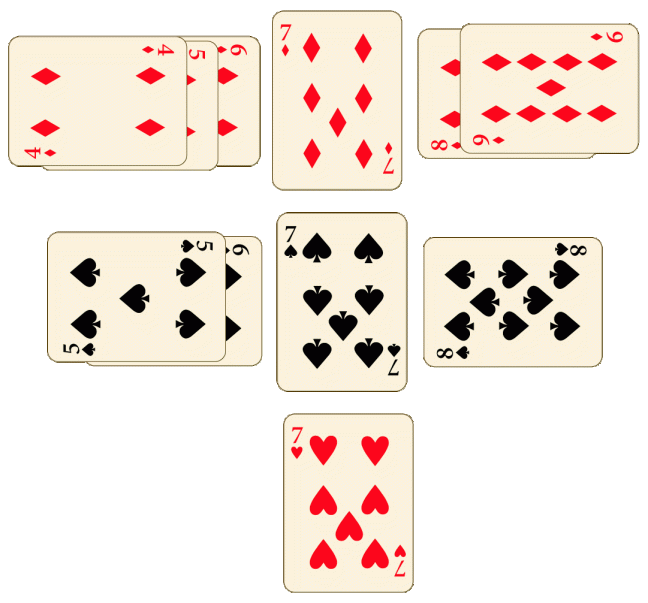
A Fan Tan game in progress.

Continue reading Math Game: Fan Tan (Sevens)

Math Teachers at Play #85

[Feature photo by Tomruen via Wikimedia Commons.]

Do you enjoy math? I hope so! If not, browsing the articles linked in this post just may change your mind.

Welcome to the 85th edition of the Math Teachers At Play math education blog carnival‌—‌a smorgasbord of links to bloggers all around the internet who have great ideas for learning, teaching, and playing around with math from preschool to pre-college.

By tradition, we start the carnival with a short puzzle or activity. But if you would like to jump straight to our featured blog posts, click here to see the Table of Contents.

Let the mathematical fun begin!

Continue reading Math Teachers at Play #85

Math Game: Thirty-One

Math Concepts: addition to thirty-one, thinking ahead.
Players: best for two.
Equipment: one deck of math cards.

How to Play

Lay out the ace to six of each suit in a row, face-up and not overlapping, one suit above another. You will have one column of four aces, a column of four twos, and so on‌—‌six columns in all.

The first player flips a card upside down and says its number value. Then the second player turns down a card, adds it to the first player’s number, and says the sum.

Players alternate, each time turning down one card, mentally adding its value to the running total, and saying the new sum out loud. The player who exactly reaches thirty-one, or who forces the next player to go over that sum, wins the game.

31-Game

Continue reading Math Game: Thirty-One

April 2015 Math Calendar

AprilMathCalendar

Six years ago, my homeschool co-op classes had fun creating this April calendar to hand out at our end-of-semester party. Looking at my regular calendar today, I noticed that April this year starts on Wednesday, just like it did back then. I wonder when’s the next time that will happen?

A math calendar is not as easy to read as a traditional calendar — it is more like a puzzle. The expression in each square simplifies to that day’s date, so your family can treat each day like a mini-review quiz: “Do you remember how to calculate this?”

The calendar my students made is appropriate for middle school and beyond, but you can make a math calendar with puzzles for any age or skill level. Better yet, encourage the kids to make puzzles of their own.

How to Use the Math Calendar

At home:
Post the calendar on your refrigerator. Use each math puzzle as a daily review “mini-quiz” for your children (or yourself).

In the classroom:
Post today’s calculation on the board as a warm-up puzzle. Encourage your students to make up “Today is…” puzzles of their own.

As a puzzle:
Cut the calendar squares apart, then challenge your students to arrange them in ascending (or descending) order.

Help Us Make the Next Math Calendar

If you like, you may use the following worksheet:

Submission details here: Kids’ Project — More Math Calendars?