Musings: Math is Communication

Young boy writing math expressions

The question came up on a homeschool math forum:

“My first grader and I were playing with equivalent expressions. We were trying to see how many ways we could write the value ‘3.’

    “He wrote down 10 – 2 × 3 + 1.

      “When I tried to explain the problem with his calculation, he got frustrated and didn’t want to do math.

        “How can I help him understand order of operations?”

        [If you think this sounds like too complex of a math expression for a first grader, you may want to read my blog post about math manipulatives and big ideas.]

        Order of operations doesn’t matter in this instance. What matters is communication.

        The mother didn’t know how to read what her son wrote.

        He could help her understand by putting parentheses around the part he wanted her to read first.

        He doesn’t need to know abstract rules for arbitrary calculations, or all the different ways we might possibly misunderstand each other. He just needs to know how to say what is in his mind.

        Continue reading Musings: Math is Communication

        FAQ: The Value of Math Rebellion

        Math Rebels fight for truth, justice, and creative reasoning

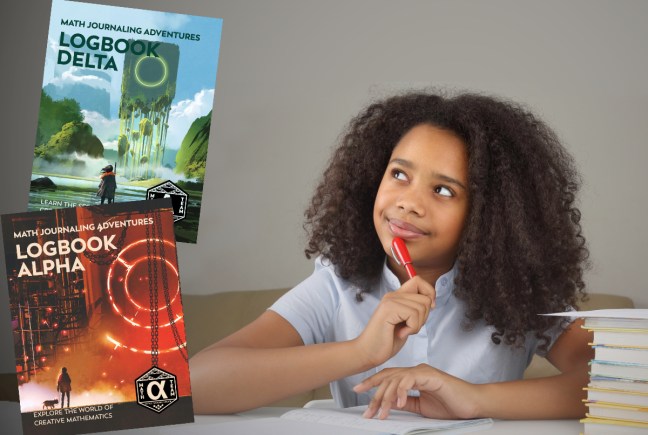
        I’ve been getting questions about my Math Journaling Adventures books:

        “I’m so excited to try math journaling! We bought your Logbook Alpha, and my 11-year-old math-averse son is trying to be a math rebel at every turn.

          “But I feel uncomfortable with the idea of rebellion. Doesn’t he need to learn how to solve math problems the right way?”

          One of my favorite things about math is that there really is no “right” way to solve math problems.

          As I pointed out in my ongoing Mental Math series, even a problem as basic as 6+8 can be approached from many directions. So perhaps I should say, the “right” way is however the student wants to make sense of the problem.

          In math, sense-making and reasoning are always the most important things.

          Continue reading FAQ: The Value of Math Rebellion

          Mental Math: Do’s and Don’ts

          Father and son working on math homework

          Over the course of this series, we’ve seen how mental math relies on a child’s own creative ways of thinking. In mental math, children develop understanding of how numbers interact with each other in many ways.

          In this way, they learn the true 3R’s of math: to Recognize and Reason about the Relationships between numbers.

          And the principles that underlie mental calculation are also fundamental to algebra, so that flexibility and confidence in mental math is one of the best predictors of success in high school math and beyond.

          But as we went through the various example problems, did you find the written-out calculations hard to follow?

          Don’t force your children to write down their mental math. It looks dreary when I write the calculations out step by step, but that’s not how it works in a child’s mind. With regular practice, this sort of thinking becomes second nature.

          Continue reading Mental Math: Do’s and Don’ts

          FAQ: Playful Math Journaling

          Girl student thinking about her math journal prompt

          Ever since the school year started, I’ve been getting questions about how to use my new Math Journaling Adventures logbooks.

          [SIDE NOTE: These logbooks are included in this month’s Thanksgiving Sale! You’ll get an automatic 10% discount off all print books, applied at checkout, no special code required.]

          “I love the way your math books get my children thinking.

            “Finally, they are having fun with math!

              “But sometimes I have no idea what the journaling prompt is all about or how to teach it. Where can I buy a solutions manual?”

              Um, that’s not how math journals work.

              The cool thing about journaling prompts is that they have no “right” answer. They are explorations into different parts of the world of math, nature walks in the land of numbers, shapes, and patterns. Springboards into whatever our children want to investigate, whatever sparks their interest.

              A few of the problem-solving prompts may have specific answers, but it really doesn’t matter if our kids find the exact solution a math professional might give. If they write what makes sense to them, they’ve accomplished the goal.

              If later, they think of something they hadn’t noticed, or they want to change their answer — well, that is mathematical thinking, too.

              Continue reading FAQ: Playful Math Journaling

              Mental Math: Advanced Subtraction

              mother and daughter talking about math homework

              As our children grow and develop their math skills, the mental math strategies grow with them.

              The basics of mental math don’t change:

              • Use friendly numbers.
              • Estimate and adjust the answer.

              But we have new ways to help children do math in their heads as the numbers get bigger and the problems more challenging.

              For example, how might kids figure out a multi-digit subtraction like 67 − 38?

              First, we need to adjust our mindset…

              Continue reading Mental Math: Advanced Subtraction

              How to Think like a School Math Genius

              Teen student thinking

              “The true joy in mathematics, the true hook that compels mathematicians to devote their careers to the subject, comes from a sense of boundless wonder induced by the subject.

                “There is transcendental beauty, there are deep and intriguing connections, there are surprises and rewards, and there is play and creativity.

                  “Mathematics has very little to do with crunching numbers. Mathematics is a landscape of ideas and wonders.”

                  —James Tanton

                  James Tanton has a new website. It looks cool, and it’s a great place to discover the things he’s working on these days.

                  But his wonderful, old-fashioned site full of great insights and interesting problems is gone.

                  😞 I hate it when some part of the internet that I love disappears. So here’s my attempt to recover one tiny bit of the old site, five tips for creative problem solving through intellectual play.

                  Continue reading How to Think like a School Math Genius

                  Notice–Wonder–Discover: The Foundation of Learning Well

                  Notebook on desk, with the words "Notice. Wonder. Discover."

                  Most of us were never taught how to teach. And we certainly weren’t taught what to do when NOTHING is working.

                  My friend Sonya Post is offering a new course that will help you rethink how learning actually works, how you can stop second-guessing yourself and start seeing real growth.

                  I’ve taken the earlier iterations of her course, and I’d recommend it to all parents.

                  Truly wonderful insights!

                  Find More Information

                  What the Course Covers

                  The course consists of six weekly online workshops, plus an optional bonus session:

                  • Session 1: Orientation – Why Learning Feels Hard
                    The default scripts we carry from school, and how to overcome them.
                  • Session 2: Notice – The First Act of Learning
                    Before anything can be learned, it must be seen.
                  • Session 3: Structure – Why Look for Structure?
                    Structure is the beginning of understanding — and the root of algebraic thinking.
                  • Session 4: Arbitrary vs. Necessary
                    Not all information deserves equal weight. Here’s how to make space for thinking.
                  • Session 5: Wonder – Curiosity That Moves Forward
                    Wonder is not optional — it’s the engine of discovery, the heart of orientation, and the builder of wisdom.
                  • Session 6: Discover – What Was Always There
                    Discovery is our response to insight, how we orient inward and express outward after recognizing something true.
                  • Optional Bonus Session
                    Mothering as Orientation — A Christian Reflection.

                  The course begins October 14: Notice–Wonder–Discover Course.

                  More About Sonya

                  You may have heard me mention Sonya before. She created The Best Math Game Ever, and she teaches the math course I wish my kids and I could have taken:

                  And in fact, anyone who is taking one of her homeschool math courses (or signs up in the next few weeks) will get the Notice-Wonder-Discover Course included for free.

                  Sonya says:

                  “I don’t just build these resources — I use them. I’ve walked the road of frustration, math tears, and feeling lost about how to teach well. This course exists because I don’t want you to walk that road alone. This is the framework I wish I’d had years ago, and I can’t wait to share it with you.”

                  I really can’t praise Sonya’s work enough. If you’re struggling at all with your teaching or family life, she’ll turn you around and give you new perspective on how to move forward with grace.

                  Sign up now, before it’s too late:

                  Get the Notice–Wonder–Discover Course

                   
                  * * *

                  Featured image above copyright © Sonya Post.

                  Mental Math: Advanced Addition

                  photo of kids having fun with math

                  Mental math is doing calculations with our minds, and perhaps with the aid of scratch paper or a whiteboard to jot down notes along the way.

                  But we cannot simply transfer the standard pencil-and-paper calculations to a mental chalkboard. That’s far too complicated.

                  We still want to follow our basic strategies of using friendly numbers, estimating, and adjusting the answer. So how can we help children do math in their heads as the numbers get bigger and the problems more challenging?

                  How might kids figure out a multi-digit addition like 87 + 39?

                  Here are three useful strategies…

                  Continue reading Mental Math: Advanced Addition

                  Mental Math: Early Division

                  Boy doing mental math calculation

                  Mental math is doing calculations with our minds, though we can use scratch paper or whiteboards to make notes as we work.

                  Doing mental math, children use the basic principles of arithmetic to simplify problems so they can think about number relationships, mastering the basic structures of how numbers work, the same structures that underlie algebraic reasoning.

                  As always, we rely on two key mental-math strategies.

                  • Use friendly numbers.
                  • Estimate, then adjust.

                  Division is the mirror image of multiplication, the inverse operation that undoes multiplication, which means we are scaling numbers down into smaller parts. Important friendly numbers include halves, thirds, and tenths, plus the square numbers and any multiplication facts the student happens to remember.

                  Continue reading Mental Math: Early Division

                  Mental Math: Early Multiplication

                  mother and daughter talking math together

                  Children learn best through interaction with others, and mental math prompts can lead to fascinating conversations, listening as our kids apply their creativity to the many ways numbers interact.

                  With mental math, students master the true 3R’s of math: to Recognize and Reason about the Relationships between numbers.

                  And these 3Rs are the foundation of algebra, which explains why flexibility and confidence in mental math is one of the best predictors of success in high school math and beyond.

                  Let’s Try an Example

                  Multiplication involves scaling one number by another, making it grow twice as big, or three times as much, or eightfold the size. Multiplication by a fraction scales the opposite direction, shrinking to half or a third or five-ninths the original amount.

                  The key friendly numbers for multiplication and division are the doubles and the square numbers. As with addition and subtraction, students can estimate the answer using any math facts they know and then adjust as needed.

                  How many ways might children think their way through the most-missed multiplication fact, 8 × 7?

                  Continue reading Mental Math: Early Multiplication