This week’s prompt features one of my favorite quotations to get kids thinking (and writing) about the value of mistakes in learning. Or you might prefer last week’s prompt, featuring a classic math brainteaser and encouraging students to create their own related puzzles.
Or, if you’re reading this post later and missed those, there’s another great new prompt this week for you to explore.
To everyone who has supported my Tabletop Math Games Collection Kickstarter project: thank you ever so much! We’ve blown past our funding target and made it into Stretch Goal territory.
Now every pledge just makes the project better, earning new games and bonuses for every backer at the $5 level and above.
If you haven’t backed the project yet, check out what you’re missing:
Math games build mental flexibility and strategic reasoning in players of all ages. And even people who hated math in school can enjoy the friendly challenge of a game.
I love how the challenge of a well-fought math game pushes players of all ages to think more creatively and build fluency.
To have a successful campaign, we need plenty of people to back the project early. The more supporters we get in these early days, the more likely the Kickstarter platform folks will help spread the news for us.
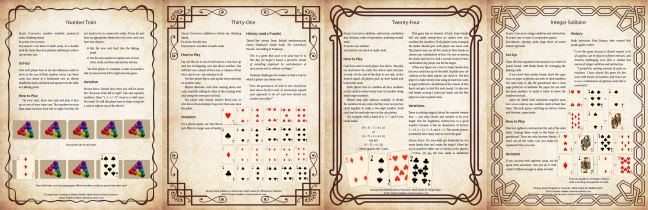
To give you a feel for the Tabletop Math Games Collection books, I’ve put together a free printable sampler file, with 4 ready-to-play card games you can enjoy today.
(Yes, if you missed last year’s Kickstarter, you’ll also be able to get Volume One.)
Test Out Four Free Sample Games
Math games build mental flexibility and strategic reasoning in players of all ages. And even people who hated math in school can enjoy the friendly challenge of a game.
I’ve put together a free printable sampler file, with four ready-to-play card games you can enjoy today.
Welcome to the 171st edition of the Playful Math Education Blog Carnival — a smorgasbord of delectable tidbits of mathy fun. It’s like a free online magazine devoted to learning, teaching, and playing around with math from preschool to high school.
Bookmark this post, so you can take your time browsing over the next week or so.
There’s so much playful math to enjoy!
By tradition, we start the carnival with a puzzle/activity in honor of our 171st edition. But if you’d rather jump straight to our featured blog posts, click here to see the Table of Contents.
Try This Puzzle/Activity
171 is a triangular number, the sum of all the numbers from 1 to 18:
1 + 2 + 3 + … + 17 + 18 = 171.
Can you think why a number like this is called “triangular”?
What other triangular numbers can you find?
Also, 171 is a palindrome number, with the same digits forward and backward. It’s also a palindrome of powers:
171 = 52 + 112 + 52
171 = 23 + 43 + 33 + 43 + 23
So in honor of our 171st Playful Math Carnival, here is a palindrome puzzle that leads to an unsolved question in math:
Does every number turn into a palindrome eventually?
Kitten (my daughter) and I sat on the couch sharing a whiteboard, passing it back and forth as we took turns working through our prealgebra book together.
The chapter on number theory began with some puzzles about multiples and divisibility rules.
Games are fun, building a positive attitude toward math. They give students a refreshing break from textbook work and make kids willing to practice their math. Games make math practice enjoyable, something children want to do. We can happily work through many more calculations during a game than anyone would ever want to do on a homework page.
Benefits of Math Games
But more important than the fun, math games push children to think about what numbers mean and how they work. The numbers in a math game are not just meaningless abstractions, but tools that players can use to gain an advantage over their opponent.
A good math game reinforces the idea that math is about reasoning, using the things you know to figure out what you need. Math is not just about getting the right answer. It’s about what goes on in your head on the way to that answer. The answer itself is merely a side-effect. of what really matters, your thinking.
A good math game helps students develop flexibility, the ability to adapt, applying what they have learned to new situations, finding a way to work out the things they haven’t mastered yet. All these add up to a more robust type of mathematical fluency than what many people imagine possible.
Having knowledge in long-term memory can be very helpful in solving problems.
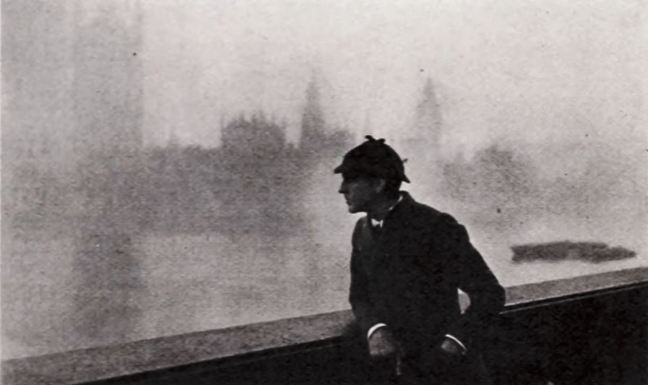
But master problem-solver Sherlock Holmes was concerned that if he had too much knowledge in his mind, new facts would crowd out the old and cause him to forget something important:
Welcome to the 170th edition of the Playful Math Education Carnival — a smorgasbord of delectable tidbits of mathy fun. It’s like a free online magazine devoted to learning, teaching, and playing around with math from preschool to high school.
Bookmark this post, so you can take your time browsing.
There’s so much playful math to enjoy!
By tradition, we start the carnival with a puzzle/activity in honor of our 170th edition. But if you’d rather jump straight to our featured blog posts, click here to see the Table of Contents.
Puzzle: Prime Permutations
According to Tanya Khovanova’s Number Gossip, 170 is the smallest composite number where exactly four permutations of its digits make prime numbers.
To find permutations, think of all the different ways you can arrange the digits 1, 7, 0 into three-digit numbers. (When the zero comes first, those permutations actually make two-digit numbers, which DO also count.)
Can you figure out which permutations make prime numbers?
Hint: The permutation that makes the number “170” is not prime, but it is the product of three prime numbers. Which ones?
For Younger Children: The 170 Square
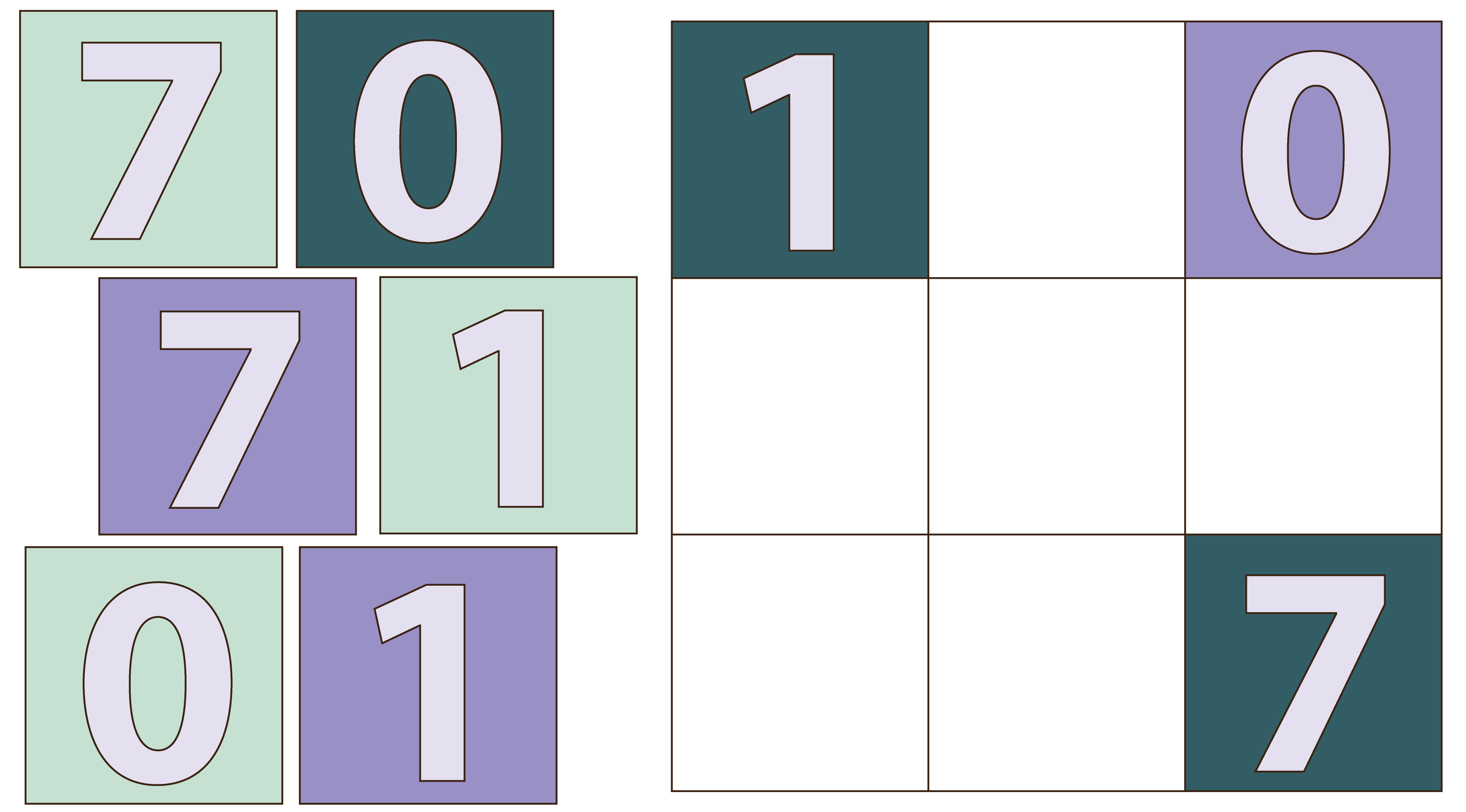
A Latin square is a grid filled with permutations: letters, numbers, or other symbols so that no row or column contains more than one of any character. You’ve probably seen the popular Latin-square puzzle called Sudoku. A Graeco-Latin square (also called an Euler square) is two independent Latin squares overlapping each other.
Can you complete this Euler square made by overlapping permutations of the digits of 170 with winter colors? Don’t repeat the same color OR the same number in any row or column.
Click the picture to get a larger image you can print.








 Denise Gaskins' Let's Play Math