Celebrating Math with Pi Day

Are your students doing anything special for Pi Day?

Back when we were homeschooling, my kids and I always felt stir-crazy after two months with no significant break. We needed a day off — and what better way could we spend it than to play math all afternoon?

I love any excuse to celebrate math!

Pi Day is March 14. If you write dates in the month/date format, then 3/14 at 1:59 is about as close as the calendar can get to 3.14159etc.

(Otherwise, you can celebrate Pi Approximation Day on July 22, or 22/7.)

Unfortunately, most of the activities on teacher blogs and Pinterest focus on the pi/pie wordplay or on memorizing the digits. With a bit of digging, however, I found a few puzzles that let us sink our metaphorical teeth into real mathematical meat.
What’s the Big Deal? Why Pi?

In math, symmetry is beautiful, and the most completely symmetric object in the (Euclidean) mathematical plane is the circle. No matter how you turn it, expand it, or shrink it, the circle remains essentially the same.

Every circle you can imagine is the exact image of every other circle there is.

This is not true of other shapes. A rectangle may be short or tall. An ellipse may be fat or slim. A triangle may be squat, or stand upright, or lean off at a drunken angle. But circles are all the same, except for magnification. A circle three inches across is a perfect, point-for-point copy of a circle three miles across, or three millimeters.

What makes a circle so special and beautiful? Any child will tell you, what makes a circle is its roundness. Perfectly smooth and plump, but not too fat.

The definition of a circle is “all the points at a certain distance from the center.” Can you see why this definition forces absolute symmetry, with no pointy sides or bumped-out curves?

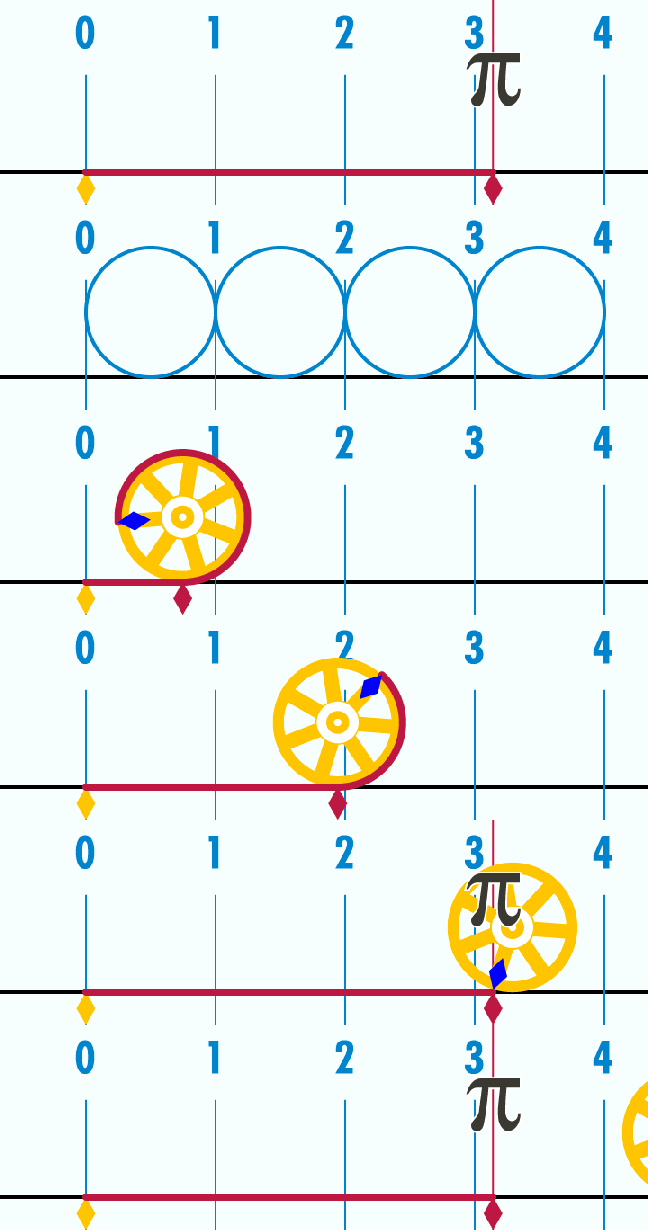
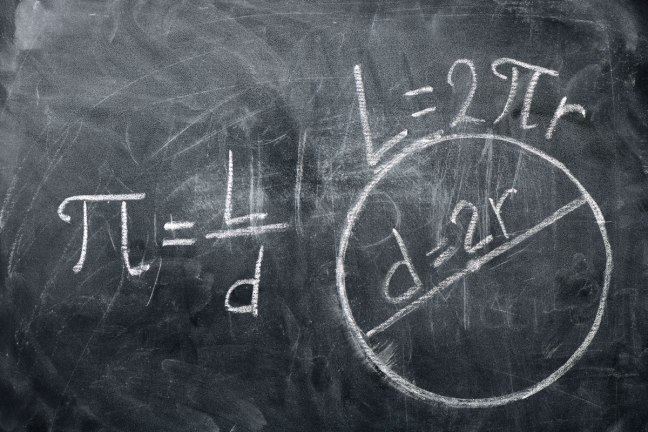
One way to express that perfect roundness in numbers is to compare it to the distance across. How many times would you have to walk back and forth across the middle of the circle to make the same distance as one trip around?

The ratio is the same for every circle, no matter which direction you walk.

That’s pi!
Puzzles with Pi

For all ages:

Sarah Carter created this fun variation on the classic Four 4s puzzle for Pi Day:

Using only the digits 3, 1, 4 once in each calculation, how many numbers can you make?

You can use any math you know: add, subtract, multiply, square roots, factorials, etc. You can concatenate the digits, putting them together to make a two-digit or three-digit number.

For older students:

1. Imagine the Earth as a perfect sphere with a long rope tightly wrapped around the equator. Then increase the length of the rope by 10 feet, and magically lift it off the Earth to float above the equator. Will an ant be able to squeeze under the rope without touching it? What about a cat? A person?

2. If you ride a bicycle over a puddle of water, the wheels will leave wet marks on the road. Obviously, each wheel leaves a periodic pattern. How the two patterns are related? Do they overlap? Does their relative position depend on the length of the puddle? The bicycle? The size of the wheels?

3. Draw a semicircle. Along its diameter draw smaller semicircles (not necessarily the same size) that touch each other. Because there are no spaces in between, the sum of the diameters of the small semicircles must equal the diameter of the large one. What about their perimeter, the sum of their arc lengths?

4. Choose any smallish number N. How can you cut a circular shape into N parts of equal area with lines of equal lengths, using only a straight-edge and compass? Hint: The lines don’t have to be straight.

[Solutions at Alexander Bogomolny’s Pi Page. Scroll down to “Extras.”]

It can be of no practical use to know that Pi is irrational, but if we can know, it surely would be intolerable not to know.

— Edward Titchmarsh
For More Information

Here are a few pi-related links you may find interesting:

Or for pure silliness:

Have fun playing math with your kids!
John Reid, CC BY-SA 3.0 via Wikimedia Commons

Why I Love Math Games

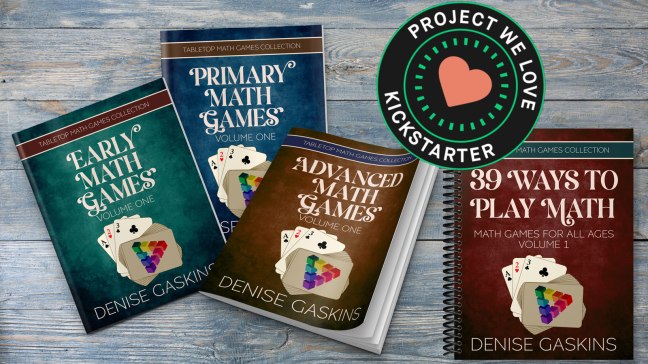
To everyone who has supported my Tabletop Math Games Collection Kickstarter project: thank you ever so much! We’ve blown past our funding target and the first two Stretch Goals. And the Kickstarter folks awarded us the “Project We Love” tag. 😻

If you haven’t backed the project yet, check out what you’re missing:

Visit the Kickstarter ❯

Why I Love Math Games

Math games build mental flexibility and strategic reasoning in players of all ages. And even people who hated math in school can enjoy the friendly challenge of a game.

I love how the challenge of a well-fought math game pushes players of all ages to think more creatively and build fluency.

Games Promote Mathematical Thinking

Math games push students to develop a creatively logical approach to solving problems. In the stress-free struggle of a game, players learn to analyze situations and draw conclusions.

Even more importantly, games help children learn to enjoy the challenge of thinking hard. Their vocabulary grows as they discuss options and strategies with their fellow players. With their attention focused on their next move, they don’t notice how much they are learning.

And games are good medicine for math anxiety. Everyone knows it takes time to master the fine points of a game, so players can get stuck or make mistakes without losing face.

What’s Special About These New Books?

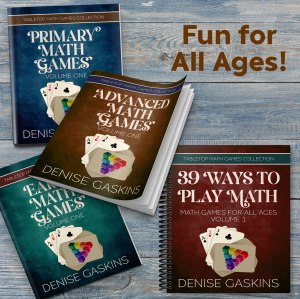
Readers of my Math You Can Play series know the joy of gaming can transform a child’s attitude toward math. But many of you tell me the books get lost on your bookshelves or in your ebook reading device. You’ve begged me to make math gaming more open-and-go.

So my new Tabletop Math Games Collection is designed to make it easier than ever for busy families and over-stressed teachers to play with math.

These books are written directly for young gamers and require only common household supplies like cards, dice, and scratch paper. Children can open to any page and start playing right away.

Not to mention the swag! I’m excited about the items we’ve created to go along with the books. The “Gaming in the Enchanted Forest” coloring page by fantasy artist Tanya Hales is absolutely delightful, and the enamel pins are a fun and colorful way to share your playful math joy.

Order Your Copy Today

Whether you’re a busy parent or an overworked teacher, you’ll love the Tabletop Math Games Collection — the natural, no-stress way to build your children’s understanding and confidence.

These are NOT the typical memory-and-speed-based math games you’ve probably seen online, but true battles of wit and skill (plus a bit of luck). Even the preschool games can be fun for adults, too.

Most of the games take only seconds to learn and less than 15 minutes to play, making them perfect ice-breakers for family gatherings, classroom warmups, or for launching a group game night.

So what are you waiting for? Grab some cards, dice, or graph paper, and let’s play some math!

Visit the Kickstarter ❯

 
* * *

This blog is reader-supported.

If you’d like to help fund the blog on an on-going basis, then please join me on Patreon for mathy inspiration, tips, and an ever-growing archive of printable activities.

If you liked this post, and want to show your one-time appreciation, the place to do that is PayPal: paypal.me/DeniseGaskinsMath. If you go that route, please include your email address in the notes section, so I can say thank you.

Which I am going to say right now. Thank you!

“__________” copyright © __________ by Denise Gaskins. Image at the top of the post copyright © __________ / Depositphotos.

Playful Math Education 162: The Math Games Carnival

Welcome to the 162nd edition of the Playful Math Education Blog Carnival — a smorgasbord of delectable tidbits of mathy fun. It’s like a free online magazine devoted to learning, teaching, and playing around with math from preschool to high school.

Bookmark this post, so you can take your time browsing.

There’s so much playful math to enjoy!

By tradition, we start the carnival with a puzzle/activity in honor of our 162nd edition. But if you’d rather jump straight to our featured blog posts, click here to see the Table of Contents.

Try This Puzzle/Activity

The number 162 is a palindromic product:

162 = 3 x 3 x 2 x 3 x 3
and 162 = 9 x 2 x 9

  • How would you define palindromic products?
  • What other numbers can you find that are palindromic products?
  • What do you notice about palindromic products?
  • What questions can you ask?

Make a conjecture about palindromic products. (A conjecture is a statement you think might be true.)

Make another conjecture. How many can you make? Can you think of a way to investigate whether your conjectures are true or false?

Click here for all the mathy goodness!

Launch Day! Act Now To Get the Earlybird Bonus

And so it begins: Tabletop Math Games Collection is LIVE on Kickstarter!

Check It Out

To have a successful campaign, we need plenty of people to back the project early. The more supporters we get — especially on the first day — the more likely the Kickstarter service folks will help spread the news for us.

So I’m offering a special bonus printable activity guide for everyone who joins the campaign at any pledge level during the first 48 hours of the campaign:

Geometric Coloring Designs 5: Advanced Tessellations is one of my favorite open-ended math art activities, which works with students from elementary to high school. And adults enjoy it, too!

The rest of the Geometric Coloring Designs series will show up as bonuses in future weeks, and early backers get them all. Whether you pledge on day 1 or day 21, your credit card won’t be charged until the campaign ends, so join early to lock in your bonus perks.

Let’s show the whole world how much fun it can be to play around with math!

Go to the Kickstarter

New Project: The Tabletop Math Games Collection

Coming Soon! On January 30th, I’ll be launching a brand new book series, the Tabletop Math Games Collection.

And the Kickstarter prelaunch page is now live. That means you can sign up to get an email from Kickstarter as soon as the campaign launches:

Visit the Prelaunch Page ❯
(free Kickstarter account required)

Test Out 4 Free Sample Games

Math games build mental flexibility and strategic reasoning in players of all ages. And even people who hated math in school can enjoy the friendly challenge of a game.

I’ve put together a free printable sampler file, with four ready-to-play card games you can enjoy today.

I think you’ll love it!

Download the Sample File ❯

Help Your Kids Learn Math the Playful Way

  • Are you a parent trying to help your child learn math?
  • Or a teacher looking for ways to encourage creative thinking?
  • Or a gamer ready to try something new with your friends?

Then the Tabletop Math Games Collection is perfect for you.

These are NOT the typical memory-and-speed-based math games you’ve probably seen online, but true battles of wit and skill (plus a bit of luck). Even the preschool games can be fun for adults, too.

Most of the games take only seconds to learn and less than 15 minutes to play, making them perfect ice-breakers for family gatherings, classroom warmups, or for launching a group game night.

Don’t miss the fun!

Hit the button to visit the prelaunch page and sign up for notifications:

Get Notified ❯

Playful Math Carnival #161 via Nature Study Australia

If you’re into math education — or just curious about how learning math could possibly be fun — you’ll definitely want to check out the latest edition of the Playful Math Education Blog Carnival. It’s a collection of awesome blog posts curated by Johanna Buijs and published on the Nature Study Australia website:

The whole point of the carnival is to show that math doesn’t have to be tedious or repetitive. Through a bunch of fun and engaging posts, we celebrate math that’s playful, creative, and totally relevant to everyday life. Because what could be more relevant that having fun while we learn?

In this edition, you’ll find everything from creative math art and music to incorporating nature and the outdoors into your lessons — and even a few racing turtles!

So if you want to mix up your math teaching and make it more enjoyable for your students (and for you!), definitely check out the Playful Math Education Blog Carnival. Happy reading!

Go Visit the Carnival

Wanted: Hosts for 2023

The Playful Math Blog Carnival is a joint effort. We depend on our volunteer hosts to collect blog posts and write the carnival each month.

Putting together a blog carnival can be a lot of work, but it’s a great opportunity to share the work of bloggers you admire and to discover new math-friends online. I love that part of being a host!

Classroom teachers, homeschoolers, college professors, unschoolers, or anyone who likes to play around with math — if you would like to take a turn hosting the carnival, please speak up.

Check the details on the carnival’s home page, and then leave a comment here or email me directly to let me know which month fits your schedule.

Playful Math Carnival Instructions

The Colors-of-Fall Carnival: Playful Math #160

Welcome to the 160th edition of the Playful Math Education Blog Carnival — a smorgasbord of delectable tidbits of mathy fun. It’s like a free online magazine devoted to learning, teaching, and playing around with math from preschool to high school.

Bookmark this post, so you can take your time browsing.

There’s so much playful math to enjoy!

By tradition, we start the carnival with a puzzle/activity in honor of our 160th edition. But if you’d rather jump straight to our featured blog posts, click here to see the Table of Contents.

Try This Puzzle/Activity

Appropriately for an October carnival, 160 is an evil number.

A number is evil if it has an even number of ones in binary form. Can you find the binary version of 160? (Hint: Exploding Dots.)

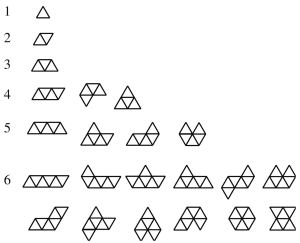
160 is also a polyiamond number. If you connect 9 equilateral triangles side-to-side, a complete set of 9-iamond shapes would have 160 pieces.

But sets that large can be overwhelming. Try playing with smaller sets of polyiamonds. Download some triangle-dot graph paper and see how many different polyiamond shapes you can make.

What do you notice? Does it make you wonder?

What designs can you create with your polyiamonds?


Photo by Daiga Ellaby on Unsplash

Click here for all the mathy goodness!

Don’t Miss Playful Math Carnivals #158 and #159!

Here is SOOOOO MUCH GREAT MATH!

Each monthly carnival brings you a new collection of ideas for playing math from preschool to high school. It’s like a free online magazine of mathematical adventures, helpful and inspiring no matter when you read them.

Explore with your kids or on your own:

Alexa Kapor-Mater put together an awesome carnival, with fun facts, activity ideas, puzzles, videos, problem-solving tips, and interesting stuff you should know. Wow!

John Golden found a delightful assortment of playful tidbits from around the internet, fun songs, games, activities, puzzles, math art, and the #Mathober challenge prompts. Love it!

Help Us Keep the Carnival Going

The Playful Math Blog Carnival is a joint effort. We depend on our volunteer hosts to collect blog posts and write the carnival each month.

Putting together a blog carnival can be a lot of work, but it’s a great opportunity to share the work of bloggers you admire and to discover new math-friends online. Classroom teachers, homeschoolers, college professors, unschoolers, or anyone who likes to play around with math — if you would like to take a turn hosting the carnival, please speak up.

Check the details on the carnival’s home page, and then leave a comment here on the blog or email me directly to let me know when you want to host.

Playful Math Carnival Instructions

CREDITS: Feature photo (top) by Count Chris on Unsplash.com.

Get a Weekly Dose of Playful Math

Our leaves haven’t started to turn yet, but summer’s on the wane, farmers are busy with harvest, and the back-to-school rush has calmed down into a daily routine.

But if you’re like me, you keep tweaking that routine, constantly looking for the perfect balance for your family or classroom. I especially love to discover easy ways to add more playful math to our schedule.

So here’s a collection of sites that offer fresh math resources on a weekly or monthly basis throughout the school year.

Which one will you try?

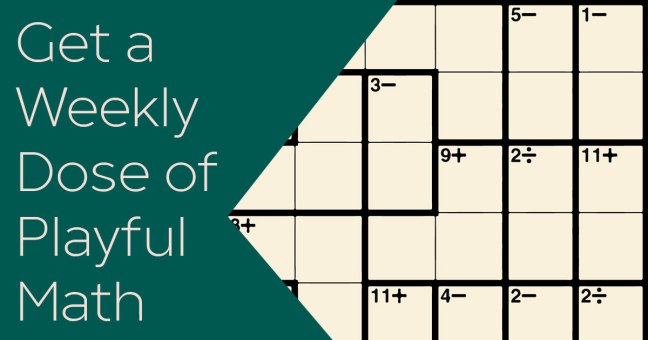
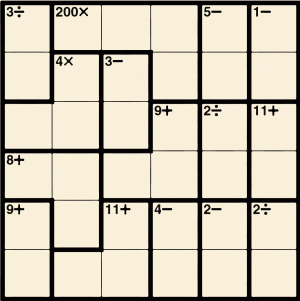
KenKen Classroom

Every week, they’ll email you a set of free KenKen arithmetic puzzles for all ages. As the challenge level subtly shifts week to week, students develop their math and logical thinking skills without even knowing it.

Subscribe ❯

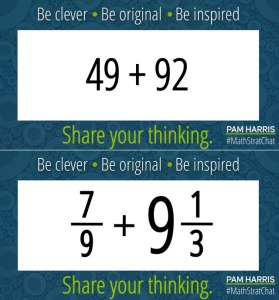
#MathStratChat

Pose an interesting math problem. How can you figure it out? What else could you do? How many different ways can you find? Which strategy do you like best for this problem?

Follow Pam Harris on your favorite social media site to get a new problem every Wednesday.

Choose a Problem ❯

The Parallel Universe

Dr Simon Singh, author of the No. 1 bestseller Fermat’s Last Theorem and The Simpsons and Their Mathematical Secrets has created a set of weekly maths challenges – just 15-30 minutes of interesting, fun and challenging tidbits of mystery and history, activities and oddities, puzzles and problems.

Help students expand their mathematical horizons beyond the school curriculum and build strong mathematical thinking skills. Stretch your brain every week!

Learn More ❯

Limited Time Book Deals

Do you want to help your children master problem-solving skills?

Check out my temporary online store for anyone who missed the Kickstarter.

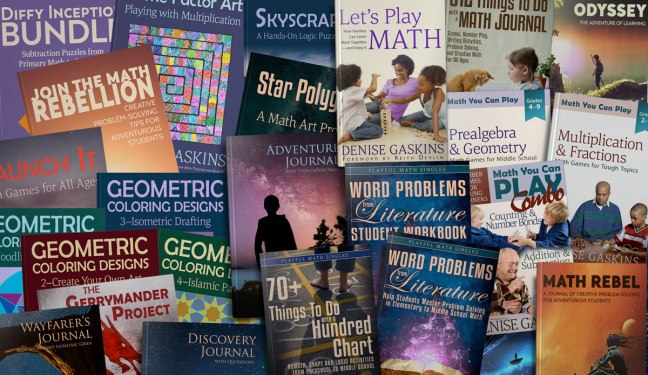
Through the end of September, you can place a preorder for the early-release edition of Word Problems from Literature, along with the Word Problems Student Workbook and exclusive Audio Commentary (or any of my other books or printable math activity guides).

I’ll lock down the preorder store when I’m ready to send the Kickstarter order to my printer.

Books will be delivered with the Kickstarter orders: Digital items in October, physical books by the end of December.

Shop Now ❯