What is a “living book”? English education reformer Charlotte Mason introduced this term for any book that brings the reader directly into contact with the major ideas that have fascinated humans across the ages.
We know that reading aloud helps build our children’s love for books. But did you know it works for math as well?
And that it can transform the parent’s attitude as well as the child’s?
A playful math book fleshes out the bones of abstract math, brings it alive, makes it human, relatable, interesting to readers of all ages, opening our eyes to the wonderful world of big ideas, where concepts meet and topics intertwine in a beautifully intricate dance of understanding.
We live in an age of abundance, with more new creative math books being published every year, so many that I can’t keep track of them all, not to mention the older classics, some out of print, that can still be found in public libraries.
Here are a few of my favorite books of playful, living math, both old and new:
I was asked to do an interview for a new podcast called Learning is Disruptable, and that got me thinking…
Is Math Education Ripe for Disruption?
Math education is not working. Too many people come out of school with math avoidance, math anxiety or even phobia, a profound conviction that math is not for them.
Generally, humans enjoy success, the feeling that things make sense, that they are capable of understanding big ideas. People like subjects that give them this type of success, where they are meeting and making sense of new ideas, growing in mastery.
But they hate subjects that make them feel like a failure, where things don’t make sense and there seems to be no real chance of success.
Therefore, understanding our students’ attitude toward math gives us a solid indication of how well they are learning.
There’s a great new homeschool math program that can radically transform your children’s experience of math, building understanding through creative exploration.
And you can start now, for free, with the Notice, Wonder, Discover Orientation Course.
Back when I was still homeschooling, I read a couple of articles by Keith Devlin about the benefits of teaching children algebra, even before they study numbers.
As a homeschooler leaning toward Charlotte Mason-style education, I found the notion of algebra-first math intriguing. What if we could introduce students to the big ideas of math, the foundational concepts that explain how numbers relate, before they get distracted by details like math facts and memorized rules?
“I think the most important thing that we need to change…we need to radically change what our idea is of what it means to learn math.
“Our biggest failure, both in the classroom and in homeschool settings, is that we’ve given our children a totally wrong idea of what math is all about.
The Playful Math Education Carnival (formerly “Math Teachers at Play”) is a monthly collection of mathy fun: tips, tidbits, games, activities, and more.
It’s like a free online magazine of mathematical adventures. If you like to learn new things and play around with ideas, you are sure to find something of interest.
Normally, I post a blog about each month’s carnival as it goes live. But this year has been anything but normal!
First there was my daughter’s medical issue, which took up months of my time. Happily, that is resolved and she’s doing well, back to all her normal-life activities.
Then there was the big storm that dropped a tree on our house. (Don’t worry, we’re all fine!) Cleaning up from that has taken months of work and more than a dozen bonfires — and we’re still far from done.
But I have climbed out from under the To-Do list enough to notice my blogging negligence. So without further ado, here are all the carnivals I missed, full of great mathy activities and games to play with your kids…
Playful Math Carnival 163 at 1001 Math Problems
First up, Sian’s delightful collection of math projects, puzzles, and games posted in March. Don’t worry that these may be out-of-date, because playful math is evergreen.
Playful Math Carnival 165 at Nature Study Australia
Jo put together an especially varied carnival, full of mathy goodness. She writes, “If you have always thought math is about right and wrong, yes and no, be prepared to be stretched and amazed at the fun ways math can be played with!”
Sue filled our summer break (or winter, for those down under) with puzzles, games, and more — even a peek at three upcoming math novels. And if you struggle with fractions, don’t miss Henri Picciotto’s Fractions on Grids.
The carnival is a joint effort. We need more volunteers.
Classroom teachers, homeschoolers, college professors, unschoolers, or anyone who likes to play around with math — if you would like to take a turn hosting the carnival, please speak up!
Are your students doing anything special for Pi Day?
Back when we were homeschooling, my kids and I always felt stir-crazy after two months with no significant break. We needed a day off — and what better way could we spend it than to play math all afternoon?
I love any excuse to celebrate math!
Pi Day is March 14. If you write dates in the month/date format, then 3/14 at 1:59 is about as close as the calendar can get to 3.14159etc.
(Otherwise, you can celebrate Pi Approximation Day on July 22, or 22/7.)
Unfortunately, most of the activities on teacher blogs and Pinterest focus on the pi/pie wordplay or on memorizing the digits. With a bit of digging, however, I found a few puzzles that let us sink our metaphorical teeth into real mathematical meat.
What’s the Big Deal? Why Pi?
In math, symmetry is beautiful, and the most completely symmetric object in the (Euclidean) mathematical plane is the circle. No matter how you turn it, expand it, or shrink it, the circle remains essentially the same.
Every circle you can imagine is the exact image of every other circle there is.
This is not true of other shapes. A rectangle may be short or tall. An ellipse may be fat or slim. A triangle may be squat, or stand upright, or lean off at a drunken angle. But circles are all the same, except for magnification. A circle three inches across is a perfect, point-for-point copy of a circle three miles across, or three millimeters.
What makes a circle so special and beautiful? Any child will tell you, what makes a circle is its roundness. Perfectly smooth and plump, but not too fat.
The definition of a circle is “all the points at a certain distance from the center.” Can you see why this definition forces absolute symmetry, with no pointy sides or bumped-out curves?
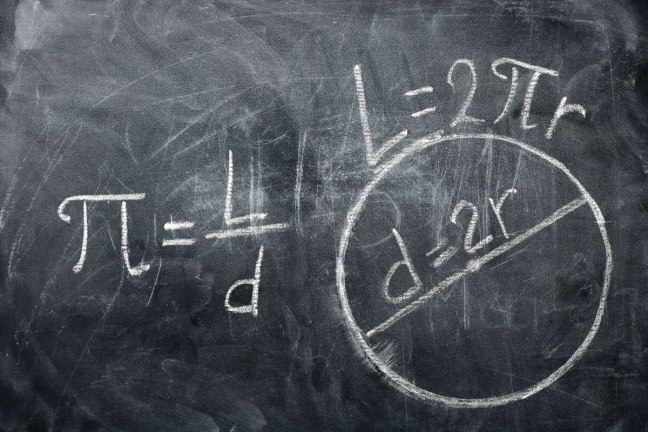
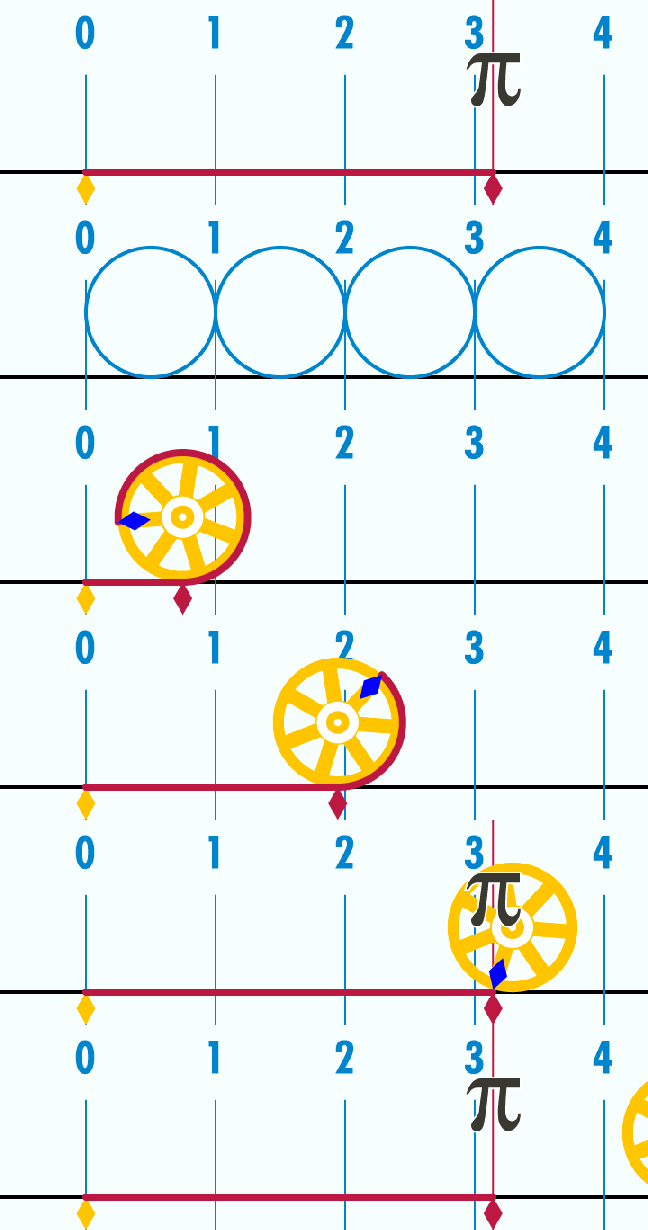
One way to express that perfect roundness in numbers is to compare it to the distance across. How many times would you have to walk back and forth across the middle of the circle to make the same distance as one trip around?
The ratio is the same for every circle, no matter which direction you walk.
That’s pi!
Puzzles with Pi
For all ages:
Sarah Carter created this fun variation on the classic Four 4s puzzle for Pi Day:
Using only the digits 3, 1, 4 once in each calculation, how many numbers can you make?
You can use any math you know: add, subtract, multiply, square roots, factorials, etc. You can concatenate the digits, putting them together to make a two-digit or three-digit number.
1. Imagine the Earth as a perfect sphere with a long rope tightly wrapped around the equator. Then increase the length of the rope by 10 feet, and magically lift it off the Earth to float above the equator. Will an ant be able to squeeze under the rope without touching it? What about a cat? A person?
2. If you ride a bicycle over a puddle of water, the wheels will leave wet marks on the road. Obviously, each wheel leaves a periodic pattern. How the two patterns are related? Do they overlap? Does their relative position depend on the length of the puddle? The bicycle? The size of the wheels?
3. Draw a semicircle. Along its diameter draw smaller semicircles (not necessarily the same size) that touch each other. Because there are no spaces in between, the sum of the diameters of the small semicircles must equal the diameter of the large one. What about their perimeter, the sum of their arc lengths?
4. Choose any smallish number N. How can you cut a circular shape into N parts of equal area with lines of equal lengths, using only a straight-edge and compass? Hint: The lines don’t have to be straight.
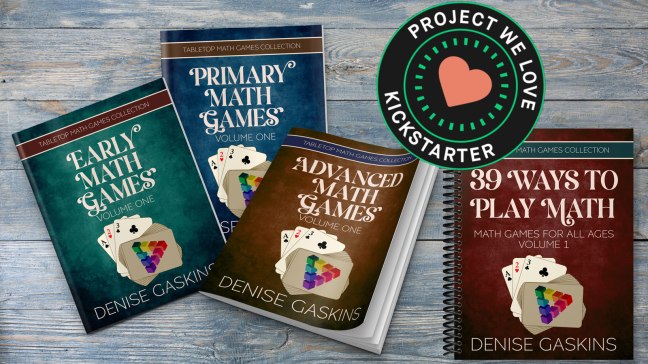
To everyone who has supported my Tabletop Math Games Collection Kickstarter project: thank you ever so much! We’ve blown past our funding target and the first two Stretch Goals. And the Kickstarter folks awarded us the “Project We Love” tag. 😻
If you haven’t backed the project yet, check out what you’re missing:
Math games build mental flexibility and strategic reasoning in players of all ages. And even people who hated math in school can enjoy the friendly challenge of a game.
I love how the challenge of a well-fought math game pushes players of all ages to think more creatively and build fluency.
Games Promote Mathematical Thinking
Math games push students to develop a creatively logical approach to solving problems. In the stress-free struggle of a game, players learn to analyze situations and draw conclusions.
Even more importantly, games help children learn to enjoy the challenge of thinking hard. Their vocabulary grows as they discuss options and strategies with their fellow players. With their attention focused on their next move, they don’t notice how much they are learning.
And games are good medicine for math anxiety. Everyone knows it takes time to master the fine points of a game, so players can get stuck or make mistakes without losing face.
What’s Special About These New Books?
Readers of my Math You Can Play series know the joy of gaming can transform a child’s attitude toward math. But many of you tell me the books get lost on your bookshelves or in your ebook reading device. You’ve begged me to make math gaming more open-and-go.
So my new Tabletop Math Games Collection is designed to make it easier than ever for busy families and over-stressed teachers to play with math.
These books are written directly for young gamers and require only common household supplies like cards, dice, and scratch paper. Children can open to any page and start playing right away.
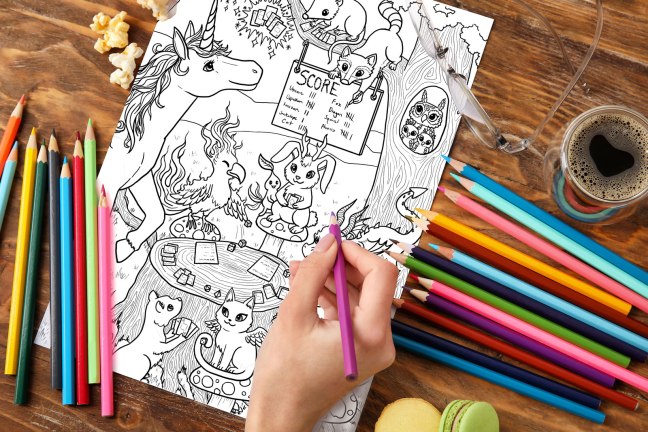
Not to mention the swag! I’m excited about the items we’ve created to go along with the books. The “Gaming in the Enchanted Forest” coloring page by fantasy artist Tanya Hales is absolutely delightful, and the enamel pins are a fun and colorful way to share your playful math joy.
Order Your Copy Today
Whether you’re a busy parent or an overworked teacher, you’ll love the Tabletop Math Games Collection — the natural, no-stress way to build your children’s understanding and confidence.
These are NOT the typical memory-and-speed-based math games you’ve probably seen online, but true battles of wit and skill (plus a bit of luck). Even the preschool games can be fun for adults, too.
Most of the games take only seconds to learn and less than 15 minutes to play, making them perfect ice-breakers for family gatherings, classroom warmups, or for launching a group game night.
So what are you waiting for? Grab some cards, dice, or graph paper, and let’s play some math!
If you’d like to help fund the blog on an on-going basis, then please join me on Patreon for mathy inspiration, tips, and an ever-growing archive of printable activities.
If you liked this post, and want to show your one-time appreciation, the place to do that is PayPal: paypal.me/DeniseGaskinsMath. If you go that route, please include your email address in the notes section, so I can say thank you.
Welcome to the 162nd edition of the Playful Math Education Blog Carnival — a smorgasbord of delectable tidbits of mathy fun. It’s like a free online magazine devoted to learning, teaching, and playing around with math from preschool to high school.
Bookmark this post, so you can take your time browsing.
There’s so much playful math to enjoy!
By tradition, we start the carnival with a puzzle/activity in honor of our 162nd edition. But if you’d rather jump straight to our featured blog posts, click here to see the Table of Contents.
Try This Puzzle/Activity
The number 162 is a palindromic product:
162 = 3 x 3 x 2 x 3 x 3
and 162 = 9 x 2 x 9
How would you define palindromic products?
What other numbers can you find that are palindromic products?
What do you notice about palindromic products?
What questions can you ask?
Make a conjecture about palindromic products. (A conjecture is a statement you think might be true.)
Make another conjecture. How many can you make? Can you think of a way to investigate whether your conjectures are true or false?
To have a successful campaign, we need plenty of people to back the project early. The more supporters we get — especially on the first day — the more likely the Kickstarter service folks will help spread the news for us.
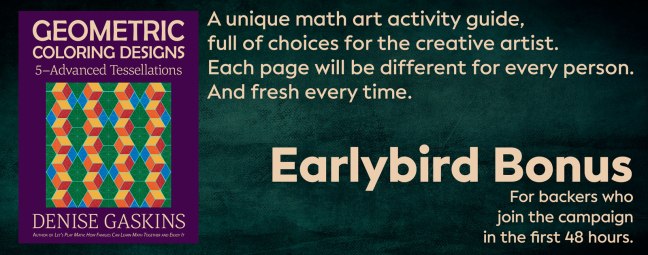
So I’m offering a special bonus printable activity guide for everyone who joins the campaign at any pledge level during the first 48 hours of the campaign:
Geometric Coloring Designs 5: Advanced Tessellations is one of my favorite open-ended math art activities, which works with students from elementary to high school. And adults enjoy it, too!
The rest of the Geometric Coloring Designs series will show up as bonuses in future weeks, and early backers get them all. Whether you pledge on day 1 or day 21, your credit card won’t be charged until the campaign ends, so join early to lock in your bonus perks.
Let’s show the whole world how much fun it can be to play around with math!