Mental Math: Advanced Division

Father and daughter working mental math

The farther we go in math, the more division disappears. It ceases to exist as a separate concept.

Instead, we learn to see division as:

  • an inverse multiplication
  • a fraction (ratio)
  • a proportional relationship

Each of these perspectives offers us a new way to think about and make sense of our calculations.

Continue reading Mental Math: Advanced Division

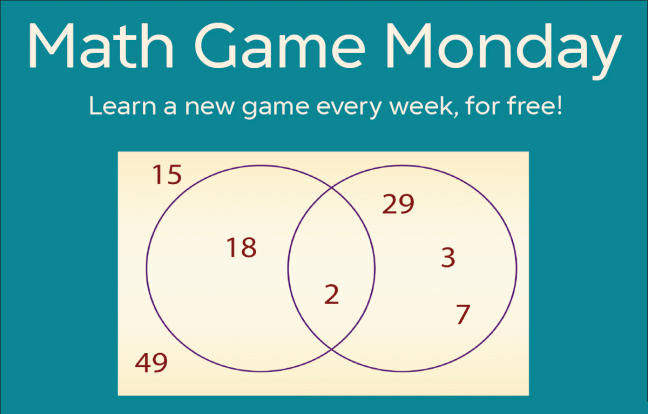
Math Game Monday: What’s My Rule?

Learn a new game with Math Game Monday

This game challenges upper-elementary and middle school students to reason about number properties.

Many parents remember struggling to learn math. We hope to provide a better experience for our children.

And one of the best ways for children to enjoy learning is through hands-on play.

What’s My Rule?

Math Concepts: Venn diagrams, factors and multiples, divisibility, prime numbers, and other number properties.

Players: two or more.

Equipment: pencil and paper, or whiteboard and markers. Calculator optional.

Continue reading Math Game Monday: What’s My Rule?

Thinking Thursday: Goose and Grapes

Thinking Thursday math journal prompt

Writing to Learn Math: Problem-solving cares less about whether an answer is right and more about whether a solution makes sense.

Do you want your children to develop the ability to reason creatively and figure out things on their own?

Help kids practice slowing down and taking the time to fully comprehend a math topic or problem-solving situation with these classic tools of learning: Notice. Wonder. Create.

Continue reading Thinking Thursday: Goose and Grapes

Mental Math: Advanced Multiplication, Part 2

Father and son celebrate a mental math answer

The methods in last week’s Advanced Multiplication post only work for certain numbers, but we have another, more powerful multiplication tool: We can always use a ratio table to make sense of any multiplication.

Ratios are the beginning of proportional thinking. We can systematically alter the numbers in a ratio to reach any quantity required by our problem.

Students begin working with ratios in story problems that help them visualize and make sense of a proportional relationship.

Continue reading Mental Math: Advanced Multiplication, Part 2

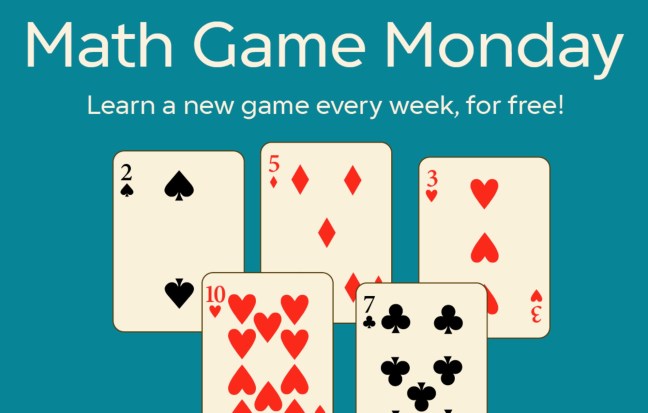
Math Game Monday: Target Ten

Learn a new math game every week, for free

This equation game for elementary students builds creative, flexible thinking about addition and subtraction.

Many parents remember struggling to learn math. We hope to provide a better experience for our children.

And one of the best ways for children to enjoy learning is through hands-on play.

Target Ten

Math Concepts: addition, subtraction, multistep calculation.

Players: any number.

Equipment: one deck of math cards, pencils and paper, timer (optional).

Continue reading Math Game Monday: Target Ten

Thinking Thursday: Ernest Hemingway

Thinking Thursday math journal prompt

Writing to Learn Math: What did the author mean? Put the thought in your own words. Do you agree or disagree? Why?

Do you want your children to develop the ability to reason creatively and figure out things on their own?

Help kids practice slowing down and taking the time to fully comprehend a math topic or problem-solving situation with these classic tools of learning: Notice. Wonder. Create.

Continue reading Thinking Thursday: Ernest Hemingway

Mental Math: Advanced Multiplication, Part 1

Mother and daughter working mental math together

Mental math is the key to algebra because the same principles underlie them both.

As our children learn to do calculations in their heads, they make sense of how numbers work together and build a strong foundation of understanding.

Remember that while mental math is always done WITH the mind, reasoning our way to the answer, it doesn’t have to be only IN the mind. Make sure your students have scratch paper or a whiteboard handy to jot down intermediate steps as needed.

Besides, math is always more fun when kids get to use colorful markers on a whiteboard.

Continue reading Mental Math: Advanced Multiplication, Part 1

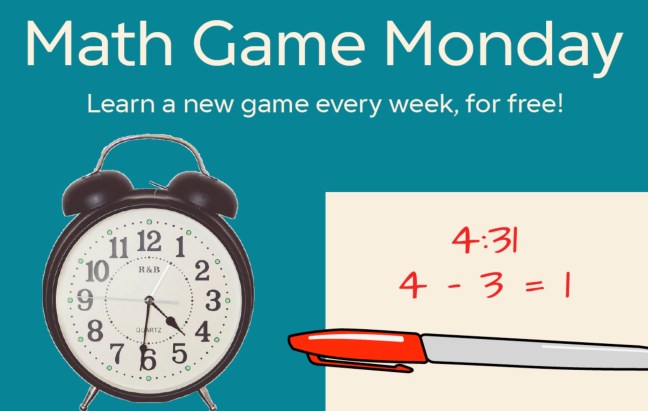
Math Game Monday: Clock Math

Learn a new math game every week, for free

This game encourages players of all ages to think creatively with numbers.

Many parents remember struggling to learn math. We hope to provide a better experience for our children.

And one of the best ways for children to enjoy learning is through hands-on play.

Clock Math

Math Concepts: arithmetic, number properties, mixed operations.

Players: any number.

Equipment: clock, pencil and paper or markers and whiteboard.

Continue reading Math Game Monday: Clock Math

Thinking Thursday: Estimation

Thinking Thursday math journal prompt

Writing to Learn Math: Research prompts help students view math as a human endeavor.

Do you want your children to develop the ability to reason creatively and figure out things on their own?

Help kids practice slowing down and taking the time to fully comprehend a math topic or problem-solving situation with these classic tools of learning: Notice. Wonder. Create.

Continue reading Thinking Thursday: Estimation

Homeschool Memories: Bill Gates Proportions II

Woman on a shopping spree to buy books

Once upon a time, when my kids and I were young…

Later the same year, not too long after our discussion of the Bill Gates proportions, I stumbled on some more data. I discovered that the median American family’s net worth was $93,100 in 2004, most of that being home equity.

This gave me another chance to play around with proportions. And since I was preparing a workshop for our regional homeschooling conference, I wrote a sample problem:

The median American family has a net worth of about $100 thousand. Bill Gates has a net worth of $56 billion. If Average Jane Homeschooler spends $100 in the vendor hall, what would be the equivalent expense for Gates?

In the last post, I explained that a proportion sets two ratios equal to each other, like equivalent fractions. Each ratio must compare similar thing to similar thing in the same order.

In this case, we are interested in the ratio “Expense compared to Net Worth.”

Continue reading Homeschool Memories: Bill Gates Proportions II