How to Build Math Literacy

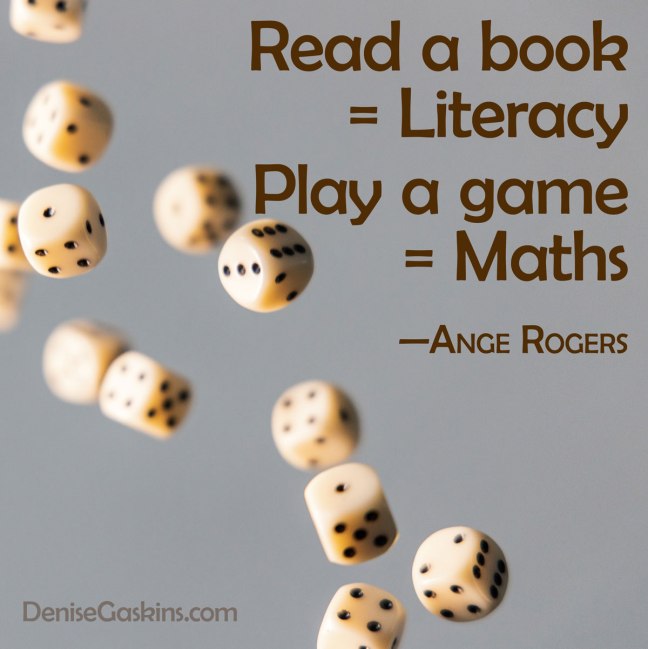
Here’s the full quote:

We all know reading a book each day to our child develops their love of literacy… well, playing games is the equivalent in maths.

Through playing card games and board games (just short and sweet ones) children develop problem solving, counting and so many other skills.

Imagine if every time you play a game you say, “Let’s do some maths.” What a positive association your child will develop with maths!

—Ange Rogers
Instagram post

Discover more creative ways to play math with young children at the Number Doctors blog.

CREDITS: “Falling dice” photo by Riho Kroll on Unsplash.

Prime Factor Art on a Hundred Chart

The best way to practice math is to play with it — to use the patterns and connections between math concepts in your pursuit of something fun or beautiful.

So this art project is a great way to practice multiplication. Use the prime factors of numbers from one to one hundred to create a colorful design.

Start with a Hundred Chart

First, download this printable file of hundred charts in non-photo blue (or light gray, if you’re printing in grayscale). The file includes:

  • Line-by-line traditional chart, counting from top to bottom.
  • Line-by-line bottom’s-up chart, counting from bottom to top.
  • Ulam’s Spiral chart, spiraling out from the center.
  • Blank grids for making your own patterns.

Download the Printable Charts

Continue reading Prime Factor Art on a Hundred Chart

Morning Coffee – 31 August 2020

Morning Coffee image

One of the best ways we can help our children learn mathematics (or anything else) is to always be learning ourselves.

Here are a few stories to read with your morning coffee this week:

  • David Butler’s post Twelve matchsticks: focus or funnel presents an interesting puzzle. But even better, it opened up a rabbit hole of thought-provoking posts about how to talk with children — or anyone.

“The approach where you have an idea in your head of how it should be done and you try to get the student to fill in the blanks is called funnelling. It’s actually a rather unpleasant experience as a student to be funnelled by a teacher. You don’t know what the teacher is getting at, and often you feel like there is a key piece of information they are withholding from you, and when it comes, the punchline feels rather flat.”

—David Butler
Twelve matchsticks: focus or funnel

Continue reading Morning Coffee – 31 August 2020

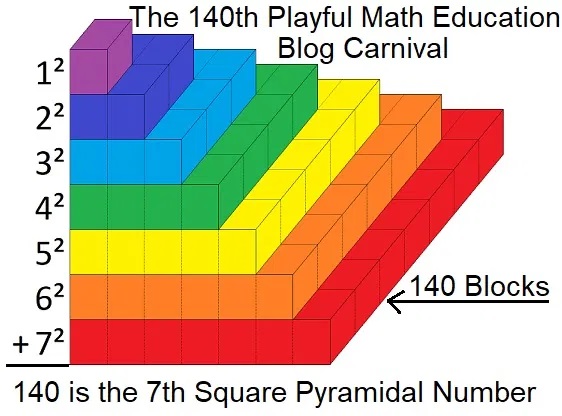
Playful Math 140 at Find the Factors

Check out new Playful Math Blog Carnival at Find the Factors blog:

A blog carnival is like a free online monthly magazine of mathematical adventures. And this edition is a great one!

Iva put together a huge collection of articles on learning, teaching, and playing around with math. There’s such a wealth of interesting things to read, you’ll want to bookmark the post and come back to it again and again.

Click here to go read the carnival blog

Continue reading Playful Math 140 at Find the Factors

Kenken is Mathematical Play

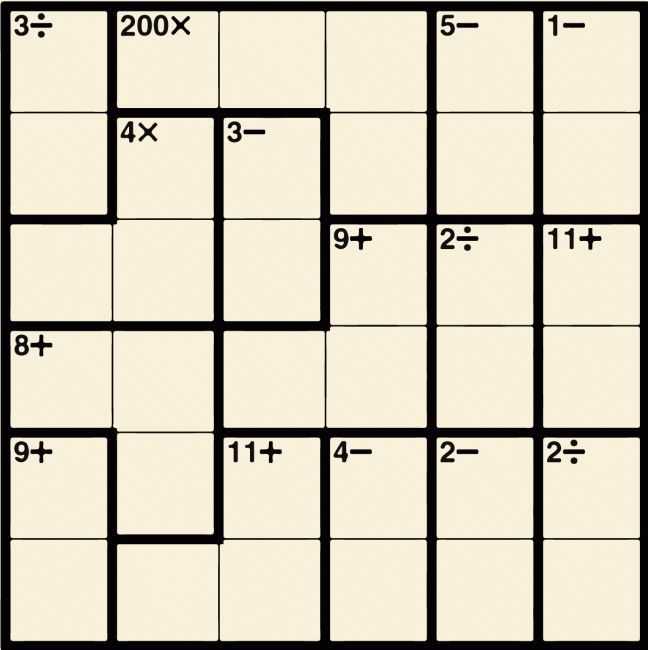
It’s back-to-school time here in the States. And that means it’s time for the Kenken Classroom Newsletter. Yay for math puzzles!

KenKen arithmetic puzzles build mental math skills, logical reasoning, persistence, and mathematical confidence.

Free via email every Friday during the school year.

What a great way to prepare your children for success in math!

Sign up anytime:

Click Here for KenKen Classroom Newsletter

Continue reading Kenken is Mathematical Play

More Math You Can Play — for Free

favorite-math-gamesThe Kickstarter is done, and today I’m kicking back and resting a bit. (And running into town for some errands, because life never stops.)

But even as I’m taking it easy around here, I know many of you are looking for ways to help your children learn to play with math.

So click the button below to go see all the games I’ve posted on my blog over the years. All free for your family’s use, and most of them don’t require anything more than a deck of cards or some paper and pencil.

My Favorite Math Games

So many great ways to play math with your kids. Have fun!

The Best Math Game Ever

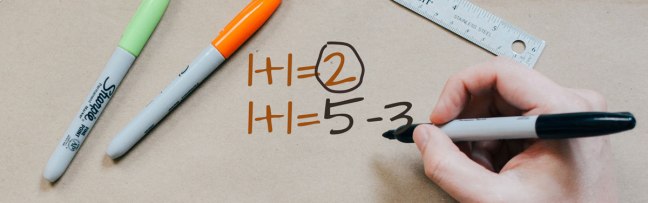
The Substitution Game features low-floor, high-ceiling cooperative play that works with any age (or with a mixed-age group) — and you can use it while distance learning, too. It’s great for building algebraic thinking.

Excerpted from my new book, Prealgebra & Geometry: Math Games for Middle School. Look for it at your favorite online bookstore.

The Substitution Game

Math Concepts: addition, subtraction, multiplication, division, order of operations, integers, fractions, equivalence and substitution.

Players: any number (a cooperative game).

Equipment: whiteboard and markers (preferred) or pencil and paper to share. Calculator optional.

Continue reading The Best Math Game Ever

Morning Coffee – 24 August 2020

Morning Coffee image

One of the best ways we can help our children learn mathematics (or anything else) is to always be learning ourselves.

Here are a few stories to read with your morning coffee this week…

“We are all mathematicians. We all have the power to notice, describe, and generalize patterns. You have all had this ability since birth. If we believe this then every day we must plan lessons that allow students to act as mathematicians. We must put something in front of our students to notice. We must put something in front of our students to describe, to generalize.”

—Sara VanDerWerf
What is Math? What do Mathematicians do?

Continue reading Morning Coffee – 24 August 2020

Journaling Pages

This afternoon, I’ve been working on the printable pdf math activity booklets I’ll be sending out as stretch goals to the backers of my Math You Can Play Kickstarter campaign.

Some of the booklets include dot grid pages for student journaling.

I love dot grid pages for writing because I can start a line anywhere on the page, and the dots help me keep things in line. (They’re also great for doodling.)

As students wrestle their thoughts into shape and create explanations, they do the same sort of work that mathematicians do every day. It’s difficult for children (or anyone) to pin down a thought and put it into words. But it’s great practice for life.

Journaling is a great practice for adult learners, too — and don’t we all want to be lifelong learners?

So I thought I’d share the journaling pages with you all, in case you’d like to get your children writing about math. There are three styles, ranging from plain to ornate parchment. Enjoy!

Download the Journaling Pages
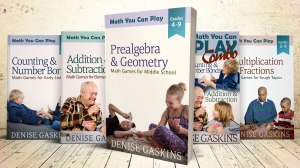
UPDATE: The Kickstarter deals have ended, but my playful math books are still available through your favorite online store or by special order at your local bookshop. (Except for the Prealgebra & Geometry Games book, scheduled for publication in early 2021. Sign up for my email list to get the latest news.)

How Mathematics Works

The full quote, as it appears in my new book:

Make a conjecture. A conjecture is a statement that you think might be true.

For example, you might make a conjecture that “All odd numbers are…” How would you finish that sentence?

Make another conjecture. And another. Does thinking about your conjectures make you wonder about math?

Can you think of any way to test your conjectures, to discover if they will always be true?

This is how mathematics works. Mathematicians notice something interesting about certain numbers, shapes, or ideas. They play around and explore how those relate to other ideas. After collecting a set of interesting things, they think about ways to organize them. They wonder about patterns and connections. They make conjectures and try to imagine ways to test them.

And mathematicians talk with one another and compare their ideas. In real life, math is a very social game.

—Denise Gaskins
Prealgebra & Geometry: Math Games for Middle School

Excerpted from my new book, Prealgebra & Geometry: Math Games for Middle School. Look for it at your favorite online bookstore.

CREDITS: “Three girls counting” photo by Charlein Gracia on Unsplash.