Mental Math: Early Addition

child counting on fingers

From the very beginning of a child’s experience with math, we want to focus on reasoning, making sense of numbers, thinking about how they relate to each other and how we can use these relationships to solve problems.

The basic idea of addition is putting like things together: combining parts to make a whole thing, putting together sets to make a collection, or starting with an original amount and adding the increase as it grows. Connecting two numbers in relationship with a third number we call the sum.

When you work with young children learning addition, remember the two key mental-math strategies I mentioned in the previous post.

  • Use friendly numbers.

For early single-digit addition, the most important friendly numbers are 5 and 10, the pairs of numbers that make 10, and the doubles.

  • Estimate, then adjust.

When children apply their creative minds to reasoning about math, they can use friendly numbers to get close to an answer, and then tweak the result as needed.

Continue reading Mental Math: Early Addition

Tell Children Interesting Things

quote by John Conway

“You don’t educate people by telling them useful things; you educate people by telling them interesting things.”

— John Conway

If you want help educating your children with interesting things about math, check out Denise Gaskins’ Playful Math store.

We’re currently running a huge back-to-school sale on ALL of my playful math ebooks, problem-solving activities, math journaling task cards, and math art projects.

So many great ways to play with math!

The 20% discount will automatically apply when you check out. No discount code required.

Check it out:

Back to School Sale 2025

Morning Coffee: That Moment of Epiphany

Morning Coffee Lifelong Learning for Parents

One of the best ways we can help our children learn mathematics (or anything else) is to be lifelong learners ourselves.

Here are a few stories to read as you sip your morning brew. . .

Download your printable Morning Coffee journal

This week’s rabbit hole started with a thought-provoking article from Dan Meyer…

“It would have been quite easy, nothing at all really, to share the epiphany with students, to share the short-cut, to tell my kid that these are all the even numbers and here is where you’ll find them…”

—Dan Meyer

Read more about the value of taking the harder long-cut in this fifth installment of professional development for homeschooling parents.

 
* * *

Are you looking for more creative ways to play math with your kids? Check out all my books, printable activities, and cool mathy merch at Denise Gaskins’ Playful Math Store. Or join my email newsletter.

This blog is reader-supported. If you’d like to help fund the blog on an on-going basis, then please join me on Patreon for mathy inspiration, tips, and an ever-growing archive of printable activities.

“Morning Coffee: That Moment of Epiphany” copyright © 2025 by Denise Gaskins. Image at the top of post copyright © Kira auf der Heide / Unsplash.

Happy Pythagorean Triple Day!

Pythagorean Theorem demonstrated with tangrams

Thursday is Pythagorean Triple Day, one of the rarest math holidays.

The numbers of Thursday’s date: 7/24/25 or 24/7/25, fit the pattern of the Pythagorean Theorem: 7 squared + 24 squared = 25 squared.

Any three numbers that fit the a2 + b2 = c2 pattern form a Pythagorean Triple.

Continue reading Happy Pythagorean Triple Day!

A Poet Completes the Square

photo of quill pen and books for a math poet

Sue VanHattum and I were chatting about her young adult math books.

[Sue would love to get your help with beta-reading her books. Scroll down to the bottom of this post for details.]

In the first book of the series, Althea and the Mystery of the Imaginary Numbers, Althea learns that Tartaglia came up with a formula to solve cubic equations and wrote about it in a poem.

Sue had discovered an English translation of that poem and shared it with me. (You can read it on JoAnne Growney’s blog.) Then we wondered whether we could come up with a simpler poem, something an algebra student might be able to follow.

Perhaps you and your kids would enjoy making up poems, too. An algebra proof-poem might be too difficult for now, but check out my blog for math poetry ideas.

Continue reading A Poet Completes the Square

Playful Math 181: The Symmetry Carnival

Playful Math Carnival 181

If you’re looking for entertainment to while away the winter (or summer, for those of us up north!) — or if you’re just curious about how learning math could possibly be fun — you’ll definitely want to check out the latest edition of the Playful Math Carnival.

It’s a collection of awesome blog posts curated by Johanna Buijs and published on the Nature Study Australia website:

The whole point of the carnival is to show that math doesn’t have to be tedious or repetitive. Through a bunch of fun and engaging posts, we celebrate math that’s playful, creative, and totally relevant to everyday life.

Because what could be more relevant than having fun while we learn?

Continue reading Playful Math 181: The Symmetry Carnival

Playing to Learn

quotation from Dan Finkel

“Play and rigor support each other.

    “When students are invited to play with math, they learn more deeply, more robustly, and remember more consistently.

      “Play is promoted as something that can engage kids and give them a more positive attitude about school, but it’s easy to assume that it’s not useful for learning, when in reality the opposite is true:

        “The student who is playing tends to be the student who is learning most deeply.”

        —Dan Finkel, Math for Love newsletter

        Mental Math: Three Basic Principles

        Doing mental math on the couch

        “We know that algorithms are amazing human achievements, but they are not good teaching tools because mimicking step-by-step procedures can actually trap students into using less sophisticated reasoning than the problems are intended to develop.”

        — Pam Harris, Math Is Figure-Out-Able Podcast

        Whether you work with a math curriculum or take a less-traditional route to learning, do not be satisfied with mere pencil-and-paper competence. Instead, work on building your children’s mental math skills, because mental calculation forces a child to understand arithmetic at a much deeper level than is required by traditional pencil-and-paper methods.

        Traditional algorithms (the math most of us learned in school) rely on memorizing and rigidly following the same set of rules for every problem, repeatedly applying the basic, single-digit math facts. Computers excel at this sort of step-by-step procedure, but children struggle with memory lapses and careless errors.

        Mental math, on the other hand, relies on a child’s own creative mind to consider how numbers interact with each other in many ways. It teaches students the true 3R’s of math: to Recognize and Reason about the Relationships between numbers.

        The techniques that let us work with numbers in our heads reflect the fundamental properties of arithmetic. These principles are also fundamental to algebra, which explains why flexibility and confidence in mental math is one of the best predictors of success in high school math and beyond.

        Your textbook may explain these properties in technical terms, but don’t be intimidated by the jargon. These are just common-sense rules for playing with numbers.

        Continue reading Mental Math: Three Basic Principles

        Playful Math for the Summer

        playful dog at the beach

        I continue to dig myself out of the avalanche of tasks that built up during the years that I spent mostly down south with my mom as she was weakening.

        But here are two tidbits of mathy fun that came across my desk recently, which I think you’ll enjoy…

        Numberhive Place Value

        I think I’ve mentioned before how much I love the Numberhive game. They recently posted a series of print-and-play freebies for their new place value variation.

        DiceCulus Core Game — Mini PnP

        This cool-looking game is in prelaunch on the crowdfunding site Gamefound, but the creator has posted a free Mini Print & Play version you can download now, suitable for prealgebra and up. (The full game will have multiple variations, including a preschool level.)

        Math Journaling and Games

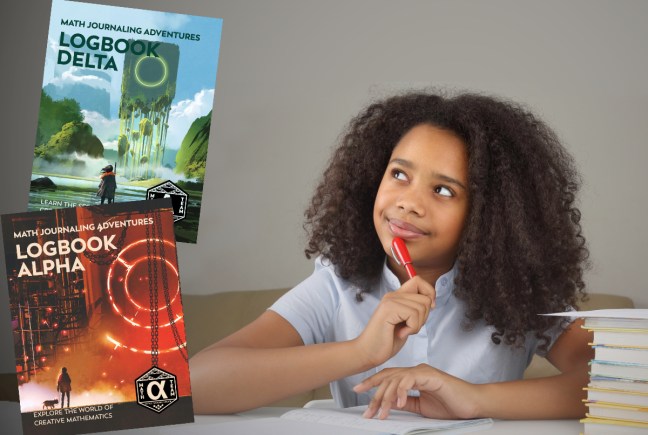
        Finally, the Math Journaling Adventures books and kids’ gear are now live in my store, and all my math game books are still on sale through the month of June.

        Have fun playing math with your kids!

         
        * * *

        Are you looking for more creative ways to play math with your kids? Join my free email newsletter.

        This blog is reader-supported. If you’d like to help fund the blog on an on-going basis, then please join me on Patreon for mathy inspiration, tips, and an ever-growing archive of printable activities.

        “Playful Math for the Summer” copyright © 2025 by Denise Gaskins. Image at the top of the post copyright © damedeeso / Depositphotos.

        Musings: Mental Math Is the Key to Algebra

        Painting by Nikolay Bogdanov-Belsky, public domain

        “If you stay with meaningful mental arithmetic longer, you will find that your child, if she is average, can do problems much more advanced than the level listed for her grade. You will find that she likes arithmetic more.

          “And when she does get to abstractions, she will understand them better.

            “She will not need two or three years of work in primary grades to learn how to write out something like a subtraction problem with two-digit numbers. She can learn that in a few moments of time, if you just wait.”

            —Ruth Beechick, An Easy Start in Arithmetic

            What Do You Mean by Mental Math?

            Mental math is doing calculations in your head, with perhaps the aid of scratch paper or a whiteboard to jot down notes along the way.

            But you cannot simply transfer the standard pencil-and-paper calculations to a mental chalkboard. That’s far too complicated.

            Continue reading Musings: Mental Math Is the Key to Algebra