Math Teachers at Play #53 via Motion Math Blog

We’re excited to celebrate the availability of Motion Math’s Pro editions and Motion Math: Hungry Guppy with this week’s Math Teachers at Play blog carnival, a monthly round-up of math-related blogs. We had some great submissions we’re excited to share with you — thanks to everyone who participated!

Let’s start with some math learning experiences —

Go read the post at Motion Math Blog!

Quotable: We’ve Been Blind

I finally got around to reading a bit of the backlog in my Google Reader. I love Malke’s blog!

I used to think that math was some kind of inaccessible, abstract magic trick, a sort of in-joke that excluded us common folk, but now I realize that math is completely not that at all. The reality of math as most of us know it is like that story where three men are standing in a dark room touching different parts of an elephant. None of them has the full picture because they’re only perceiving individual elements of the whole animal.

The reality, I’m discovering, is that math is just like that elephant: a large, expansive, three-dimensional, intelligent, sensitive, expressive creature.

The problem is that most of us have been standing around in that dark room since about kindergarten, grasping its tail, thinking “this is what math is and, personally, I don’t think it’s for me.” We’ve been blind to the larger, incredibly beautiful picture that would emerge if only we would turn on the lights and open our eyes.

Malke Rosenfeld
The Elephant in the Room

Build Mathematical Skills by Delaying Arithmetic, Part 4

To my fellow homeschoolers,

While Benezet originally sought to build his students’ reasoning powers by delaying formal arithmetic until seventh grade, pressure from “the deeply rooted prejudices of the educated portion of our citizens” forced a compromise. Students began to learn the traditional methods of arithmetic in sixth grade, but still the teachers focused as much as possible on mental math and the development of thinking strategies.

Notice how waiting until the children were developmentally ready made the work more efficient. Benezet’s students studied arithmetic for only 20-30 minutes per day. In a similar modern-day experiment, Daniel Greenberg of Sudbury School discovered the same thing: Students who are ready to learn can master arithmetic quickly!

Grade VI

[20 to 25 minutes a day]

At this grade formal work in arithmetic begins. Strayer-Upton Arithmetic, book III, is used as a basis.

[Note: Essentials of Arithmetic by George Wentworth and David Eugene Smith is available free and would probably work as a substitute.]

The processes of addition, subtraction, multiplication, and division are taught.

Care is taken to avoid purely mechanical drill. Children are made to understand the reason for the processes which they use. This is especially true in the case of subtraction.

Problems involving long numbers which would confuse them are avoided. Accuracy is insisted upon from the outset at the expense of speed or the covering of ground, and where possible the processes are mental rather than written.

Before starting on a problem in any one of these four fundamental processes, the children are asked to estimate or guess about what the answer will be and they check their final result by this preliminary figure. The teacher is careful not to let the teaching of arithmetic degenerate into mechanical manipulation without thought.

Fractions and mixed numbers are taught in this grade. Again care is taken not to confuse the thought of the children by giving them problems which are too involved and complicated.

Multiplication tables and tables of denominate numbers, hitherto learned, are reviewed.

— L. P. Benezet
The Teaching of Arithmetic II: The Story of an experiment

Continue reading Build Mathematical Skills by Delaying Arithmetic, Part 4

Build Mathematical Skills by Delaying Arithmetic, Part 3

To my fellow homeschoolers,

How can our children learn mathematics if we delay teaching formal arithmetic rules? Ask your librarian to help you find some of the wonderful living books about math. Math picture books are great for elementary students. Check your library for the Time-Life “I Love Math” books or the “Young Math Book” series. You’ll be amazed at the advanced topics your children can understand!

Benezet’s students explored their world through measurement, estimation, and mental math. Check out my PUFM Series for mental math thinking strategies that build your child’s understanding of number patterns and relationships.

Grade IV

Still there is no formal instruction in arithmetic.

By means of foot rules and yard sticks, the children are taught the meaning of inch, foot, and yard. They are given much practise in estimating the lengths of various objects in inches, feet, or yards. Each member of the class, for example, is asked to set down on paper his estimate of the height of a certain child, or the width of a window, or the length of the room, and then these estimates are checked by actual measurement.

The children are taught to read the thermometer and are given the significance of 32 degrees, 98.6 degrees, and 212 degrees.

They are introduced to the terms “square inch,” “square foot,” and “square yard” as units of surface measure.

With toy money [or real coins, if available] they are given some practise in making change, in denominations of 5’s only.

All of this work is done mentally. Any problem in making change which cannot be solved without putting figures on paper or on the blackboard is too difficult and is deferred until the children are older.

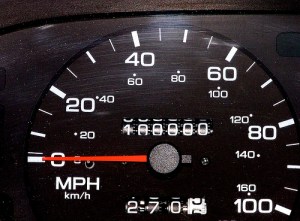
Toward the end of the year the children will have done a great deal of work in estimating areas, distances, etc., and in checking their estimates by subsequent measuring. The terms “half mile,” “quarter mile,” and “mile” are taught and the children are given an idea of how far these different distances are by actual comparisons or distances measured by automobile speedometer.

The table of time, involving seconds, minutes, and days, is taught before the end of the year. Relation of pounds and ounces is also taught.

— L. P. Benezet
The Teaching of Arithmetic II: The Story of an experiment

Continue reading Build Mathematical Skills by Delaying Arithmetic, Part 3

Cool Fibonacci Conversion Trick

photo by Muffet via flickr

Maria explains how to use the Fibonacci Numbers to convert distance measurements between miles and kilometers:

P.S.: Congratulations to Maria for her Math Mammoth program being featured in the latest edition of Cathy Duffy’s 100 Top Picks for Homeschool Curriculum! And Home School Buyer’s Co-op has a sale on Cathy Duffy’s book through the end of July.

Build Mathematical Skills by Delaying Arithmetic, Part 2

To my fellow homeschoolers,

Most young children are not developmentally ready to master abstract, pencil-and-paper rules for manipulating numbers. But they are eager to learn about and explore the world of ideas. Numbers, patterns, and shapes are part of life all around us. As parent-teachers, we have many ways to feed our children’s voracious mental appetites without resorting to workbooks.

To delay formal arithmetic does not mean that we avoid mathematical topics — only that we delay math fact drill and the memorization of procedures. Notice the wide variety of mathematics Benezet’s children explored through books and through their own life experiences:

Grade I

There is no formal instruction in arithmetic. In connection with the use of readers, and as the need for it arises, the children are taught to recognize and read numbers up to 100. This instruction is not concentrated into any particular period or time but comes in incidentally in connection with assignments of the reading lesson or with reference to certain pages of the text.

Meanwhile, the children are given a basic idea of comparison and estimate thru [sic] the understanding of such contrasting words as: more, less; many. few; higher, lower; taller, shorter; earlier, later; narrower, wider; smaller, larger; etc.

As soon as it is practicable the children are taught to keep count of the date upon the calendar. Holidays and birthdays, both of members of the class and their friends and relatives, are noted.

— L. P. Benezet
The Teaching of Arithmetic II: The Story of an experiment

Continue reading Build Mathematical Skills by Delaying Arithmetic, Part 2

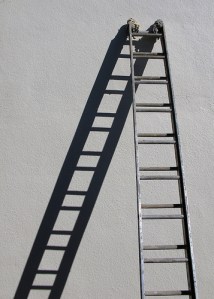
Abstraction in Language and in Math

photo by Robert Couse-Baker via flickr creative commons

Check out Dan’s interesting semi-philosophical discussion of the meaning and importance of abstraction:

The physical five oranges goes up the ladder to the picture of the five oranges which goes up to the representation of the five oranges as a numeral.

This points in the direction of a definition of abstraction: when we abstract we voluntarily ignore details of a context, so that we can accomplish a goal.

Dan Meyer

Continue reading Abstraction in Language and in Math

Build Mathematical Skills by Delaying Arithmetic, Part 1

To my fellow homeschoolers,

It’s counter-intuitive, but true: Our children will do better in math if we delay teaching them formal arithmetic skills. In the early years, we need to focus on conversation and reasoning — talking to them about numbers, bugs, patterns, cooking, shapes, dinosaurs, logic, science, gardening, knights, princesses, and whatever else they are interested in.

In the fall of 1929 I made up my mind to try the experiment of abandoning all formal instruction in arithmetic below the seventh grade and concentrating on teaching the children to read, to reason, and to recite — my new Three R’s. And by reciting I did not mean giving back, verbatim, the words of the teacher or of the textbook. I meant speaking the English language.

— L. P. Benezet
The Teaching of Arithmetic I: The Story of an experiment

Continue reading Build Mathematical Skills by Delaying Arithmetic, Part 1