MathCounts: No More Homeschool Teams

MATHCOUNTSIf you’ve heard rumors about the new ruling, here is the official take.

I try to avoid ranting on this blog, but I’m deeply disappointed. My students always enjoyed the team aspect of working/suffering together. I don’t know if any of them will be willing to participate as individuals.

Update: MathCounts: Grandfather Clause for Existing Homeschool Teams

My New Project: Blogging 2 Learn

Beginning in January, I will teach a 4th-12th grade Blogging 2 Learn class through our local homeschool co-op. For now, here is my research blog, testing ideas and trying to imagine myself as a new blogger:

Have you used blogs with your students? If so, I would love to hear your suggestions and comments. And whether you are an experienced or a wanna-be blogger, please share: What do you think a “Blogging to Learn” class should cover?

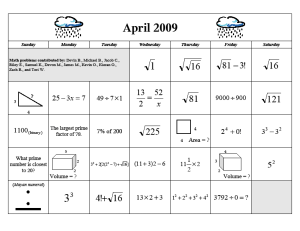
April Math Calendar

april-math-calendar

My homeschool co-op classes had a lot of fun creating this April calendar to hand out at our end-of-semester party on Friday. It’s not as easy to read as a traditional calendar — it is more like a puzzle. The expression in each square simplifies to that day’s date, so families can treat each day like a mini-review quiz: “Do you remember how to calculate this?”

Download your own copy:

If you’ve been wanting to start your own math club, you will find plenty of helpful ideas here:

Update

Check out my May Math Calendar post for more ideas about how to use these puzzles.

 
* * *

This blog is reader-supported.

If you’d like to help fund the blog on an on-going basis, then please join me on Patreon for mathy inspiration, tips, and an ever-growing archive of printable activities.

If you liked this post, and want to show your one-time appreciation, the place to do that is PayPal: paypal.me/DeniseGaskinsMath. If you go that route, please include your email address in the notes section, so I can say thank you.

Which I am going to say right now. Thank you!

“April Math Calendar” copyright © 2009 by Denise Gaskins.

My New Blog: Frugal Homeschooling


Photo by ninjapoodles.

As if I didn’t have enough things to do, I have started a new blog: Frugal Homeschooling, [It’s still there, but no new posts since Sept. 2008. I was stretched too thin, trying to do two blogs.] inspired by the popularity of my math resource page. For months, I have been wanting to write a similar page about homeschooling, but it always seemed like too big a chore even to get started.

On the new blog, however, I can enter links one post at a time — check out the latest Frugal posts in the sidebar widget, just under my Popular Posts list. Bit by bit, I hope it will grow into a helpful resource list for homeschoolers.

Continue reading My New Blog: Frugal Homeschooling

Free Shakespeare for Fun and Copywork


Photo by Arbron.

This week only, [When I checked the link in April 2011, this was still free!] CurrClick (which carries the Math Mammoth workbook series) is offering Quotations from Shakespeare’s Plays as a free download. This ebook offers copywork tips from Charlotte Mason and about 30 pages of passages from Macbeth, King Lear, Much Ado About Nothing, etc.

And if you are planning a study of the Bard, you won’t want to miss the following always-free Internet resources.

Continue reading Free Shakespeare for Fun and Copywork

Way To Go, Boys!

Math competition
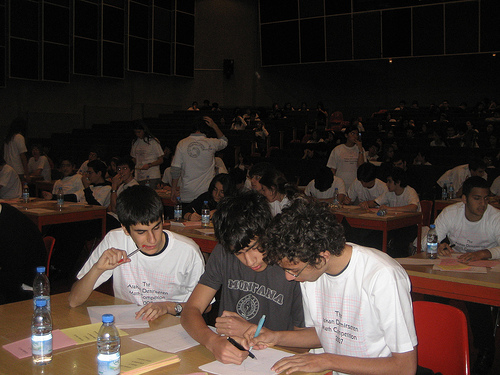
Photo by ccarlstead.

Congratulations, math team! All your hard work paid off, and I hope you enjoyed yourselves thoroughly. Of course, as C. S. Lewis wrote:

…if you do one good deed, your reward usually is to be set to do another and harder and better one.

C. S. Lewis
The Horse and His Boy

Now it’s time to practice for the state level in March. You can find practice problems online at:

Preparation Drills for MATHCOUNTS
or
The “Go Figure!” math challenge
[ACK! MathCounts has re-written their website. The old link is no longer any good, but I haven’t yet found the new location for this game.]

And give the new interactive Countdown Round game a try:

AoPS For The Win!

Continue reading Way To Go, Boys!

Quotations XIII: Mathematics Education Is Much More Complicated than You Expected

Registrations have been rolling in for our homeschool co-op, and the most popular classes are full already. Math doesn’t seem to be a “most popular” class. I can’t imagine why! Still, many of my students from last year are coming back for another go, and I am getting spill-over from the science class waiting list.

Anyway, I have started planning in earnest for our fall session. As usual, I look to those wiser than myself for inspiration…

Many teachers are concerned about the amount of material they must cover in a course. One cynic suggested a formula: since, he said, students on the average remember only about 40% of what you tell them, the thing to do is to cram into each course 250% of what you hope will stick.

Paul Halmos

Continue reading Quotations XIII: Mathematics Education Is Much More Complicated than You Expected

Top 10 Reasons To Homeschool

This week’s Carnival of Homeschooling highlights the Department of Education’s (yes, the federal government agency) list of top reasons to homeschool your children. Janine Cate of Why Homeschool, the carnival’s home blog, says:

I’ve noticed that these reasons for homeschooling are phrased with the assumption that there must be something wrong with the school, wrong with the child or wrong with the family to motivate homeschooling. This is not surprising considering the list came from the Department of Education. Thus, I’ve added my own commentary in parenthesis.

It is an interesting read, as are the many homeschooling blog articles in the carnival. Check it out!

As I write, there is still time to send in your submissions for this week’s Carnival of Education, which should be up sometime tomorrow at The Education Wonks. I will come back then to put up a specific link.

Edited to add: The Carnival Of Education—Week 127 is now posted.

How To Start a Homeschool Math Club

From a recent e-mail:

“Hello! I am on the board of a homeschool co-op. We have had requests for a math club and wondered if you have any tips for starting one. We service children from K-10th and would need to try to meet the needs of as many ages as possible.”

There are several ways you might organize a homeschool math club, depending on the students you have and on your goals. I think you would have to split the students by age groups — it is very hard to keep that wide of a range of students interested. Then decide whether you want an activity-oriented club or a more academic focus.

When I started my first math club, I raided the math shelves in the children’s section at my library (510-519) for anything that interested me. I figured that if an activity didn’t interest me, I couldn’t make it fun for the kids. Over the years we have done a variety of games, puzzles, craft projects, and more — always looking for something that was NOT like whatever the kids would be doing in their textbooks at home.

Continue reading How To Start a Homeschool Math Club