Free Shakespeare for Fun and Copywork


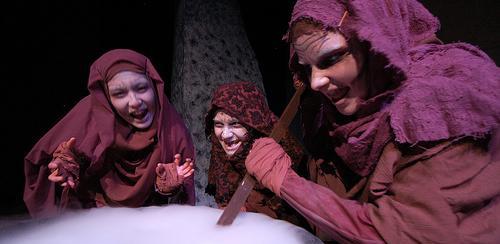
Photo by Arbron.

This week only, [When I checked the link in April 2011, this was still free!] CurrClick (which carries the Math Mammoth workbook series) is offering Quotations from Shakespeare’s Plays as a free download. This ebook offers copywork tips from Charlotte Mason and about 30 pages of passages from Macbeth, King Lear, Much Ado About Nothing, etc.

And if you are planning a study of the Bard, you won’t want to miss the following always-free Internet resources.

Continue reading Free Shakespeare for Fun and Copywork

Way To Go, Boys!

Math competition
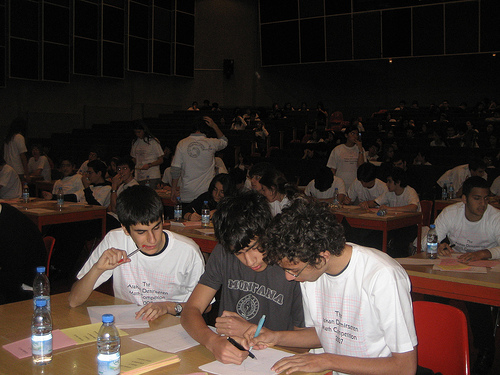
Photo by ccarlstead.

Congratulations, math team! All your hard work paid off, and I hope you enjoyed yourselves thoroughly. Of course, as C. S. Lewis wrote:

…if you do one good deed, your reward usually is to be set to do another and harder and better one.

C. S. Lewis
The Horse and His Boy

Now it’s time to practice for the state level in March. You can find practice problems online at:

Preparation Drills for MATHCOUNTS
or
The “Go Figure!” math challenge
[ACK! MathCounts has re-written their website. The old link is no longer any good, but I haven’t yet found the new location for this game.]

And give the new interactive Countdown Round game a try:

AoPS For The Win!

Continue reading Way To Go, Boys!

Quotations XIII: Mathematics Education Is Much More Complicated than You Expected

Registrations have been rolling in for our homeschool co-op, and the most popular classes are full already. Math doesn’t seem to be a “most popular” class. I can’t imagine why! Still, many of my students from last year are coming back for another go, and I am getting spill-over from the science class waiting list.

Anyway, I have started planning in earnest for our fall session. As usual, I look to those wiser than myself for inspiration…

Many teachers are concerned about the amount of material they must cover in a course. One cynic suggested a formula: since, he said, students on the average remember only about 40% of what you tell them, the thing to do is to cram into each course 250% of what you hope will stick.

Paul Halmos

Continue reading Quotations XIII: Mathematics Education Is Much More Complicated than You Expected

Top 10 Reasons To Homeschool

This week’s Carnival of Homeschooling highlights the Department of Education’s (yes, the federal government agency) list of top reasons to homeschool your children. Janine Cate of Why Homeschool, the carnival’s home blog, says:

I’ve noticed that these reasons for homeschooling are phrased with the assumption that there must be something wrong with the school, wrong with the child or wrong with the family to motivate homeschooling. This is not surprising considering the list came from the Department of Education. Thus, I’ve added my own commentary in parenthesis.

It is an interesting read, as are the many homeschooling blog articles in the carnival. Check it out!

As I write, there is still time to send in your submissions for this week’s Carnival of Education, which should be up sometime tomorrow at The Education Wonks. I will come back then to put up a specific link.

Edited to add: The Carnival Of Education—Week 127 is now posted.
How To Start a Homeschool Math Club

From a recent e-mail:

“Hello! I am on the board of a homeschool co-op. We have had requests for a math club and wondered if you have any tips for starting one. We service children from K-10th and would need to try to meet the needs of as many ages as possible.”

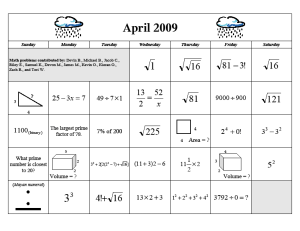
There are several ways you might organize a homeschool math club, depending on the students you have and on your goals. I think you would have to split the students by age groups — it is very hard to keep that wide of a range of students interested. Then decide whether you want an activity-oriented club or a more academic focus.

When I started my first math club, I raided the math shelves in the children’s section at my library (510-519) for anything that interested me. I figured that if an activity didn’t interest me, I couldn’t make it fun for the kids. Over the years we have done a variety of games, puzzles, craft projects, and more — always looking for something that was NOT like whatever the kids would be doing in their textbooks at home.

Continue reading How To Start a Homeschool Math Club

How To Harness Metacognitive Decision-Making

To organize a homeschool co-op requires an awesome team of innovative planners. The e-mails keep flying as we attempt to generate dynamic problem-solving strategies. Our goal for the fall semester is to orchestrate learning intensive experiences that will encourage real-world critical thinking in our upper-level students, while at the same time maximizing developmentally- appropriate enrichment for our preschool and elementary communities.

Now you, too, can talk just like a school system bureaucrat with this handy-dandy Educational Jargon Generator. Have fun!

[Hat tip: Matthew Tabor.]

Spring, the Season for Planning…

Oops! No Alexandria Jones post this week. My writing time has been overtaken by the monster school supply catalog (“Mom, haven’t you ordered my books yet?!“) and by yesterday’s co-op planning meeting and today’s 13 (so far!) follow up emails.

Planning a homeschool co-op is a little bit like juggling kittens. No matter how careful you are, something is going to get scratched. Several of the classes I was hoping for did not draw enough interest in the public polling, but of those that remain, I would like my students to study:

dd#1 — drama, photography, sewing, Spanish, writing, guitar, and biology lab
ds — drama, photography, writing, Spanish, guitar, PE/health, and maybe biology
dd#2 — art, sewing, cooking, music, science, and maybe PE/health
[Wouldn’t you know it, not a single one of my kids wants to take any of their mom’s math classes. 🙂 ]

Problem:
We only offer three class periods. And dd#1 plans to teach karate during one of those time slots.

Well, whatever else works or doesn’t work out, I sure hope we can get the lady who took these pictures to teach that photography class.

Homeschool Burnout? 10 Tips for Coping

[Rescued from my old blog.]

Spring cleaning has made my desk look worse than before. Nobody feels like studying. The kids would rather be outside, and their mom would rather take a nap. Sound familiar? It is our annual attack of homeschool burnout.

If you, too, are suffering from lethargy and can’t face another day of school work, here are some ideas that have helped me:

(1) Re-read the homeschooling books on your shelves, or get some new ones from the library. Try to read about one a month, if you can, to help get your enthusiasm back. And then read at least one new homeschooling book per year to help you stay inspired.

(2) Connect with other homeschoolers. Meet with friends for tea, or have a Mom’s Night Out while Dad babysits.

(3) Attend support group meetings. I find that after so many years, I let the meetings slide. I think, I already know everything they are going to say. But being with other homeschoolers is encouraging, and if you find out that you can help a new homeschooler with advice, that gives you a boost, too.

Continue reading Homeschool Burnout? 10 Tips for Coping

The “Are You a Homeschooler?” Quiz

It is spring cleaning week at our house, and I thought I’d do some virtual cleaning, too. So from a folder where I stuff the “To blog about sometime” websites comes this quiz. It claims to determine whether you deserved your high school diploma — Ha! There is no way I could remember anything from that long ago.

So tell me, what did the quiz really measure?

Continue reading The “Are You a Homeschooler?” Quiz