FAQ: Memorizing the Math Facts

It came up again this week, one of the most frequently asked questions about homeschooling math:

“I believe it’s important for children to memorize the math facts, but my kids are struggling with mental math. How can I help them master these important number relationships?”

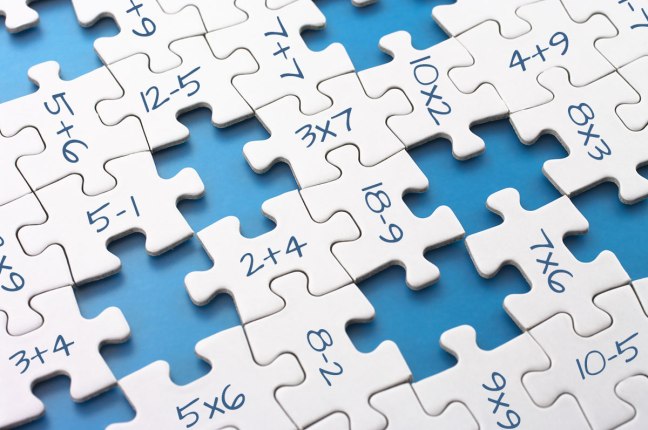
We all want our children to own the math facts, those basic relationships between small numbers that form the foundation of all arithmetic.

But I don’t think emphasizing memorization will develop the sort of fluency your children need.

The human brain remembers what it thinks about, so we want children using their brains and thinking as deeply as possible about number relationships from as many different perspectives as we can get, noticing patterns, finding connections, making sense of the math.

Continue reading FAQ: Memorizing the Math Facts

Homeschooling Math: Start Where You Are

There’s a well-known quote attributed to tennis champion Arthur Ashe (and to President Theodore Roosevelt, and probably others):

“Start where you are, use what you have, do what you can.”

How does this apply to learning math?

Many homeschoolers fear that their students have fallen behind grade level in math and worry about how to catch up.

We have an educational myth that math is a steady progression of topics arranged by ever-increasing complexity with regular signposts like mile markers that identify what students must learn at each stage along the way.

For example, first-grade students can add one-or two-digit numbers, but three-digit numbers are beyond them. Second-grade students can add three- or four-digit numbers, but never wander off into millions and billions. And so forth.

That is one valid path to learning math.

Continue reading Homeschooling Math: Start Where You Are

5 Tips for Better Homeschool Math

Many homeschoolers hate or even fear math. It’s the topic most likely to bring our children to tears.

In my last several posts, I’ve indulged my theoretical muse letting my thoughts wander over topics that may seem esoteric to parents in the midst of a daily struggle to help their child learn.

So today, let’s put away the theory and get practical:

  • What can you do today to make learning stick?
  • How can you transform tears of frustration into the satisfaction of “Aha! I get it”?

You don’t have to invest in a new curriculum to revolutionize your child’s experience of math. Just change how you use the math program you have.

Here are five tips that will help you and your child work together to build mathematical understanding.

Continue reading 5 Tips for Better Homeschool Math

Homeschool Musings: Math Manipulatives Part 3

We’ve talked about several types of math manipulative that homeschooling parents might use to help their children learn math (see part 1 and part 2), but we never stopped to ask the most basic question:

Why use math manipulatives at all?

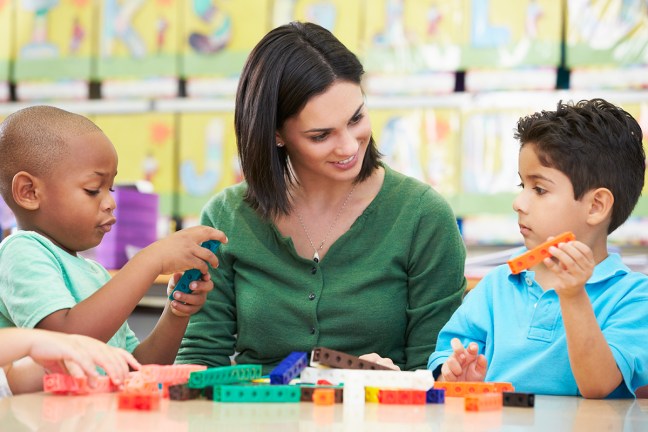
Math manipulatives are a tool for solving educational problems, so we should first decide what problem we are trying to solve. That will help us know which tool to use.

Continue reading Homeschool Musings: Math Manipulatives Part 3

Homeschool Musings: Math Manipulatives Part 2

In my previous post, I examined fingers and found items (beans, buttons, leaves, and so on) as tools that can help our children learn math. This time, we move on to the kinds of math manipulatives you’ll find in stores or packaged with your favorite curriculum.

Standard base ten blocks

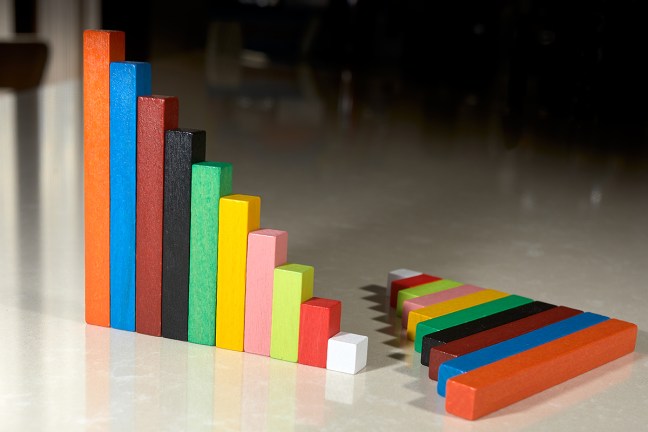
The standard base ten blocks consist of plastic or wooden cubes, a rod with the length of ten cubes, a flat shape the size of ten rods side-by-side, and a large cube equivalent to ten of the flat shapes stacked atop each other.

These are used primarily for modeling place value as a means of developing the standard arithmetic algorithms for addition and subtraction.

They can also be used for modeling decimals as a place value notation, without relying on fraction concepts. And with a bit of imagination (“Pretend the rods are stretchy, so we don’t know how long they really are”) they can model simple algebraic expressions.

Continue reading Homeschool Musings: Math Manipulatives Part 2

Homeschool Musings: Math Manipulatives Part 1

I stumbled across another blogger’s post on the common question, “What are the best math manipulatives for homeschooling?”

My answer to this question has changed over the years, as I’ve grown in my understanding of math and of education. As my current stance is far different from much of what I read from other homeschoolers, I’m going to lay out my reasoning below.

I’d love to hear your thoughts, especially if you disagree, because comparing ideas with one another is a great way to learn.

Continue reading Homeschool Musings: Math Manipulatives Part 1

Living Books for Math

What is a “living book”? English education reformer Charlotte Mason introduced this term for any book that brings the reader directly into contact with the major ideas that have fascinated humans across the ages.

We know that reading aloud helps build our children’s love for books. But did you know it works for math as well?

And that it can transform the parent’s attitude as well as the child’s?

A playful math book fleshes out the bones of abstract math,
brings it alive,
makes it human, relatable,
interesting to readers of all ages,
opening our eyes to the wonderful world of big ideas,
where concepts meet and topics intertwine
in a beautifully intricate dance
of understanding.

We live in an age of abundance, with more new creative math books being published every year, so many that I can’t keep track of them all, not to mention the older classics, some out of print, that can still be found in public libraries.

Here are a few of my favorite books of playful, living math, both old and new:

Continue reading Living Books for Math

Musings: School Math vs. Real Math

I was asked to do an interview for a new podcast called Learning is Disruptable, and that got me thinking…

Is Math Education Ripe for Disruption?

Math education is not working. Too many people come out of school with math avoidance, math anxiety or even phobia, a profound conviction that math is not for them.

Generally, humans enjoy success, the feeling that things make sense, that they are capable of understanding big ideas. People like subjects that give them this type of success, where they are meeting and making sense of new ideas, growing in mastery.

But they hate subjects that make them feel like a failure, where things don’t make sense and there seems to be no real chance of success.

Therefore, understanding our students’ attitude toward math gives us a solid indication of how well they are learning.

Continue reading Musings: School Math vs. Real Math

A Revolutionary New Approach to Homeschool Math

There’s a great new homeschool math program that can radically transform your children’s experience of math, building understanding through creative exploration.

First, a bit of history…

What Is Algebra Before Arithmetic?

Back when I was still homeschooling, I read a couple of articles by Keith Devlin about the benefits of teaching children algebra, even before they study numbers.

As a homeschooler leaning toward Charlotte Mason-style education, I found the notion of algebra-first math intriguing. What if we could introduce students to the big ideas of math, the foundational concepts that explain how numbers relate before they get distracted by details like math facts and memorized rules?

Continue reading A Revolutionary New Approach to Homeschool Math

Podcast: Cultivating Math Curiosity and Reasoning in Kids

I have a new podcast interview, and I think you’ll enjoy it!

Check out Learning Is Disruptable on your favorite podcast app, or listen on the website:

Go to the podcast ❱

Here’s an excerpt…

“I think the most important thing that we need to change…we need to radically change what our idea is of what it means to learn math.

    “Our biggest failure, both in the classroom and in homeschool settings, is that we’ve given our children a totally wrong idea of what math is all about.

    Continue reading Podcast: Cultivating Math Curiosity and Reasoning in Kids