The more years we spent homeschooling, the more I appreciated Charlotte Mason’s work and tried to incorporate her ideas into our laid-back, eclectic, not-quite-unschooling program.
We never fit the typical Charlotte Mason mold. Mosquitos and natural laziness limited our nature walks, and our version of narration was much too informal.
But those are just techniques, methods.
What really interests me in Mason’s writing is the philosophy behind the methods. Two points resonated: That we must respect our children as persons in their own right. And that we must provide a generous, wide-ranging feast to their minds.
Striving to live out those principles had a profound influence on our day-to-day homeschooling.
My youngest daughter wanted to do Singapore math. Miquon Red was her main math text at the time, but we added a bit of Singapore Primary Math 1B whenever she was in the mood.
We turned to the lesson on subtracting with numbers in the 30-somethings.
Well, I hadn’t planned on spending my day that way. But one of the great things about homeschooling is the freedom to follow rabbit trails.
While browsing the Carnival of Homeschooling, I found a link to Farm School blog’s article Fib Foolery, which sent me to Gotta Book for his articles The Fib and More Fibbery (read the comments on both threads, but be warned that some are crude) and several other posts, all of which set me off on a morning of poetic fun.
A “Fib” is a Fibonacci poem. It’s based on syllable count, like a haiku, but the lines follow the Fibonacci counting series: 1, 1, 2, 3, 5, 8… Each number is the sum of the previous two numbers.
I love my new paperback math journal series. The books are sturdy, inexpensive, and fit nicely in my purse.
But as with any paperback book, these have one problem. How do I use them without cracking the spine?
When we exercise, we need to warm up our bodies with a bit of stretching to prevent injury. In the same way, we need to warm up a new book to protect it. The process is called “breaking it in.”
It only takes a few minutes to break in a paperback book:
Step by Step
Never force the book but help it limber up gradually, and it will serve you well.
Because my journals are working books, I take the breaking-in process a bit further than shown in the video:
(1) Set the book on its back and follow the process above. Press down each cover, but not completely flat — let it bend at the fold line, about 1 cm from the actual spine. Then press a couple pages at a time, alternating front and back, down flat on each cover.
(2) Flip through the pages of the book forward and backward to limber them up.
(3) Repeat the steps of the video. This time, gently lean the main part of the book away from the part you are pressing down. Aim for a 130–140 degree angle.
(4) Flip through the pages again. For paperbacks, you can even roll the whole book back and forth a bit — gently curving the cover and pages almost as if you’re trying to fold the book in half — to encourage flexibility.
(5) Optional: Repeat the breaking-in process one more time. This time, fold each section back as close to 180 degrees as it will go.
And you’re done!
The pages will still curve in at the fold line, where they connect to the spine of the book. You want that because it makes the book strong. But now they’ll also open up to provide a nice, wide area for writing or math doodling.
“Spring cleaning has made my desk look worse than before. Nobody feels like studying. The kids would rather be outside, and their mom would rather take a nap. If I line everyone up on the curb in the morning, do you think the yellow bus will take them?”
Homeschool burnout — it’s a perennial problem. If you’re suffering from lethargy and can’t face another day of school work, here are some ideas that kept me going long enough to graduate almost-five kids (my “baby” finishes homeschooling this spring!):
(1) Re-read the homeschooling books on your shelves, or get some new ones from the library. Write down your favorite quotes as you read. Try to read about one a month, to help get your enthusiasm back. And then read at least one new homeschooling book per year to help you stay inspired.
Each week, we’ll be playing with the math, language, and logic topics found in a single chapter. I’ll be posting ideas for extension activities, videos demonstrating the concepts for the week, and additional resources. I’m really excited for the opportunity to share all the extra ideas that have been floating around my brain which I didn’t have room to include in the book (as in Marco Polo’s famous words: “I did not tell half of what I saw.”)
— Lilac Mohr
Here’s a Quick Taste of Week One
This Week’s Activities
Lilac’s blog post includes a full schedule for the eleven-week book club, featuring plenty of classic math puzzlers to play with. Here are the topics for this week.
Read Chapter 1: Mrs. Magpie’s Manual
Alliteration
Memorizing digits of Pi
Palindromes
Calculating your age on other planets
It looks like a lot of fun. I highly recommend the book (read my review), and I’m sure you and your children will enjoy discovering math and magic with Lulu and Elizabeth.
If you’d like to help fund the blog on an on-going basis, then please join me on Patreon for mathy inspiration, tips, and an ever-growing archive of printable activities.
If you liked this post, and want to show your one-time appreciation, the place to do that is PayPal: paypal.me/DeniseGaskinsMath. If you go that route, please include your email address in the notes section, so I can say thank you.
“I can’t find a home school math program my son likes. We’ve tried Singapore Math, Right Start, Saxon, and Math Mammoth. We subscribed to a month of IXL Math to keep him in practice, but he hates that, too. I know I shouldn’t have changed so many times, but this was our first year of homeschooling, and I was trying to please him. But I’m running out of things to try. Do you think Life of Fred might work?”
You’ve tried all those math programs in one year? Many people recommend that new homeschoolers take a few months off to “detox” from the classroom setting, to relax and enjoy the freedom of making their own choices. But your son might want a few months to detox from his homeschool experience.
I suggest you set aside all those books and focus on games and informal math. Try to avoid schoolish lessons until your son starts to enjoy learning for its own sake.
Here on the Range, I’m determined to establish an environment where math is not just numbers and answers. I firmly believe my children can learn all the math they want, when they’re ready, as long as they don’t convince themselves they can’t learn it, they don’t like it, or that it’s too hard. To reach this goal, math must be a regular part of our lives in a way that encourages conversation and exploration.
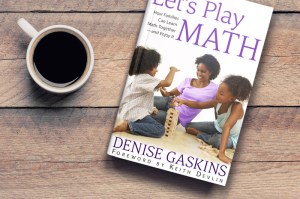
Let’s Play Math could be the very introduction a young family needs as they contemplate the first few years of homeschooling. First Son’s early years may have been completely different if I had read this book when he was five.
It could be a fantastic book for a family with a child that’s struggling (in homeschool or otherwise) with math. A few years ago, when First Son first showed signs of a potentially life-long hatred of all things numerical, reading this book may have helped me adapt the curriculum we were then using to meet his needs and enrich him. (We ended up switching and I’m happy with that, but I could have avoided quite a bit of angst.)
This book would be perfect for a parent who has always struggled with inadequacies in math or for someone like me, who always did just fine in math but never understood the claims of math’s beauty or fascination. I find myself excited to explore some of the resources the author has gathered together for my own growth and new challenges.
Socks Are Like Pants, Cats Are Like Dogs by Malke Rosenfeld and Gordon Hamilton is filled with a diverse collection of math games, puzzles, and activities exploring the mathematics of choosing, identifying and sorting. The activities are easy to start and require little preparation.
The school experience makes a tremendous difference in a child’s learning. Which of the following students would you rather be?
I continued to do arithmetic with my father, passing proudly through fractions to decimals. I eventually arrived at the point where so many cows ate so much grass, and tanks filled with water in so many hours. I found it quite enthralling.


 There’s still time to enter the book giveaway at Our Home on the Range blog: