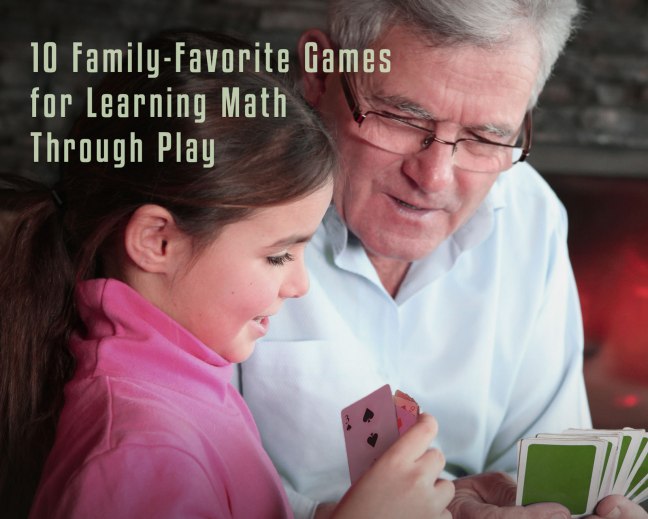
My new Let’s Play Math Sampler: 10 Family-Favorite Games for Learning Math Through Play contains short excerpts from my most popular titles, including a preview of two games from my work-in-progress Prealgebra & Geometry Games.
It’s a great way to get started with playful math!
This week, my publisher Tabletop Academy Press is offering a free copy of the Sampler to TWO lucky winners. [Winners with a U.S. mailing address will receive both paperback (by U.S. Media Mail) and ebook (by online download) versions of the book. International winners will receive ebooks only.]
How to Enter the Giveaway
The giveaway is over, but I’d still love to hear your “math memory” comments.
Share a math memory! Scroll down to leave a comment with something from your school days, a cute thing your child has said, or anything else about learning or playing with math.
Congratulations to our winners: Michael and Caroline. Check your email for details on how to claim your Let’s Play Math Sampler books.
Oops! I can’t believe I forgot to post these links when my latest book came out way back in March. Indie author fail…
Do you want your children to enjoy learning math?
Teach them how to play!
In excerpts from five of my most popular books, the Let’s Play Math Sampler features ten kid-tested games covering math concepts from counting to prealgebra.
Pick up a copy of the Let’s Play Math Sampler today, and make math a playful family adventure.
Teen author Teresa GaskinsDo you enjoy binge reading tales of epic fantasy?
Love exploring magical worlds wracked by the struggle of good against evil?
Then don’t miss Teresa Gaskins’s four-book serial adventure, The Riddled Stone.
Those of us who read her earlier books have waited eagerly to hear how the story ends. Two years longer than we hoped, since she had to squeeze in her writing between calculus exams and college essays.
But finally, it’s done!
Now a homeschool graduate, she wrote the last few scenes right at the tail end of her nineteenth year — which means these will be Teresa’s final books as a teen author.
Check them out…
The Riddled Stone: Omnibus Edition, Four Books in One
How can a knight fight magic?
Christopher Fredrico loved the quiet life of a scholar-in-training. Plenty of spare time to spend with his friends. But the night Crown Prince Tyler came to dinner, everything changed.
Falsely accused of stealing a magical artifact and banished under threat of death, Chris leaves the only home he knows.
But as he and his three friends travel towards the coast, they find a riddle that may save a kingdom — or cost them their lives.
Discover the full story of The Riddled Stone, complete in one volume.
A gift she never wanted. A curse she can’t escape.
Alone in the dark, Nora of Yorc feels the dungeon walls pressing in. Even worse, the duke’s sorcery weaves itself around her, unseen and deadly. But as the spell tightens, shy, fragile Nora breaks — and something new takes her place.
Or something old beyond memory.
Nora joined this quest to help her friends. But can she stop herself before the wildness within destroys them all?
Find out in Revealed, the exciting conclusion of Teresa Gaskins’s four-book serial fantasy adventure, The Riddled Stone.
“There are some obvious protagonists and some obvious villains, but Gaskins creates a nice ambiguity around several of the key characters. The plot itself is interesting and engaging with multiple levels of motivation that drive it along.”
“I enjoyed the book and I am absolutely amazed at how such a young author can write so well. I definitely see her going far in her writing career, and I can’t wait to see what stories she publishes next.”
CREDITS: Feature image of Neuschwanstein Castle, Schwangau, Germany, (top) by William West via Unsplash. Author photo by Christina Vernon, MelliRu.com.
One of the most common questions I get from parents who want to help their children enjoy math is, “Where do we start?”
My favorite answer: “Play games!”
Math games meet children each at their own level. The child who sits at the head of the class can solidify skills. The child who lags behind grade level can build fluency and gain confidence.
And (as Peggy Kaye pointed out in her book Games for Math) both will learn something even more important — that hard mental effort can be fun.
Now I’ve put together a short, inexpensive book to help families begin playing with math.
Let’s Play Math Sampler: 10 Family-Favorite Games for Learning Math Through Play contains short excerpts from my most popular books, including a preview of two games from my work-in-progress Prealgebra & Geometry Games.
“Denise Gaskins is that sound voice of reason that comes into my head when I get agitated teaching. This isn’t performance — this is play. My kids aren’t on trial, they are learning to learn.”
—Sonya Post
“By exploring math in a playful way, your kids will be happy to learn and will discover an enjoyment of math in the process. You might even have fun, too! ”
Do the holidays mess with your schedule? They sure do mine!
Every year, we get busy. Distracted. Just can’t focus on lessons.
I love easy activities that require minimal preparation so I can pull something out and play when we’re having one of those no-energy days.
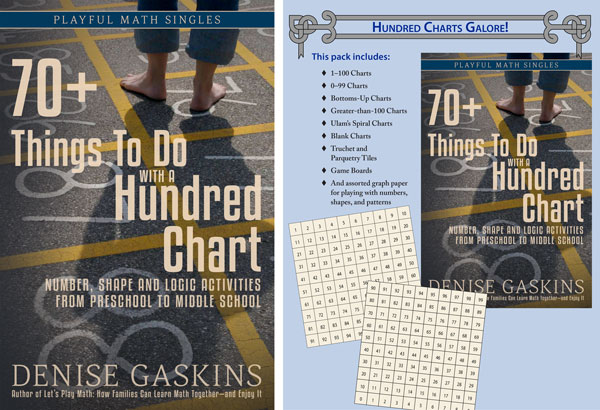
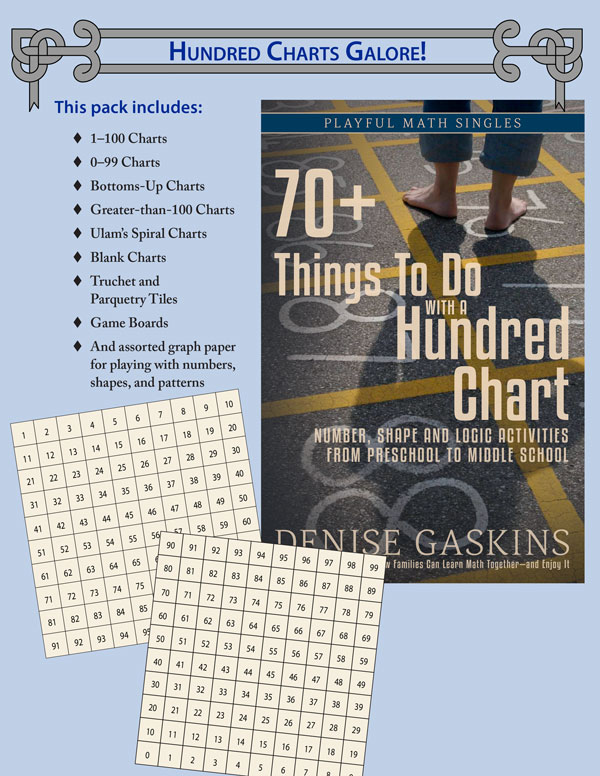
If that sounds good to you, too, then you’ll want to check out my new ebook 70+ Things To Do with a Hundred Chart: Number, Shape, and Logic Activities from Preschool to Middle School.
Long years ago, when I did workshops at homeschooling conferences, I used to share a list of seven ways to play with a hundred chart. The all-time most visited post on my blog offers 34 playful activities. Now I’ve more than doubled that total for this book.
So many ways to play! One of them is sure to be perfect for you and your children.
Take your child on a mathematical adventure with these playful, practical activities.
“It is exactly the kind of math exploration that I want to undertake with my kids.
“After reading through the book, I noticed myself making more room to trust my kids’ ability to make connections and not try to dominate by telling them how math ‘should’ work.
“An excellent way for me to move outside my math and teaching comfort zones and explore math more deeply with my kids.”
— Olisia Barron, author of ThimbleberryHome.wordpress.com
P.S.: If you have a blog and would like to host a giveaway for 70+ Things To Do with a Hundred Chart (or any of my other books), I’d be glad to provide the prize. Leave a comment below or use the contact form on my “About” page, and we’ll set up all the details.
Check out my new printables for playing math with your kids:
The free 50-page PDF Hundred Charts Galore! file features 1–100 charts, 0–99 charts, bottom’s-up versions, multiple-chart pages, blank charts, game boards, and more. Everything you need to play the activities in my new 70+ Things to Do with a Hundred Chart book.
This fall, my homeschool co-op math class will play with math journaling.
But my earlier dot-grid notebooks were designed for adults. Too thick, too many pages. And the half-cm dot grid made lines too narrow for young writers.
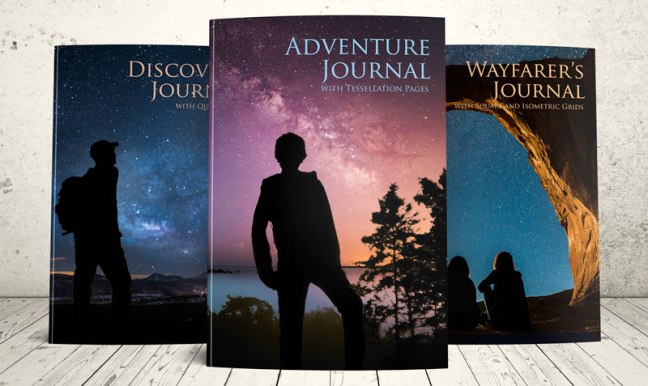
So I created a new series of paperback dot-grid journals for my elementary and middle school students.
I’m sure we’ll use several of these activities in my homeschool co-op math class this fall.
Noticing and Wondering
Learning math requires more than mastering number facts and memorizing rules. At its heart, math is a way of thinking.
So more than anything else, we need to teach our kids to think mathematically — to make sense of math problems and persevere in figuring them out.
Help your children learn to see with mathematical eyes, noticing and wondering about math problems.
Whenever your children need to learn a new idea in math, or whenever they get stuck on a tough homework problem, that’s a good time to step back and make sense of the math.
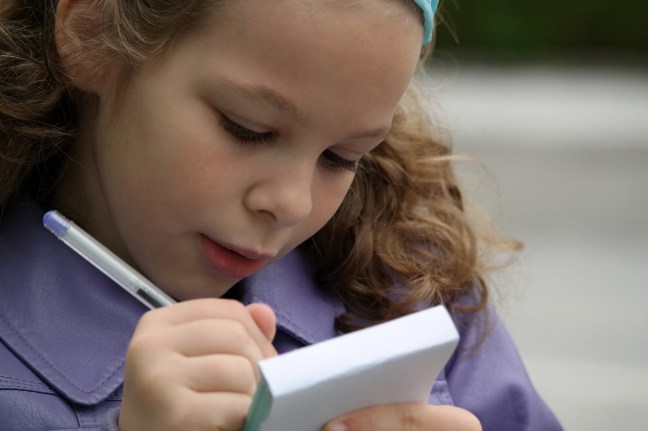
Kids can write their noticings and wonderings in the math journal. Or you can act as the scribe, writing down (without comment) everything child says.
For more tips on teaching students to brainstorm about math, check out these online resources from The Math Forum:
Problem-solving is a habit of mind that you and your children can learn and grow in. Help your kids practice slowing down and taking the time to fully understand a problem situation.
Puzzles Are Math Experiments
Almost anything your child notices or wonders can lead to a math experiment.
For example, one day my daughter played an online math game…
A math journal can be like a science lab book. Not the pre-digested, fill-in-the-blank lab books that some curricula provide. But the real lab books that scientists write to keep track of their data, and what they’ve tried so far, and what went wrong, and what finally worked.
Here are a few open-ended math experiments you might try:
Explore Shapes
Pick out a 3×3 set of dots. How many different shapes can you make by connecting those dots? Which shapes have symmetry? Which ones do you like the best?
What if you make shapes on isometric grid paper? How many different ways can you connect those dots?
Limit your investigation to a specific type of shape. How many different triangles can you make on a 3×3 set of dots? How many different quadrilaterals? What if you used a bigger set of dots?
Explore Angles
On your grid paper, let one dot “hold hands” with two others. How many different angles can you make? Can you figure out their degree without measuring?
Are there any angles you can’t make on your dot grid? If your paper extended forever, would there be any angles you couldn’t make?
Does it make a difference whether you try the angle experiments on square or isometric grid paper?
Explore Squares
How many different squares can you draw on your grid paper? (Don’t forget the squares that sit on a slant!) How can you be sure that they are perfectly square?
Number the rows and columns of dots. Can you find a pattern in the corner positions for your squares? If someone drew a secret square, what’s the minimum information you would need to duplicate it?
Does it make a difference whether you try the square experiments on square or isometric grid paper?
I’d love to hear your favorite math explorations or journaling tips!
Please share in the comments section below.
* * *
P.S.: Do you have a blog? If you’d like to feature a math journal review and giveaway, I’ll provide the prize. Send a message through my contact form or leave a comment below, and we’ll work out the details.
This blog is reader-supported.
If you’d like to help fund the blog on an on-going basis, then please head to my Patreon page.
If you liked this post, and want to show your one-time appreciation, the place to do that is PayPal: paypal.me/DeniseGaskinsMath. If you go that route, please include your email address in the notes section, so I can say thank you.
Ooo, look at my shiny new book! Let’s Play Math is now out in Korean. How cool is that?
You can find the book at these two major bookstores:
And probably in other places where Korean education or parenting books are sold.
I’m sorry to say I can’t read Korean — but I did play math there a couple years back. My daughter teaches English through EPIK, and I had a wonderful visit with her in Jeju. If you’re interested, you can see a few of my photos here, and my fraction-math sidewalk puzzle here.
And if you know a Korean-speaking family who wants to play math with their kids, I’d be honored if you share my book.
The posts on my Let’s Play Math blog are, for the most part, first-draft material. Of course, I’ve proofread each post — many times! because I’m a perfectionist that way, and yet I still miss typos — but these articles haven’t gotten the sort of feedback that polishes a book manuscript.
Well, now I’m taking some of the best of my old blog posts, expanding them with a few new games or activities, and giving them that book-quality polish. Let me introduce my newest series, the Playful Math Singles.
Under Construction …
The Playful Math Singles from Tabletop Academy Press will be short, topical books featuring clear explanations and ready-to-play activities.
I’m hoping to finish up two or three of these this year. Watch for them at your favorite online bookstore.
The first one is done …
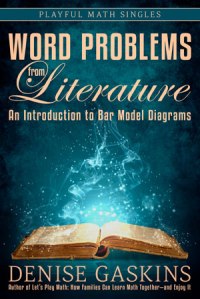
Word Problems from Literature: An Introduction to Bar Model Diagrams
You can help prevent math anxiety by giving your children the mental tools they need to conquer the toughest story problems.
Young children expect to look at a word problem and instantly see the answer. But as they get older, their textbook math problems also grow in difficulty, so this solution-by-intuitive-leap becomes impossible.
Too often the frustrated child concludes, “I’m just not good at math.”
But with guided practice, any student can learn to master word problems.
Word Problems from Literature features math puzzles for elementary and middle school students from classic books such as Mr. Popper’s Penguins and The Hobbit.
For each puzzle, I demonstrate step by step how to use the problem-solving tool of bar model diagrams, a type of pictorial algebra. For children who are used to playing with Legos or other blocks — or with computer games like Minecraft — this approach reveals the underlying structure of a math word problem. Students can make sense of how each quantity in the story relates to the others and see a path to the solution.
And when you finish the puzzles in this book, I’ll show you how to create your own word problems from literature, based in your children’s favorite story worlds.
“I found this method really clarified for me what was going on visually and conceptually. Particularly when it came to more complex questions, for which I would normally write out an equation, I felt that thinking about what was going on with the bars actually made more sense … This is a wonderful book for those who want to support their children in finding better ways to work on word problems.”
 Want to help your children learn math?












 I’d love to hear your favorite math explorations or journaling tips!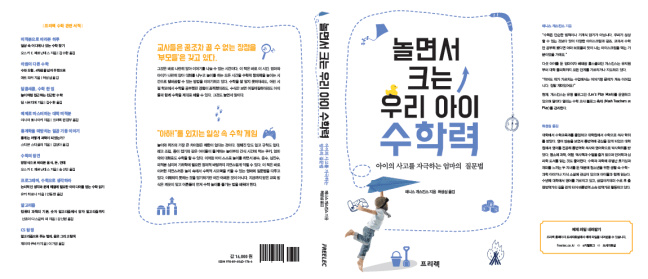


 — but these articles haven’t gotten the sort of feedback that polishes a book manuscript.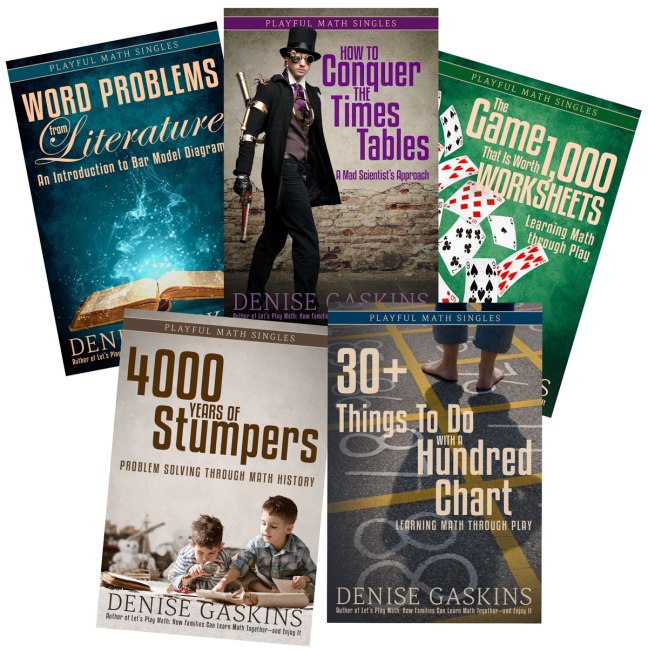
 For each puzzle, I demonstrate step by step how to use the problem-solving tool of bar model diagrams, a type of pictorial algebra. For children who are used to playing with Legos or other blocks — or with computer games like Minecraft — this approach reveals the underlying structure of a math word problem. Students can make sense of how each quantity in the story relates to the others and see a path to the solution.
 Denise Gaskins' Let's Play Math