You know the parable about the mustard seed?
After all these years, we discovered it’s a translation error.
What Jesus really said was, “The ragweed is the smallest of seeds…”

You know the parable about the mustard seed?
After all these years, we discovered it’s a translation error.
What Jesus really said was, “The ragweed is the smallest of seeds…”

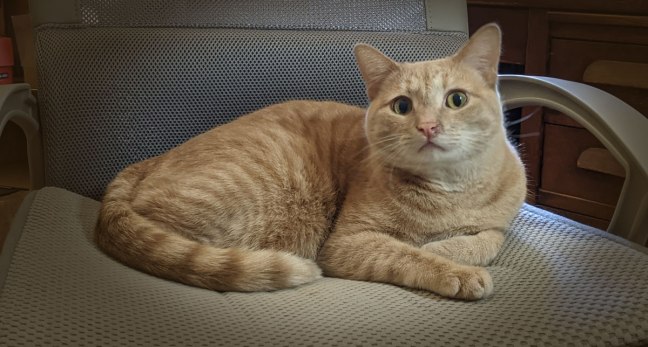
Only a writer who loves wordplay (my daughter) would name her cat Hypocorism. Hypocorism’s hypocorism is “Puck,” which well suits the little trouble-maker. He loves to climb up to the top of the bookshelf by the window, where we hung a couple of toys for him.
When he was little, he used to climb across the curtain rod to the opposite set of shelves. He still tries it from time to time, though the rod bends under his adult weight. And at least once he took a fall and had to grab for the curtain on his way down. We didn’t see it, but that’s the only explanation we could think of for the huge rip we found later.
One other disadvantage to growing up: The places he loves to sleep have somehow shrunk. After playing for a bit, he stretches out for a nap — and his back hangs dangerously over the edge.

Michael and Nash have been creating and posting new math games with astonishing regularity throughout the pandemic. Their YouTube channel is a great resource for parents who want to play math with elementary-age children.
Today’s entry: Closest to Ten, a quick game for addition and subtraction fluency with a tiny bit of multiplication potential.
And here’s one of my favorites for older players: Factor Triangles, a card game for 2-digit multiplication.
Check out their channel, and have fun playing math with your kids!
Here’s the full quote:
We all know reading a book each day to our child develops their love of literacy… well, playing games is the equivalent in maths.
Through playing card games and board games (just short and sweet ones) children develop problem solving, counting and so many other skills.
Imagine if every time you play a game you say, “Let’s do some maths.” What a positive association your child will develop with maths!—Ange Rogers
Instagram post
Discover more creative ways to play math with young children at the Number Doctors blog.
CREDITS: “Falling dice” photo by Riho Kroll on Unsplash.
The best way to practice math is to play with it — to use the patterns and connections between math concepts in your pursuit of something fun or beautiful.
So this art project is a great way to practice multiplication. Use the prime factors of numbers from one to one hundred to create a colorful design.
First, download this printable file of hundred charts in non-photo blue (or light gray, if you’re printing in grayscale). The file includes:
Do you still want a chance at the Kickstarter book deals? Or did a friend of yours miss out?
I’ve had a couple of requests from people who missed the campaign deadline but still wanted to order a book. So for a limited time, I’m taking direct orders at the Kickstarter price.
Here’s what to do:
This offer will expire in about a week — whenever Kickstarter finishes processing all the pledges and sends me their paperwork. So if you want to make an order, do it quickly.
One of the best ways we can help our children learn mathematics (or anything else) is to always be learning ourselves.
Here are a few stories to read with your morning coffee this week:
“The approach where you have an idea in your head of how it should be done and you try to get the student to fill in the blanks is called funnelling. It’s actually a rather unpleasant experience as a student to be funnelled by a teacher. You don’t know what the teacher is getting at, and often you feel like there is a key piece of information they are withholding from you, and when it comes, the punchline feels rather flat.”
—David Butler
Twelve matchsticks: focus or funnel
Check out new Playful Math Blog Carnival at Find the Factors blog:
A blog carnival is like a free online monthly magazine of mathematical adventures. And this edition is a great one!
Iva put together a huge collection of articles on learning, teaching, and playing around with math. There’s such a wealth of interesting things to read, you’ll want to bookmark the post and come back to it again and again.
For an indie business, weekends are just another workday. But I suppose with the pandemic and so many people working at home, perhaps that’s true of everyone these days.
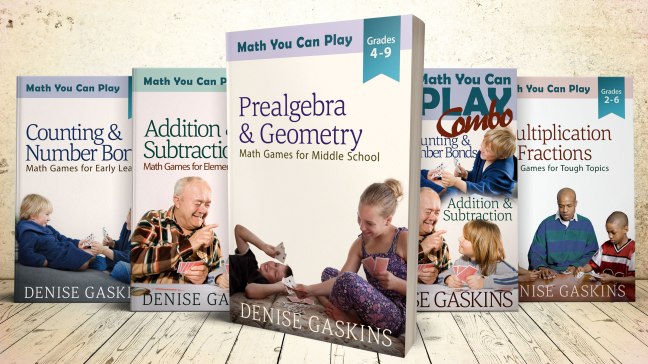
I finished the index work on Prealgebra & Geometry Games, and I think I might have the book layout under control. Time to order a proof copy.
I can get an instant digital proof. It looks just like the file I already have on my computer. But the physical book is a whole different thing from a computer file. There are always surprises.
So I want to see a real proof — an actual paperback copy — before I release a book to readers. Wouldn’t you?
And that may be a problem.