The Colors-of-Fall Carnival: Playful Math #160

Welcome to the 160th edition of the Playful Math Education Blog Carnival — a smorgasbord of delectable tidbits of mathy fun. It’s like a free online magazine devoted to learning, teaching, and playing around with math from preschool to high school.

Bookmark this post, so you can take your time browsing.

There’s so much playful math to enjoy!

By tradition, we start the carnival with a puzzle/activity in honor of our 160th edition. But if you’d rather jump straight to our featured blog posts, click here to see the Table of Contents.

Try This Puzzle/Activity

Appropriately for an October carnival, 160 is an evil number.

A number is evil if it has an even number of ones in binary form. Can you find the binary version of 160? (Hint: Exploding Dots.)
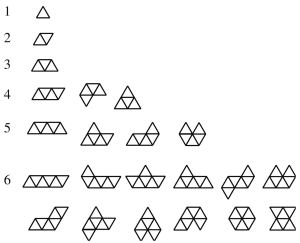
160 is also a polyiamond number. If you connect 9 equilateral triangles side-to-side, a complete set of 9-iamond shapes would have 160 pieces.

But sets that large can be overwhelming. Try playing with smaller sets of polyiamonds. Download some triangle-dot graph paper and see how many different polyiamond shapes you can make.

What do you notice? Does it make you wonder?

What designs can you create with your polyiamonds?


Photo by Daiga Ellaby on Unsplash
Click here for all the mathy goodness!

Playful Math Carnival #154: The Math Journaling Edition

Welcome to the 154th edition of the Playful Math Education Blog Carnival — a smorgasbord of delectable tidbits of mathy fun. It’s like a free online magazine devoted to learning, teaching, and playing around with math from preschool to high school.

Bookmark this post, so you can take your time browsing.

There’s so much playful math to enjoy!

By tradition, we start the carnival with a puzzle/activity in honor of our 154th edition. But if you’d rather jump straight to our featured blog posts, click here to see the Table of Contents.

Try This Puzzle/Activity

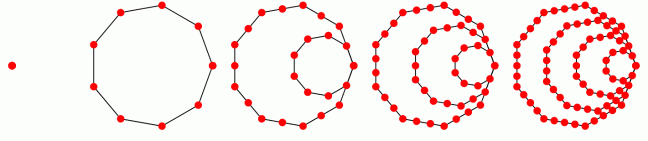
Since 154 is a nonagonal number, I think you might enjoy visiting some of my old “Adventures of Alexandria Jones” posts about figurate numbers:

And then try this math journaling prompt: Build or draw your own nonagonal numbers — numbers built from 9-sided polygons.

How many nonagonal numbers can you find? What do you notice? Does it make you wonder?

Click here for all the mathy goodness!

How Will You Celebrate this Epic Twosday?

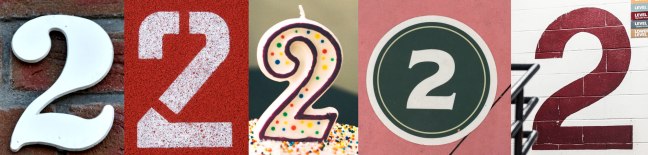
Tomorrow is Tuesday 2/22/22 (or 22/2/22, if you prefer). What a wonderfully epic Twosday!

Here’s a puzzle your family or class may enjoy…

The “All 2s” Challenge

Use only the digit 2, and try to use as few of them as you can for each calculation. You may use any math operations you know.

For example:
0 = 2 − 2
8 = 2 + 2 + 2 + 2

  • Can you find a way to make 8 using fewer than four 2s?
  • What other numbers can you make?
  • Can you calculate all the numbers from 1–20? 1–100?

Putting 2 in Perspective

You might enjoy practicing your math art skills with this 2-digit challenge from Steve Wyborney.

How many blocks make the digit 2? How did you count them?

Playful Math #152: Auld Lang Syne Edition

Welcome to the 152nd edition of the Playful Math Education Blog Carnival — a smorgasbord of delectable tidbits of mathy fun. It’s like a free online magazine devoted to learning, teaching, and playing around with math from preschool to high school.

Bookmark this post, so you can take your time browsing. There’s so much playful math to enjoy!

We didn’t have a volunteer host for January, so I’m squeezing this in between other commitments. This is my third no-host-emergency carnival in the last year, which is NOT sustainable. If you’d like to help keep the Playful Math Carnival alive, we desperately need hosts for 2022!

By tradition, we start the carnival with a puzzle or activity in honor of our 152nd edition. But if you’d rather jump straight to our featured blog posts, click here to see the Table of Contents.

Math Journaling with Prime Numbers

Cool facts about 152: The eighth prime number is 19, and 8 × 19 = 152. When you square 152, you get a number that contains all the digits from 0–4. You can make 152 as the sum of eight consecutive even numbers, or as the sum of four consecutive prime numbers.
But 152 has two real claims to fame:

  • It’s the smallest number that is the sum of the cubes of two distinct odd primes.
  • And it’s the largest known even number you can write as the sum of two primes in exactly four ways.

So here’s your math investigation prompt:

  • Play around with prime numbers. Explore their powers, their sums, and anything else about them you like.
  • What do you notice? What do you wonder?
  • What’s the most interesting number relationship you can find?

Continue reading Playful Math #152: Auld Lang Syne Edition

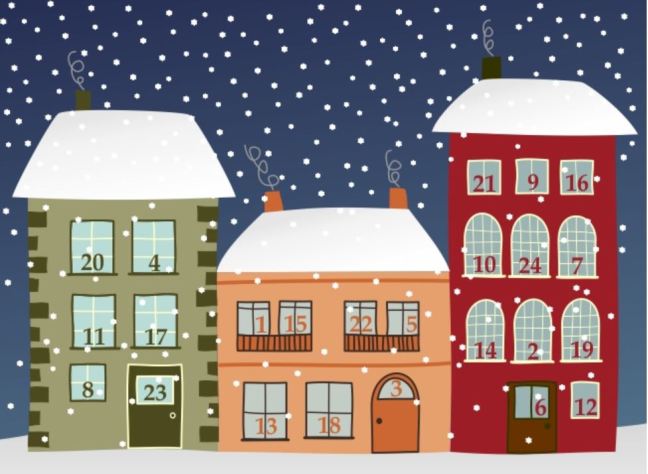
Advent Math Activity Calendars

Once again, the delightful Nrich Maths website offers a seasonal selection of activities to encourage your children’s (and your own!) mathematical creativity.

Click the images below to visit the corresponding December Math Calendar pages.

For Primary Students

Here are twenty-four activities for elementary and middle school, one for each day in December during the run-up to Christmas.

2021 Primary Advent Calendar

When you get to the Nrich website, click a number to go to that day’s math.

For Secondary Students

Here are twenty-four favorite activities for middle and high school, one for each day in December in the run-up to Christmas.

2021 Secondary Advent Calendar

When you get to the Nrich website, click a number to go to that day’s math.

More Holiday Math

I encourage you also to explore my HUGE holiday math post:

Or check out these pages for more ideas:

Have fun playing math with your kids!

“Black Friday” Shopping Season Discount

‘Tis the season for discount sales. I usually ignore the annual Black Friday push, because NOT shopping is an even better way to save money.

But this year, my publishing company Tabletop Academy Press has decided to join in the fun.

So if you’re looking for new math activities to play with your kids, I’ve just added several new books and discount bundles to our online store — including a huge variety of math journaling resources.

And for the next week or so, you can get 15% off anything in our store by using the coupon code TABLETOP15 at checkout.

But act fast! The discount code expires December 5th.

Playful Math Journaling: Try It for Yourself

Math journaling helps students enjoy the adventure of learning math through playful exploration.

In a math journal, children explore their own ideas about numbers, shapes, and patterns through drawing or writing in response to a question. Journaling teaches them to see with mathematical eyes. Not just to remember what we adults tell them, but to create their own math.

All they need is a piece of paper, a pencil, and a good prompt to launch their mathematical journey.

Give It a Try

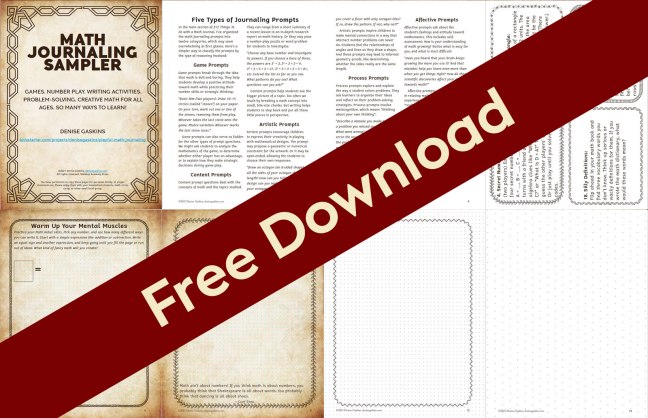
You can launch your family’s math journaling adventure today. Download the free 16-page printable (pdf) Math Journaling Sampler, which includes:

  • “Five Types of Journaling Prompts,” a short excerpt with example prompts from my new book 312 Things To Do with a Math Journal
  • Four sample task cards from the accompanying series of printable Math Prompt Task Card books
  • And a few pages from my Adventurous Student Journals (also known as the Math Rebel journals) to get kids writing

Click here for the Math Journaling Sampler

Back the Kickstarter

And if you like what you see, I’d love to have your support for my Playful Math Journaling Kickstarter project. Check it out:

Playful Math Education Carnival 147

Welcome to the 147th edition of the Playful Math Education Blog Carnival — a smorgasbord of delectable tidbits of mathy fun. It’s like a free online magazine devoted to learning, teaching, and playing around with math from preschool to high school.

Bookmark this post, so you can take your time browsing. There’s so much playful math to enjoy!

By tradition, we start the carnival with a puzzle in honor of our 147th edition. But if you’d rather jump straight to our featured blog posts, click here to see the Table of Contents.

Continue reading Playful Math Education Carnival 147

Notice, Wonder, Create

Many homeschooling parents dream of a mathematical magic bullet — a game, app, or book that will help their children learn math and enjoy it.

As in life, so also in math, there is no magic solution.

Do you want your children to learn math and enjoy it? Teach them to be Math Makers.

When they create their own math, students build deep, personal connections to math concepts. They think about the relationships between numbers, shapes, and patterns. Math becomes personal.

Toys, hobbies, favorite stories — all can be fodder for math creation.

Where Do Math Makers Get Ideas?

Let the child choose something to think about.

Make an “I Notice” list. How does that item relate to math? What patterns or shapes can you see?

Or how would the story characters use numbers in their daily lives? Would they cook, or go shopping? Might they build something? Would they decorate it with a design? What would they count or measure?

Make an “I Wonder” list. How many different ways might you turn the things you noticed into questions? What else might you ask?

Then turn one of your noticings or wonderings into a math story, poem, puzzle, drawing, or game. Create your own math. Share your creation with family and friends.

Now Get Published

Join the Student Math Makers team. We’d love to add your math creation to our collection and share it with viewers all around the world!

Download a Math Makers Invitation and Submission Form below:

 
* * *

This blog is reader-supported.

If you’d like to help fund the blog on an on-going basis, then please join me on Patreon for mathy inspiration, tips, and an ever-growing archive of printable activities.

If you liked this post, and want to show your one-time appreciation, the place to do that is PayPal: paypal.me/DeniseGaskinsMath. If you go that route, please include your email address in the notes section, so I can say thank you.

Which I am going to say right now. Thank you!

“Notice, Wonder, Create” copyright © 2021 by Denise Gaskins. Feature photo (top) by MI PHAM via Unsplash.com.