New! Your Student Can Be a Math Maker

When children create their own math, they build a deep understanding of mathematical concepts and relationships.

And it’s fun!

So take a break from your normal math program to play with creative math. Students can:

And when students create something they’re proud of, let them share it with the world. Visit the Student Math Makers Gallery at tabletopacademy.net/math-makers to share your children’s math creations.

 
* * *

Are you looking for more creative ways to play math with your kids? Check out all my books, printable activities, and cool mathy merch at Denise Gaskins’ Playful Math Store. Or join my email newsletter.

This blog is reader-supported. If you’d like to help fund the blog on an ongoing basis, then please join me on Patreon (or choose the paid level on Substack) for mathy inspiration, tips, and an ever-growing archive of printable activities.

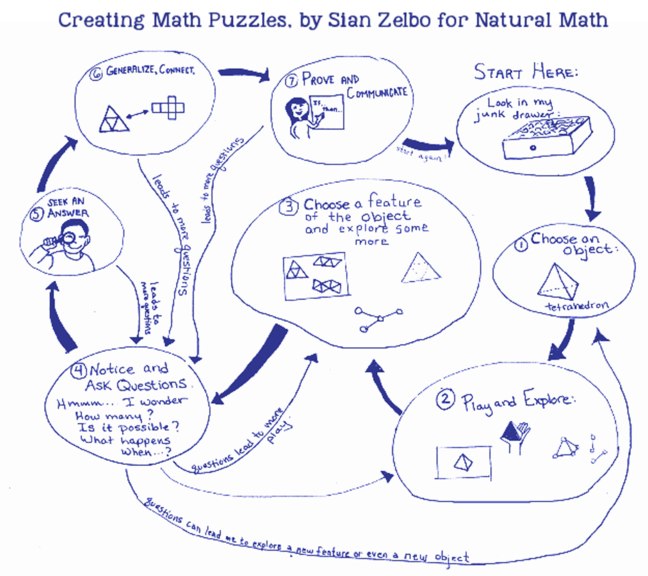
“New! Your Student Can Be a Math Maker” copyright © 2021 by Denise Gaskins. “Creating Math Puzzles by Sian Zelbo, the author of Camp Logic, via NaturalMath.com.

Final (?) Lockdown Ebook Sale

Would anyone have guessed we’d still be under pandemic social restrictions after a year?

Certainly not me!

And now that spring is in the air … Well, at least it is in the northern hemisphere. Would that be called “Up Yonder,” as opposed to “Down Under”? … Anyway, whatever you call it, everyone is getting antsy. We’re all ready to be set free, whenever our governments give in.

To help your family keep busy through the final (we hope!) lockdowns, my publisher is offering a 30% discount coupon on everything at our Tabletop Academy Press online store.

That includes all my math books and playful activity guides, plus my daughter’s fantasy fiction epic, The Riddled Stone.

Enter STAYSAFE2021 at checkout.
(Expires March 31, 2021.)

Shop Now

Playful Math Carnival 144: Anniversary Edition

Welcome to the 144th edition of the Playful Math Education Blog Carnival — a smorgasbord of delectable tidbits of mathy fun. It’s like a free online magazine devoted to learning, teaching, and playing around with math from preschool to high school.

Bookmark this post, so you can take your time browsing.

There’s so much playful math to enjoy!

By tradition, we would start the carnival with a puzzle/activity in honor of our 144th edition. But this time, I want to take a peek back at the history of our carnival.

But if you’d rather jump straight to our featured blog posts, click here to see the Table of Contents.

Continue reading Playful Math Carnival 144: Anniversary Edition

Did You Get Your Playful Math?

Mary Everest Boole first wrote about string art in 1904.
Mary Everest Boole first wrote about string art in her 1904 book, The preparation of the child for science.

My February playful math newsletter went out yesterday morning to all subscribers.

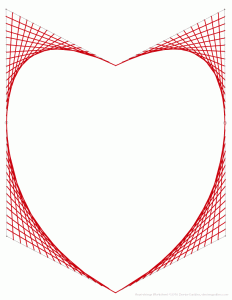
This month’s issue featured a couple of string art projects for Valentine’s Day, the cardioid curve, make-your-own math art, and the link between string art and calculus.

If you didn’t see it, check your Updates or Promotions tab (in Gmail) or your Spam folder. And to make sure you get all the future newsletters, add denise (dot) gaskins (at) tabletopacademypress (dotcom) to your contacts or address book.

Click to View the Newsletter

Not a subscriber? Don’t miss next month’s playful math activities! Click the link below to sign up today, and we’ll send you our free math and writing booklets, too.

As a Bonus: You’ll receive my 8-week email series “Playful Math for Families” and be one of the first to hear about any new books, revisions, and sales or other promotions

Mathy Christmas Cards

I always wait too long to put cards in the mail. Maybe these creative beauties will inspire me to get started right away?

For More Holiday Math

CREDITS: Reindeer photo (top) by Norman Tsui via Unsplash.com.

Math Advent Calendars for 2020

Would you like to add some no-preparation-required fun to your math lessons this month?

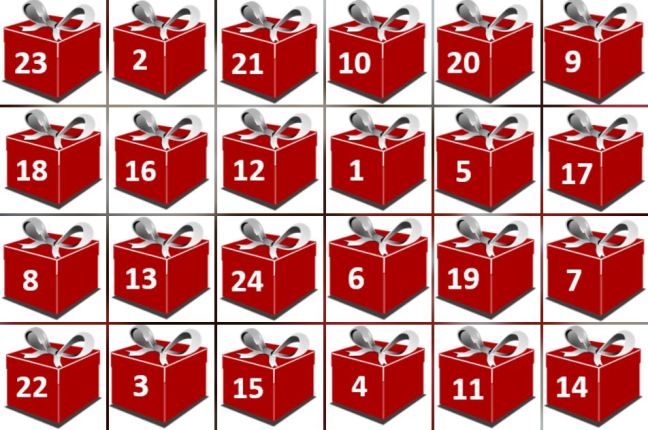
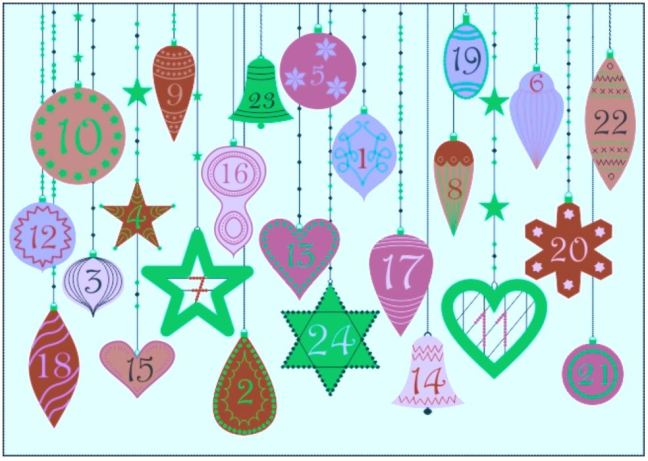
Check out these creative mathematical Advent calendars, each featuring one puzzle or activity per day for December 1–24.

Some of the calendars may show a previous year’s date. (This is 2020 after all!) But the puzzles are evergreen — you can enjoy them anytime.

For more Advent-math links, visit Colleen Young’s Mathematical Advent Calendars post. And don’t miss my massive blog post Holiday Math Puzzles and Activities for Christmas, Winter Break.

Printable Activity Guides

Since my publishing house opened its online store last month, I’ve been busy stocking the shelves with printable math activities for all ages.

It’s a fun collection of low- or no-prep ideas for playing math with your kids.

And it’s still growing. I’m pouring through old notes of my favorite projects from years of playing math with the kids in our math clubs and homeschool co-op enrichment classes, looking for ideas.

Which One Will You Try?

We’ve kept our prices as low as possible to fit struggling family budgets — less than a cup of coffee at my favorite cafe, back when we could still go out for a sweet, creamy cuppa.

Just go to our online store and click the “Printable Activity Guides” button to check out all the mathy fun.

Someday, I hope to combine these books into a creative math “uncurriculum” for homeschoolers. Stay tuned to this blog for more news about that. Eventually…

Playing with a Hundred Chart #36: Cover 100 Squares

Patrick Vennebush shared this puzzle from his new book, One-Hundred Problems Involving the Number 100:

It’s easy to cover a hundred chart with 100 small squares: 10 rows of 10 squares = 100.

It’s easy to cover a hundred chart with one big square: one 10×10 square = 100.

But can you cover the chart with 20 squares? Or with 57 squares? The squares do NOT have to be all the same size.

If we only consider squares with whole-number sides, so they exactly fit on the grid, then:

  • What numbers of squares work to cover the chart?
  • What numbers don’t work — and can you prove it?

Click to read the original puzzle along with some teaching tips at Patrick’s blog:

Covering 100 Squares

If you’d like some printable hundred charts for coloring in squares, download my free Hundred Charts Galore! file.

And discover more ways to play with these printables in my classic blog post: 30+ Things to Do with a Hundred Chart.

The Gerrymander Math Project

With a big election on the horizon, now is a great time to talk about the math of politics.

Does “One person, one vote” make a fair democracy?

Or does it give the majority license to trample a minority?

How can planners arrange voting districts to give everyone the best representation? And is that really what politicians would do, if they had the choice?

Try the Gerrymander Project with your students to investigate these questions and spark real-world mathematical discussion.

First, Create a Map
[Or buy a copy of my printable activity guide, The Gerrymander Project: Math in the World of Politics, which includes a prepared city map with more detailed instructions, answers, and journaling prompts. My publisher has extended the 10% discount code TBLTOP10 through to Election Day, 3 November 2020.]

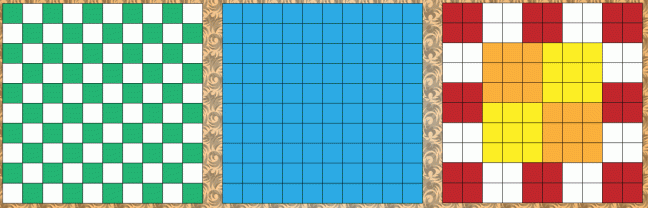
  • Print a blank hundred chart or outline a 10×10 square on grid paper. This represents your city. Give it a name.
  • Pull out your colored pencils. Choose one color for your city’s Majority Party and another for the Minority Party.
  • Color 10 squares in a neutral color for non-voting areas. These might be malls or parks or the downtown business district — your choice.
  • Color the remaining 90 blocks in a random distribution so that 60% are the Majority color and 40% the Minority. How will you choose which squares to make which colors? Can you think of a way to use dice or playing cards to make your choices random, yet still get the right proportion?

Slip your finished map into a clear page protector, so you can mark on it with dry-erase markers. Or make several copies, so you can write on them without destroying the original.

Then Gerrymander Your City

“Gerrymandering” is the American political tradition of adjusting the voting district boundaries to favor one’s own party at the expense of one’s opponents.

The city has hired you to mark out 10 new voting districts of 9 squares each (not counting the neutral squares, which can go in any district). The squares in each district must touch side-to-side, not just meet at a corner.

So now you get to play “political hack.”

First, see how fair you can make the map:

  • What happens if you ignore the party colors and make your districts as compact as possible, so the people living nearest to each other vote together? Will the Majority Party always win?
  • Can you give all your voters a proportional representation? Both parties should win the number of districts that most closely matches their percentage of the voting population.

Next, try your hand at gerrymandering, but make sure all the squares in each district stay connected. Can you create ten voting districts that will guarantee:

  • A come-from-behind triumph for the Minority Party? They need to carry at least six districts to wrest control of the City Council from their opponents.
  • The greatest possible margin of victory for the Majority Party? Can you keep the Minority from winning any districts at all?

Share Your Thoughts

I’d love to hear your students’ reaction to this project. Please share in the comments section below.

For myself, the more I play with this project, the more I admire the work done by the framers of the U.S. Constitution. Our Electoral College divides the country into “districts” based on state boundaries, giving each a vote roughly proportional to its population — but in a way that slightly strengthens the Minority Party. The system may not be perfect, but it’s done an amazing job through the centuries of maintaining a balance of power, making sure that neither major political party can destroy the other.

Which is NOT to say that our country always protects the rights of true minorities. Clearly, that’s an ongoing struggle.

But overall, the political parties stay relatively balanced, making for a stable government. After more than two centuries, we still have, as Ben Franklin said, “a republic, if you can keep it.”

 
* * *

This blog is reader-supported.

If you’d like to help fund the blog on an on-going basis, then please head to my Patreon page.

If you liked this post, and want to show your one-time appreciation, the place to do that is PayPal: paypal.me/DeniseGaskinsMath. If you go that route, please include your email address in the notes section, so I can say thank you.

Which I am going to say right now. Thank you!

“The Gerrymander Math Project” copyright © 2020 by Denise Gaskins.
How to Draw Minecraft Blocks

Running out of time on my Math You Can Play Kickstarter, so I better get to work on that Kickstarter Special Edition math-art book I promised to all the backers as a bonus reward.

Today I’m working on the Isometric Drawing and Impossible Figures section, because my co-op math classes had so much fun learning how to draw those.

Here’s a starter image on how to draw Minecraft blocks. At first I called them “isometric blocks” — but changing the name to “Minecraft” made the students really excited to learn. I’m not sure whether I like the pencil sketch, or if I should remake the illustrations on the computer…

Key steps:

  1. Make a Y.
  2. Turn it into an M.
  3. Slant down for the bottom.
  4. Slant up for the top.
Student drawings from my co-op classes.

The most common problem for beginners is that they try to make the base straight. They know a block can sit on a table, so the bottom has to be flat, right? But once students get a feel for how it goes, they can really take off and have fun.

UPDATE: The Kickstarter deals have ended, but my playful math books are still available through your favorite online store or by special order at your local bookshop. (Except for the Prealgebra & Geometry Games book, scheduled for publication in early 2021. Sign up for my email list to get the latest news.)