As a bonus, I’ll add you to my Playful Math News email subscription and send you monthly tips and activity ideas for playing math with your kids.
From time to time, I’ll even throw in a free sample of whatever I’ve been working on — an early draft of something that will eventually show up in one of my books or printable activity guides.
For example, check out this fun freebie I sent last April:
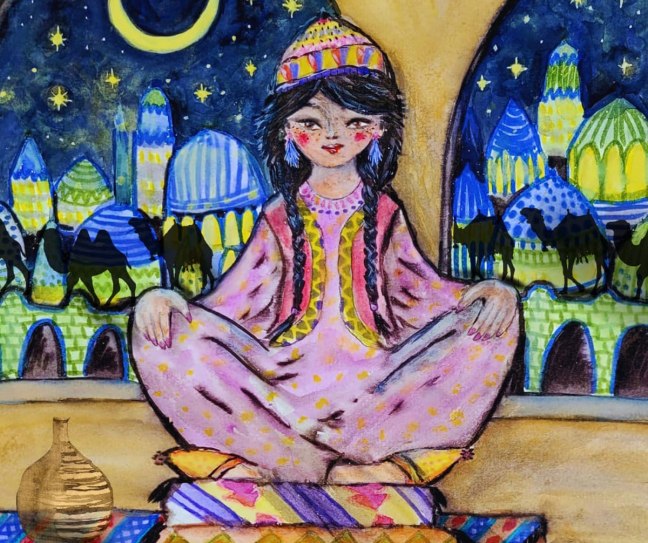
Farzanah and the 17 Camels celebrates the excitement and the rewards of solving a challenging and intriguing math problem. Set against the backdrop of the ancient Silk Road, with bustling markets, stunning carpets, fun characters, and camels, the story draws readers into the magic of Farzanah’s surroundings.
As Farzanah searches for an unusual approach, a way of solving the problem that no one else could think of, she follows the wise advice of her mother:
“My dear Farzanah, don’t be discouraged,” said Mama. “Sometimes, being stuck is exactly where you need to be. I find the best thing I can do is to step away. I free my mind to think about other things. It is in that space that the magic happens. I am able to look at things from a different perspective. With wait time and wishful thinking comes the solution.”
Farzanah embodies the joy of productive struggle in mathematical problem-solving. She is patient, persistent, and curious, using these qualities to tackle a perplexing dilemma that has troubled everyone.
For a bonus math puzzle you can play today, based on Farzanah’s life, download Farzanah’s Sheep Dilemma.
Looney’s earlier book, Ying and the Magic Turtle, is available on the Natural Math website. Or check out her Same But Different discussion prompts for all ages on her website.
Each monthly carnival brings you a new collection of ideas for playing math from preschool to high school. It’s like a free online magazine of mathematical adventures, helpful and inspiring no matter when you read them.
Explore with your kids or on your own:
173rd Playful Math Carnival
Johanna Buijs found a delightful assortment of knots, meanders, mazes and labyrinths, plus other math tidbits from around the world. Love it!
Sue VanHattum focused on the perplexing topics of fractions and division (and division of fractions) with puzzles, games, fractals, and delightful stories.
The carnival is a joint effort. We depend on our volunteer hosts to collect blog posts and write the carnival each month.
Putting together a blog carnival can be a lot of work, but it’s a great opportunity to share the work of bloggers you admire and to discover new math-friends online. I love that part of being a host!
Classroom teachers, homeschoolers, college professors, unschoolers, or anyone who likes to play around with math — if you would like to take a turn hosting the carnival, please speak up!
Welcome to the 172nd edition of the Playful Math Blog Carnival, a buffet of delectable tidbits of mathy fun. It’s like a free online magazine devoted to learning, teaching, and playing around with math from preschool to high school.
The carnival went on hiatus for a couple of months due to unexpected life issues facing our volunteer hosts. But we’re back now, and ready to celebrate!
By tradition, we start the carnival with a puzzle in honor of our 172nd edition. But if you’d rather jump straight to our featured blog posts, click here for the Table of Contents.
Try This: Lazy Caterers and Clock-Binary Numbers
172 is a lazy caterer number: Imaging a caterer who brought a single large pie to serve the whole party. He needs to cut it into as many pieces as he can, using the fewest (straight) cuts he can get away with.
If each guest gets one piece of pie, what sizes of parties (numbers of people) can the lazy caterer serve?
Can you find a pattern in the lazy caterer sequence?
But for those of you who have followed the carnival for years, you may remember we played with the lazy caterer back in Playful Math 106. (That time, the caterer was serving pizza.) So here’s a bonus activity we’ve never done before…
The first several stages of a pattern are as follows:
What do you notice about this pattern of shapes?
What is the next shape in the sequence?
Can you figure out how the shape below fits into the pattern?
This pattern sequence was named clock binary by its creator, noelements-setempty.
Did you know that, with our recent stretch goals, the Tabletop Math Games Kickstarter now features more than 90 amazing ways to play math with your kids?
And every pledge pushes us closer to the next new bonus, which means more new games and playful math goodies for every backer.
Don’t miss out on the excitement. Order your copy today:
I love how the challenge of a well-fought math game pushes players of all ages to think more creatively and build fluency.
So my Tabletop Math Games Collection is designed to make it easier than ever for busy families and over-stressed teachers to play with math.
All you need are common household supplies like cards, dice, and scratch paper. Children can open a Tabletop Math Games Collection book to any page and start playing right away, and the digital files make great classroom handouts or learning center games.
Welcome to the 171st edition of the Playful Math Education Blog Carnival — a smorgasbord of delectable tidbits of mathy fun. It’s like a free online magazine devoted to learning, teaching, and playing around with math from preschool to high school.
Bookmark this post, so you can take your time browsing over the next week or so.
There’s so much playful math to enjoy!
By tradition, we start the carnival with a puzzle/activity in honor of our 171st edition. But if you’d rather jump straight to our featured blog posts, click here to see the Table of Contents.
Try This Puzzle/Activity
171 is a triangular number, the sum of all the numbers from 1 to 18:
1 + 2 + 3 + … + 17 + 18 = 171.
Can you think why a number like this is called “triangular”?
What other triangular numbers can you find?
Also, 171 is a palindrome number, with the same digits forward and backward. It’s also a palindrome of powers:
171 = 52 + 112 + 52
171 = 23 + 43 + 33 + 43 + 23
So in honor of our 171st Playful Math Carnival, here is a palindrome puzzle that leads to an unsolved question in math:
Does every number turn into a palindrome eventually?
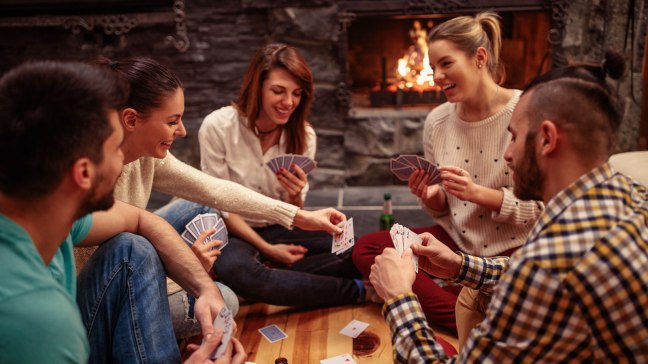
Games are fun, building a positive attitude toward math. They give students a refreshing break from textbook work and make kids willing to practice their math. Games make math practice enjoyable, something children want to do. We can happily work through many more calculations during a game than anyone would ever want to do on a homework page.
Benefits of Math Games
But more important than the fun, math games push children to think about what numbers mean and how they work. The numbers in a math game are not just meaningless abstractions, but tools that players can use to gain an advantage over their opponent.
A good math game reinforces the idea that math is about reasoning, using the things you know to figure out what you need. Math is not just about getting the right answer. It’s about what goes on in your head on the way to that answer. The answer itself is merely a side-effect. of what really matters, your thinking.
A good math game helps students develop flexibility, the ability to adapt, applying what they have learned to new situations, finding a way to work out the things they haven’t mastered yet. All these add up to a more robust type of mathematical fluency than what many people imagine possible.
Welcome to the 170th edition of the Playful Math Education Carnival — a smorgasbord of delectable tidbits of mathy fun. It’s like a free online magazine devoted to learning, teaching, and playing around with math from preschool to high school.
Bookmark this post, so you can take your time browsing.
There’s so much playful math to enjoy!
By tradition, we start the carnival with a puzzle/activity in honor of our 170th edition. But if you’d rather jump straight to our featured blog posts, click here to see the Table of Contents.
Puzzle: Prime Permutations
According to Tanya Khovanova’s Number Gossip, 170 is the smallest composite number where exactly four permutations of its digits make prime numbers.
To find permutations, think of all the different ways you can arrange the digits 1, 7, 0 into three-digit numbers. (When the zero comes first, those permutations actually make two-digit numbers, which DO also count.)
Can you figure out which permutations make prime numbers?
Hint: The permutation that makes the number “170” is not prime, but it is the product of three prime numbers. Which ones?
For Younger Children: The 170 Square
A Latin square is a grid filled with permutations: letters, numbers, or other symbols so that no row or column contains more than one of any character. You’ve probably seen the popular Latin-square puzzle called Sudoku. A Graeco-Latin square (also called an Euler square) is two independent Latin squares overlapping each other.
Can you complete this Euler square made by overlapping permutations of the digits of 170 with winter colors? Don’t repeat the same color OR the same number in any row or column.
Click the picture to get a larger image you can print.
What is a “living book”? English education reformer Charlotte Mason introduced this term for any book that brings the reader directly into contact with the major ideas that have fascinated humans across the ages.
We know that reading aloud helps build our children’s love for books. But did you know it works for math as well?
And that it can transform the parent’s attitude as well as the child’s?
A playful math book fleshes out the bones of abstract math, brings it alive, makes it human, relatable, interesting to readers of all ages, opening our eyes to the wonderful world of big ideas, where concepts meet and topics intertwine in a beautifully intricate dance of understanding.
We live in an age of abundance, with more new creative math books being published every year, so many that I can’t keep track of them all, not to mention the older classics, some out of print, that can still be found in public libraries.
Here are a few of my favorite books of playful, living math, both old and new: