Fraction Models, and a Card Game

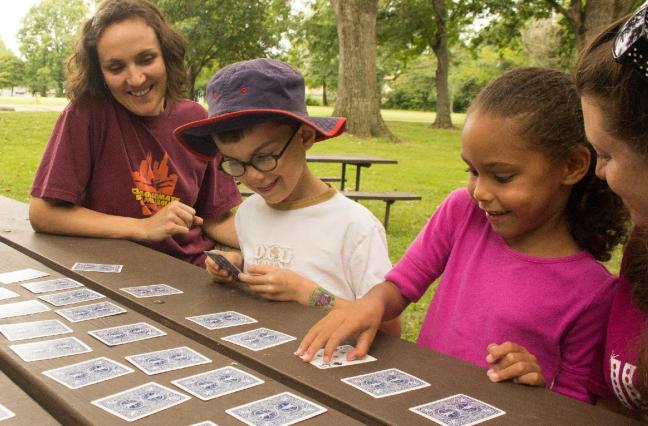
Fraction cards

Models give us a way to form and manipulate a mental image of an abstract concept, such as a fraction. There are three basic ways we can imagine a fraction: as partially-filled area or volume, as linear measurement, or as some part of a given set. Teach all three to give your students a well-rounded understanding.

When teaching young students, we use physical models — actual food or cut-up pieces of construction paper. Older students and adults can firm up the foundation of their understanding by drawing many, many pictures. As we move into abstract, numbers-only work, these pictures remain in our minds, an always-ready tool to help us think our way through fraction problems.
Continue reading Fraction Models, and a Card Game

Game: Hundred Chart Nim

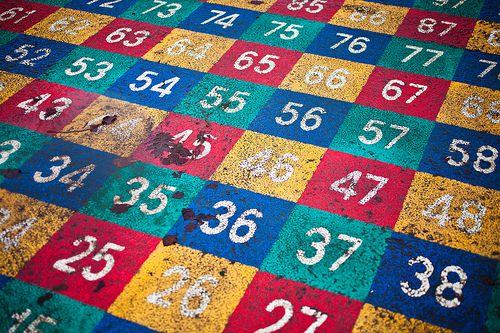
Photo by Håkan Dahlström via flickr.

Math concepts: addition and subtraction within 100, logical strategy
Number of players: 2 or 3
Equipment: printed hundred chart (also called a hundred board) and beans, pennies, or other tokens with which to mark numbers — or use this online hundred chart

Set Up

Place the hundred chart and a small pile of tokens where both players can reach them.

Continue reading Game: Hundred Chart Nim

How to Read a Fraction

Fraction notation and operations may be the most abstract math monsters our students meet until they get to algebra. Before we can explain those frustrating fractions, we teachers need to go back to the basics for ourselves. First, let’s get rid of two common misconceptions:

  • A fraction is not two numbers.
    Every fraction is a single number. A fraction can be added to other numbers (or subtracted, multiplied, etc.), and it has to obey the Distributive Law and all the other standard rules for numbers. It takes two digits (plus a bar) to write a fraction, just as it takes two digits to write the number 18 — but, like 18, the fraction is a single number that names a certain amount of whatever we are counting or measuring.
  • A fraction is not something to do.
    A fraction is a number, not a recipe for action. The fraction 3/4 does not mean, “Cut your pizza into 4 pieces, and then keep 3 of them.” The fraction 3/4 simply names a certain amount of stuff, more than a half but not as much as a whole thing. When our students are learning fractions, we do cut up models to help them understand, but the fractions themselves are simply numbers.

Continue reading How to Read a Fraction

How Shall We Teach Fractions?

How did you fare on the Frustrating Fractions Quiz? With so many apparent inconsistencies, we can all see why children (and their teachers) get confused. And yet, fractions are vital to our children’s test scores — and scores are important to college admissions officers. What is a teacher to do? Must we tell our children, “Do it this way, and don’t ask questions”?

Parents and teachers are tempted to wonder if the struggle is worth it. After all, how often do you divide by a fraction in your adult life? If only we could skip the hard stuff…

Continue reading How Shall We Teach Fractions?

Quiz: Those Frustrating Fractions

[Photo by jimmiehomeschoolmom.]

Fractions confuse almost everybody. In fact, fractions probably cause more math phobia among children (and their parents) than any other topic before algebra. Middle school textbooks devote a tremendous number of pages to teaching fractions, and still many students find fractions impossible to understand. Standardized tests are stacked with fraction questions.

Fractions are a filter, separating the math haves from the luckless have nots. One major source of difficulty with fractions is that the rules do not seem to make sense. Can you explain these to your children?

Start with an easy one…

Question #1

If you need a common denominator to add or subtract fractions…

  • Why don’t you need a common denominator when you multiply?

Continue reading Quiz: Those Frustrating Fractions

Number Bonds, Number Rainbows

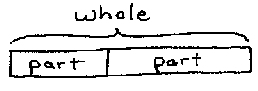
Basic bar diagram

Many of us use the idea of number bonds with our young students. A number bond is a mental picture of the relationship between a number and the parts that combine to make it.

Now we have a new, colorful way to show these relationships, thanks to Maria at Homeschool Math Blog. If you teach math to young children, check this out:

Continue reading Number Bonds, Number Rainbows

Elementary Problem Solving: The Tools

[This article begins a series rescued from my old blog. Moving has been a long process, but I’m finally unpacking the last cardboard box! To read the entire series, click here: elementary problem solving series.]

Most young students solve story problems by the flash of insight method: When they read the problem, they know almost instinctively how to solve it. This is fine for problems like:

There are 7 children. 2 of them are girls. How many boys are there?

As problems get more difficult, however, that flash of insight becomes less reliable, so we find our students staring blankly at their paper or out the window. They complain, “I don’t know what to do. It’s too hard!”

We need to give our students a tool that will help them when insight fails.

Continue reading Elementary Problem Solving: The Tools

7 Things to Do with a Hundred Chart


This post has been revised to incorporate all the suggestions in the comments below, plus many more activities. Please update your bookmarks:

Or continue reading the original article…


Continue reading 7 Things to Do with a Hundred Chart

Are You Smarter than a 3rd-6th Grader?

Here are a few challenging word problems from Singapore:

I did fine on the 3rd-grade problems, but I stumbled a bit on the 4/5th-grade “How much sugar…” problem. The toy cars were tricky, but manageable. I misread the problem with the chocolate and sweets at first — I think of chocolates as a sub-category of sweets, but in this problem they are totally different. (Perhaps “sweets” are what I would call “hard candy”?) Finally, I had to resort to algebra for the last two Grade 6 questions.

How many can you solve?

Game: Tens Concentration

Math concepts: addition, number bonds for 10, visual memory
Number of players: any number, mixed ages
Equipment: math cards, one deck

Set Up

Each player draws a card, and whoever choses the highest number will go first. Then shuffle the cards and lay them all face down on the table, spread out so no card covers any other card. There are 40 cards in a deck, so you can make a neat array with five rows of eight cards each, or you may scatter them at random.

Continue reading Game: Tens Concentration