Talking Math with Your Kids

Danielson-Talking Math

Christopher Danielson, one of my favorite math bloggers, has a new book out that is perfect for parents of preschool and elementary-age children:

It’s a short book with plenty of great stories, advice, and conversation-starters. While Danielson writes directly to parents, the book will also interest grandparents, aunts & uncles, teachers, and anyone else who wants to help children notice and think about math in daily life.

“You don’t need special skills to do this. If you can read with your kids, then you can talk math with them. You can support and encourage their developing mathematical minds.
 
“You don’t need to love math. You don’t need to have been particularly successful in school mathematics. You just need to notice when your children are being curious about math, and you need some ideas for turning that curiosity into a conversation.
 
“In nearly all circumstances, our conversations grow organically out of our everyday activity. We have not scheduled “talking math time” in our household. Instead, we talk about these things when it seems natural to do so, when the things we are doing (reading books, making lunch, riding in the car, etc) bump up against important mathematical ideas.
 
“The dialogues in this book are intended to open your eyes to these opportunities in your own family’s life.”

— Christopher Danielson
Talking Math with Your Kids

 
* * *

This blog is reader-supported.

If you’d like to help fund the blog on an on-going basis, then please join me on Patreon for mathy inspiration, tips, and an ever-growing archive of printable activities.

If you liked this post, and want to show your one-time appreciation, the place to do that is PayPal: paypal.me/DeniseGaskinsMath. If you go that route, please include your email address in the notes section, so I can say thank you.

Which I am going to say right now. Thank you!

“Talking Math with Your Kids” copyright © 2013 by Denise Gaskins.
How to Recognize a Successful Homeschool Math Program

photo by danielrmccarthy
photo by Dan McCarthy (cc-by)

After teaching co-op math classes for several years, I’ve become known as the local math maven. Upon meeting one of my children, fellow homeschoolers often say, “Oh, you’re Denise’s son/daughter? You must be really good at math.”

The kids do their best to smile politely — and not to roll their eyes until the other person has turned away.

I hear similar comments after teaching a math workshop: “Wow, your kids must love math!” But my children are individuals, each with his or her own interests. A couple of them enjoy an occasional geometry or logic puzzle, but they never voluntarily sit down to slog through a math workbook page.

In fact, one daughter expressed the depth of her youthful perfectionist angst by scribbling all over the cover of her Miquon math workbook:

  • “I hate math! Hate, hate, hate-hate-HATE MATH!!!”

Translation: “If I can’t do it flawlessly the first time, then I don’t want to do it at all.”

photo by Jason Bolonski (cc-by)

Continue reading How to Recognize a Successful Homeschool Math Program

Hundred Chart Idea #28: Hang It on the Wall

Math is beautiful when it communicates an abstract idea clearly and provides new insight. Yelena’s hundred chart poster does just that:

[From the Moebius Noodles blog]

Check out my newest home decor item, a hundred chart. The amount of work I put into it, I consider getting it framed to be proudly displayed in the living room. The thing is monumental in several ways:

1. It is monumentally different from my usual approach to choosing math aids. My rule is if it takes me more than 5 minutes to prepare a math manipulative, I skip it and find another way.

2. It is monumentally time-consuming to create from scratch all by yourself.

3. It is monumentally fun to show to a child.

— Yelena McManaman
Moebius Noodles

Now she’s provided a fantastic set of free hundred chart printables:

Thanks, Yelena!

Share Your Ideas

It began with a humble list of seven things in the first (now out of print) edition of my book about teaching home school math. Over the years I added new ideas, and online friends contributed, too, so the list grew to become one of the most popular posts on my blog:

Can you think of anything else we might do with a hundred chart? Add your ideas in the Comments section below, and I’ll add the best ones to our master list.

PUFM 1.5 Multiplication, Part 2

Poster by Maria Droujkova of NaturalMath.com. In this Homeschooling Math with Profound Understanding (PUFM) Series, we are studying Elementary Mathematics for Teachers and applying its lessons to home education.

Multiplication is taught and explained using three models. Again, it is important for understanding that students see all three models early and often, and learn to use them when solving word problems.

— Thomas H. Parker & Scott J. Baldridge
Elementary Mathematics for Teachers

I hope you are playing the Tell Me a (Math) Story game often, making up word problems for your children and encouraging them to make up some for you. As you play, don’t fall into a rut: Keep the multiplication models from our lesson in mind and use them all. For even greater variety, use the Multiplication Models at NaturalMath.com to create your word problems.

Continue reading PUFM 1.5 Multiplication, Part 2

Trouble with Times Tables

[feature photo above by dsb nola via flickr.]

Food for thought:

Imagine that you wanted your children to learn the names of all their cousins, aunts and uncles. But you never actually let them meet or play with them. You just showed them pictures of them, and told them to memorize their names.

Each day you’d have them recite the names, over and over again. You’d say, “OK, this is a picture of your great-aunt Beatrice. Her husband was your great-uncle Earnie. They had three children, your uncles Harpo, Zeppo, and Gummo. Harpo married your aunt Leonie … yadda, yadda, yadda.

— Brian Foley
Times Tables – The Worst Way to Teach Multiplication

On the other hand, if you want your children to develop relationships with the numbers, to learn the math facts naturally, then be sure to tell lots of math stories. And when you are ready to focus on multiplication, be sure to study the patterns and relationships within the times tables.

Build Mathematical Skills by Delaying Arithmetic, Part 3

To my fellow homeschoolers,

How can our children learn mathematics if we delay teaching formal arithmetic rules? Ask your librarian to help you find some of the wonderful living books about math. Math picture books are great for elementary students. Check your library for the Time-Life “I Love Math” books or the “Young Math Book” series. You’ll be amazed at the advanced topics your children can understand!

Benezet’s students explored their world through measurement, estimation, and mental math. Check out my PUFM Series for mental math thinking strategies that build your child’s understanding of number patterns and relationships.

Grade IV

Still there is no formal instruction in arithmetic.

By means of foot rules and yard sticks, the children are taught the meaning of inch, foot, and yard. They are given much practise in estimating the lengths of various objects in inches, feet, or yards. Each member of the class, for example, is asked to set down on paper his estimate of the height of a certain child, or the width of a window, or the length of the room, and then these estimates are checked by actual measurement.

The children are taught to read the thermometer and are given the significance of 32 degrees, 98.6 degrees, and 212 degrees.

They are introduced to the terms “square inch,” “square foot,” and “square yard” as units of surface measure.

With toy money [or real coins, if available] they are given some practise in making change, in denominations of 5’s only.

All of this work is done mentally. Any problem in making change which cannot be solved without putting figures on paper or on the blackboard is too difficult and is deferred until the children are older.

Toward the end of the year the children will have done a great deal of work in estimating areas, distances, etc., and in checking their estimates by subsequent measuring. The terms “half mile,” “quarter mile,” and “mile” are taught and the children are given an idea of how far these different distances are by actual comparisons or distances measured by automobile speedometer.

The table of time, involving seconds, minutes, and days, is taught before the end of the year. Relation of pounds and ounces is also taught.

— L. P. Benezet
The Teaching of Arithmetic II: The Story of an experiment

Continue reading Build Mathematical Skills by Delaying Arithmetic, Part 3

Build Mathematical Skills by Delaying Arithmetic, Part 2

To my fellow homeschoolers,

Most young children are not developmentally ready to master abstract, pencil-and-paper rules for manipulating numbers. But they are eager to learn about and explore the world of ideas. Numbers, patterns, and shapes are part of life all around us. As parent-teachers, we have many ways to feed our children’s voracious mental appetites without resorting to workbooks.

To delay formal arithmetic does not mean that we avoid mathematical topics — only that we delay math fact drill and the memorization of procedures. Notice the wide variety of mathematics Benezet’s children explored through books and through their own life experiences:

Grade I

There is no formal instruction in arithmetic. In connection with the use of readers, and as the need for it arises, the children are taught to recognize and read numbers up to 100. This instruction is not concentrated into any particular period or time but comes in incidentally in connection with assignments of the reading lesson or with reference to certain pages of the text.

Meanwhile, the children are given a basic idea of comparison and estimate thru [sic] the understanding of such contrasting words as: more, less; many. few; higher, lower; taller, shorter; earlier, later; narrower, wider; smaller, larger; etc.

As soon as it is practicable the children are taught to keep count of the date upon the calendar. Holidays and birthdays, both of members of the class and their friends and relatives, are noted.

— L. P. Benezet
The Teaching of Arithmetic II: The Story of an experiment

Continue reading Build Mathematical Skills by Delaying Arithmetic, Part 2

Build Mathematical Skills by Delaying Arithmetic, Part 1

To my fellow homeschoolers,

It’s counter-intuitive, but true: Our children will do better in math if we delay teaching them formal arithmetic skills. In the early years, we need to focus on conversation and reasoning — talking to them about numbers, bugs, patterns, cooking, shapes, dinosaurs, logic, science, gardening, knights, princesses, and whatever else they are interested in.

In the fall of 1929 I made up my mind to try the experiment of abandoning all formal instruction in arithmetic below the seventh grade and concentrating on teaching the children to read, to reason, and to recite — my new Three R’s. And by reciting I did not mean giving back, verbatim, the words of the teacher or of the textbook. I meant speaking the English language.

— L. P. Benezet
The Teaching of Arithmetic I: The Story of an experiment

Continue reading Build Mathematical Skills by Delaying Arithmetic, Part 1

PUFM 1.5 Multiplication, Part 1

Photo by Song_sing via flickr. In this Homeschooling Math with Profound Understanding (PUFM) Series, we are studying Elementary Mathematics for Teachers and applying its lessons to home education.

My apologies to those of you who dislike conflict. This week’s topic inevitably draws us into a simmering Internet controversy.

Thinking my way through such disputes helps me to grow as a teacher, to re-think on a deeper level concepts that I thought I understood. This is why I loved Liping Ma’s book when I first read it, and it’s why I thoroughly enjoyed Terezina Nunes and Peter Bryant’s book Children Doing Mathematics.

repeatedaddition

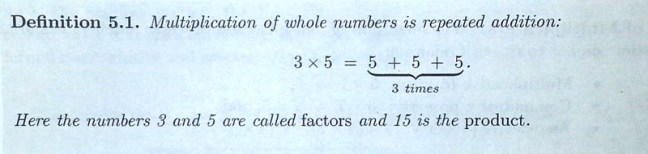
Multiplication of whole numbers is defined as repeated addition…

— Thomas H. Parker & Scott J. Baldridge
Elementary Mathematics for Teachers

Multiplication simply is not repeated addition, and telling young pupils it is inevitably leads to problems when they subsequently learn that it is not… Adding numbers tells you how many things (or parts of things) you have when you combine collections. Multiplication is useful if you want to know the result of scaling some quantity.

— Keith Devlin
It Ain’t No Repeated Addition

Continue reading PUFM 1.5 Multiplication, Part 1